
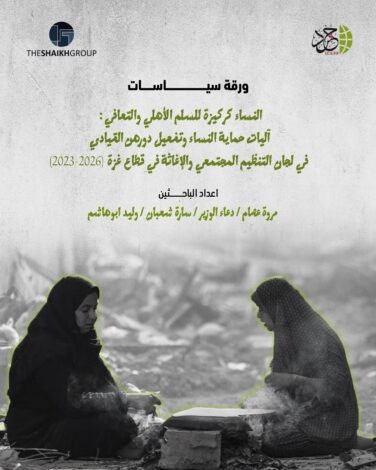
ICSPR Issues a Policy Paper Calling for Women’s Empowerment and Protection as a Pathway to Strengthening Civil Peace and Recovery in the Gaza Strip

Date: 7 September 2026
Press Release
ICSPR Issues a Policy Paper Calling for Women’s Empowerment and Protection as a Pathway to Strengthening Civil Peace and Recovery in the Gaza Strip
The International Commission to Support Palestinian Rights (ICSPR) has issued a policy paper on mechanisms to protect women and strengthen their leadership role in community-organising, relief, and emergency committees in the Gaza Strip. The paper affirms that women’s empowerment and protection are not merely matters of rights or symbolic responses to representation standards; they are a strategic and security necessity for ensuring fair humanitarian response, efficient resource distribution, civil peace, and early recovery.
The paper sheds light on the continued exclusion of women from leadership and decision-making positions within relief and community-organising committees in the Gaza Strip, despite the central roles women play in managing displacement centres, leading community initiatives, organising aid distribution, caring for families, and addressing disputes arising from shortages of water, food, and essential services.
The paper explains that women and girls constitute approximately 49% of Gaza’s population and bear compounded humanitarian, health, and economic burdens amid the widespread collapse of institutions and services. It notes that around 83% of local women’s organisations have had their premises damaged or have fully or partially ceased operations, weakening protection and social-safety networks for women and girls across the Strip.
The paper points to the significant rise in the number of women-led households following the loss, killing, injury, or disappearance of family providers during the war. According to the data it reviews, more than 28,000 new widows have been recorded since the outbreak of the war, bringing the total number of widows to over 50,000. The proportion of households headed by women has risen from 12% before the war to approximately 18%, while around 57,000 women have become the principal providers for their families under extremely harsh economic, social, and humanitarian conditions.
The paper highlights the compounded health risks facing pregnant and breastfeeding women. It estimates that around 37,000 pregnant and breastfeeding women are at risk of acute malnutrition, while more than 500,000 women are deprived of access to essential health services, including reproductive health services and care during pregnancy and childbirth, as a result of the widespread collapse of the health system.
The paper affirms that women should not be viewed solely as affected groups or recipients of aid, but as essential partners in planning, guidance, and decision-making. It explains that women-led initiatives and organisations in the Gaza Strip have demonstrated their ability to organise limited assistance, identify the needs of women, children, and older persons, provide psychosocial support, create temporary safe spaces, and help reduce tension and disputes in shelters.
The paper warns that the continued marginalisation of women in relief and emergency committees results in humanitarian interventions that do not reflect the actual needs of women and other vulnerable groups, including pregnant and breastfeeding women, children, persons with disabilities, and older persons. It further notes that women’s exclusion from decision-making perpetuates what the paper describes as “gender blindness” in the distribution of aid and the management of resources and services.
It also notes that reliance on traditional family structures or family-registration records to register and distribute assistance may deprive women heads of households, widows, abandoned women, women in unresolved marital situations, wives of injured persons with disabilities, and other women from direct access to aid. Such systems can turn relief cards into tools for material, physical, or coercive exploitation against some women and deepen their vulnerability and dependence on others.
The paper explains that displacement camps and shelters often lack minimum facilities that respond to women’s needs, including adequate night-time lighting, gender-segregated sanitation facilities, and doors and locks that ensure privacy and safety. It warns that these structural gaps turn women’s daily needs into a constant source of fear and anxiety and increase the risk of gender-based violence.
The paper is grounded in an international and domestic legal and human-rights framework that includes the Fourth Geneva Convention, the Convention on the Elimination of All Forms of Discrimination against Women, UN Security Council Resolution 1325 on Women, Peace and Security, the Palestinian Basic Law, the Law on Charitable Associations and Civil Society Organisations, and national plans for implementing the Women, Peace and Security Agenda.
It affirms that the Fourth Geneva Convention requires special protection for women in armed conflict, particularly against attacks on dignity and sexual violence. The Convention on the Elimination of All Forms of Discrimination against Women also affirms women’s right to participate in public and political life, formulate policies, and assume responsibilities at all levels. The paper stresses that UN Security Council Resolution 1325 requires women’s meaningful and sustainable participation in conflict prevention, management and resolution, as well as in recovery and reconstruction processes.
The paper concludes that maintaining the existing approach to managing the humanitarian response results in continued resource waste, entrenched gender blindness, and the inability of the relief system to provide genuine structural protection for women. It also warns that imposing a nominal quota without granting women effective authority may produce symbolic participation that does not achieve real empowerment.
The paper recommends adopting a comprehensive and integrated approach as the most sustainable option capable of achieving long-term structural results. This approach would combine binding organisational frameworks, capacity-building, strict protection mechanisms, and safety nets, transforming women from aid recipients into leadership partners in planning, resource management, and decision-making for early recovery.
The paper calls on Palestinian government bodies to align legislation and emergency and crisis-management plans with UN Security Council Resolution 1325 and the Convention on the Elimination of All Forms of Discrimination against Women. It further calls for adopting a mandatory representation quota of no less than 30% for women heads of households and women community leaders in neighbourhood committees and high-level emergency committees, as a condition for the legal and national legitimacy of these bodies.
It also recommends activating provisions of the Palestinian Basic Law relating to equality and participation in public life and considering any emergency or community-organising committee that excludes women from decision-making to lack representative and human-rights legitimacy. It calls for formally including women in local reconciliation and mediation committees to resolve disputes over scarce resources, particularly water and food, inside displacement centres.
The paper calls on UN agencies, international organisations, and donor bodies to adopt gender-responsive financing and to prioritise projects and emergency committees that ensure women’s representation of no less than 30% in leadership bodies and budget management. It also calls for increasing the direct funding allocated to local women’s organisations in the Gaza Strip from the current limited level of between 1% and 2% of humanitarian funding to no less than 15%.
The paper stresses the importance of updating aid databases and adopting flexible mechanisms that allow women heads of households to access assistance independently and directly, including widows, abandoned women, women in unresolved marital situations, wives of injured persons with disabilities, and unmarried women caring for minor siblings after the loss of the family provider.
ICSPR stresses that ensuring effective protection for women and enabling them to exercise leadership roles in humanitarian response, recovery, and reconstruction is an essential condition for safeguarding civil peace, reducing community disputes, and ensuring equitable resource distribution in the Gaza Strip.
ICSPR affirms that this paper is issued in partnership with The Shaikh Group (TSG) as part of efforts to advance and protect the rights of Palestinian women, strengthen their meaningful participation in crisis management, humanitarian response, early recovery, and civil-peace building in the Gaza Strip.
It should be noted that this paper does not necessarily reflect the views of ICSPR or The Shaikh Group (TSG).
To read the full paper, click here.