
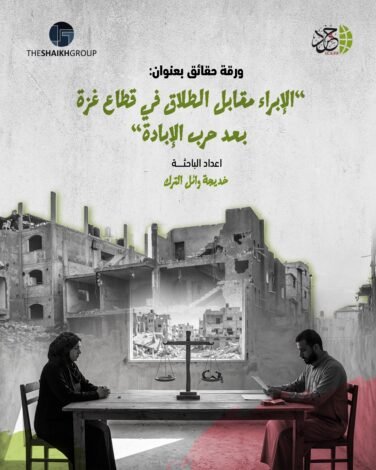
ICSPR Issues a Fact Sheet on Waiving Financial Rights in Exchange for Divorce in the Gaza Strip and the War’s Impact on Women’s Rights

Date: 24 September 2026
Press Release
ICSPR Issues a Fact Sheet on Waiving Financial Rights in Exchange for Divorce in the Gaza Strip and the War’s Impact on Women’s Rights
The International Commission to Support Palestinian Rights (ICSPR) has issued a fact sheet on the practice of waiving financial rights in exchange for divorce in the Gaza Strip. It examines how war, displacement, poverty, and the disruption of protection and legal-aid services affect women’s decisions about ending a marriage. The paper warns that some women may be compelled to give up their financial rights to obtain a divorce or leave an abusive relationship.
The paper explains that this form of divorce involves a wife relinquishing financial rights arising from marriage or divorce, such as the deferred portion of the marriage dower, maintenance, and post-divorce financial entitlements, in exchange for her husband’s agreement to end the marriage. It stresses that the issue is not the existence of this procedure itself, but whether a woman can choose it freely when she faces displacement, lost income, high litigation costs, or domestic violence.
The paper notes that the war has profoundly changed family life in the Gaza Strip. Loss of shelter and work, repeated displacement, and rising prices have increased financial and psychological pressures within households. Under these conditions, some women may see waiving their rights as a faster route than pursuing court proceedings over marital discord and conflict, even when doing so means surrendering money they need to rebuild their lives.
The paper places this issue within the wider humanitarian crisis. It cites estimates indicating that more than 71,000 Palestinians were killed in Gaza between October 2023 and the end of 2025, more than 21,000 women were widowed as a result of the war, and hundreds of thousands of families experienced displacement and loss of shelter. It also notes that approximately 93% of Gaza’s population faced severe food insecurity in 2025—conditions that increase women’s economic vulnerability and narrow their options when family disputes arise.
The paper points to practical indications that more women are resorting to waiving financial rights in exchange for divorce under current conditions. At the same time, it emphasises that no independent statistical data are available to document the number of such cases accurately. The absence of regular data makes it harder to assess the scale of the practice, identify cases in which rights were relinquished under economic or social pressure, and design appropriate legal protections.
The paper explains that the length and cost of court proceedings concerning marital discord and conflict may push women towards a quicker and less expensive route. Meanwhile, the closure of some women’s rights centres and associations, or the reduction of their services, has limited access to legal advice and representation, as well as psychosocial support. Together, these factors may make the waiver of rights appear to be a necessity rather than an expression of free and informed consent.
The paper examines the economic effects of lost housing, employment, and income on family relationships, including the tensions and difficulties that can arise when households cannot meet daily needs. It also addresses the social effects of overcrowding in displacement centres, lack of privacy, and difficulty accessing the courts. Women experiencing violence, it notes, may face a harsh choice between remaining in an unsafe relationship and ending it at the cost of their financial rights.
The paper recounts the case of a woman who sought to end a nine-month marriage after being beaten. She could not afford to bring a marital-discord case and was told that legal-aid services she had hoped to use had been suspended. The paper presents her experience as an example of how domestic violence, poverty, and the loss of support services intersect—and of the need for legal and community pathways that allow women to seek protection and leave harmful relationships without having to surrender their financial rights.
The paper affirms that protecting a woman’s right to decide whether to divorce requires ensuring that she fully understands her religious and legal rights and the consequences of any waiver, as well as providing accessible legal assistance. It also stresses the importance of examining the circumstances in which consent is given, particularly when a woman is displaced, has no income, is experiencing violence, or is under family or social pressure.
The paper recommends strengthening women’s legal awareness before they agree to waive their rights, expanding free legal-aid services, and restoring psychosocial support programmes for families affected by the war. It also calls for monitoring cases in which rights are waived under economic or social pressure and strengthening economic-empowerment programmes for divorced women and other women affected by the war. These measures would give women safer livelihood options and protect their access to justice.
ICSPR affirms that waiving financial rights in exchange for divorce in the Gaza Strip can no longer be viewed as a procedural matter separate from the reality of war. It is a question of whether women can exercise their choices freely amid displacement, poverty, violence, and the breakdown of protection systems. The response must combine legal protection, psychosocial support, and economic empowerment so that no woman is forced to choose between her safety and her rights.
ICSPR affirms that this paper is issued in partnership with The Shaikh Group (TSG) as part of efforts to highlight the war’s impact on women’s and family rights and to strengthen women’s access to protection, legal assistance, and justice in the Gaza Strip.
To read the full paper, click here.