
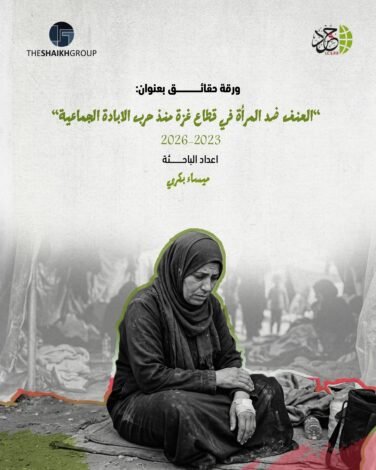
ICSPR Issues a Fact Sheet on Violence Against Women in the Gaza Strip Since the Genocide

Date: 16 September 2026
Press Release
ICSPR Issues a Fact Sheet on Violence Against Women in the Gaza Strip Since the Genocide
The International Commission to Support Palestinian Rights (ICSPR) has issued a fact sheet titled: “Violence Against Women in the Gaza Strip Since the Genocide.” The paper examines the deteriorating humanitarian, health, psychological, and social conditions of women and girls in the Gaza Strip. It documents the multiple forms of violence and violations they have experienced amid the war, forced displacement, the collapse of essential services, and the deterioration of protection and care systems.
The paper explains that violence against women is not limited to physical, psychological, sexual, or economic violence. It is compounded in armed-conflict settings by direct targeting, the loss of safety and shelter, and the collapse of infrastructure and health and social services, exposing women and girls to overlapping and multifaceted risks.
The paper notes that, since 7 October 2023, the Gaza Strip has faced an unprecedented humanitarian catastrophe. As of the date of the paper’s preparation, more than 72,775 Palestinians had been killed and more than 172,750 injured, in addition to widespread forced displacement and the destruction of homes and vital facilities. It affirms that these conditions have deepened women’s suffering and made them more vulnerable to violence, exploitation, and deprivation of essential needs and services.
According to the data reviewed in the paper, more than 11,979 women and girls have been killed as a result of direct bombardment of residential areas and vital facilities since the beginning of the war. It also indicates that around 70% of women and children have sustained injuries of varying severity, including serious injuries caused by air, ground, and naval attacks, resulting in amputations, disfigurement, and permanent disabilities, amid the collapse of the health system and difficulties accessing treatment and rehabilitation services.
The paper states that more than 600,000 women have been forcibly displaced and compelled to live in shelters, tents, and displacement sites lacking safety, privacy, clean water, food, sanitation facilities, personal hygiene products, and essential menstrual-health supplies. These conditions have intensified the health, psychological, and social risks they face.
It notes that the loss of homes, spouses, and family members, together with repeated displacement and the breakdown of social-support networks, has placed additional burdens on women. These include caring for children, older persons, and sick family members, as well as securing daily household needs amid lost income, scarce resources, and declining humanitarian and health services.
The fact sheet documents alarming indicators of increased psychological and physical violence against women in the Gaza Strip. More than 73% of women have experienced psychological violence, while at least 68% have been subjected to physical violence. The data further indicate that more than 36% of women have experienced violence by their intimate partners; approximately 22% have experienced physical violence by a partner; and around 40% have suffered psychological violence at the hands of their husbands.
The paper indicates that approximately 15% of women have experienced sexual violence, including cases of rape and harassment by family members or others. Around 65% of women do not report violence because of fear of social stigma or possible repercussions. Nearly 70% of women exposed to violence experience long-term psychological consequences, including anxiety, depression, trauma, and loss of a sense of safety.
The fact sheet affirms that pregnant and breastfeeding women face extremely dangerous health conditions amid shortages of essential medical services, the disruption of hospitals, and the absence of adequate care. It notes that more than 50,000 pregnant women have faced the prospect of childbirth in unsafe conditions without adequate medical care, while around 5,500 women were at risk of serious health complications during childbirth and the postpartum period due to shortages of medical staff, medicines, medical supplies, and adequate nutrition.
The paper warns that deprivation of reproductive health care, shortages of food, water, and nutritional supplements, and the disruption of antenatal and childbirth follow-up services increase the risk of death and illness among mothers and newborns, and threaten women’s right to health care, protection, and human dignity.
The paper explains that the violations experienced by women and girls in the Gaza Strip constitute serious breaches of international humanitarian law and international human rights law, particularly in light of attacks on civilians, forced displacement, destruction of infrastructure, and the deprivation of the population of essential services.
It notes that international humanitarian law requires parties to armed conflict to distinguish between civilians and combatants, prohibits attacks against civilians, and requires respect for the principles of proportionality and precaution to minimise harm to civilians.
The paper affirms that women enjoy special protection under Article 27 of the Fourth Geneva Convention of 1949, which requires women to be protected against any attack on their honour and dignity, particularly sexual violence and all forms of degrading treatment. The paper also draws on the Convention on the Elimination of All Forms of Discrimination against Women and UN Security Council Resolution 1325 on Women, Peace and Security, both of which affirm the need to protect women and girls in armed conflict and ensure their participation in decision-making, humanitarian response, recovery, and reconstruction.
The paper stresses that violence against women in Gaza must not be considered a side effect of the war. Rather, it is part of a broader system of violations encompassing killing, injury, loss, forced displacement, lack of privacy, deprivation of health care, and the deterioration of social and economic protection. These violations require independent legal documentation and urgent international action for protection and accountability.
The paper recommends strengthening legal documentation of violations against women and girls, including killing, injury, displacement, loss of family members, and deprivation of health and humanitarian services, so that such documentation may be used in human rights reports, international accountability mechanisms, and proceedings before competent courts.
It also calls for integrating a gender perspective into the humanitarian response to ensure that relief plans address the needs of women and girls regarding food, water, health, hygiene, and protection. It calls for the creation of safe spaces for women and girls in shelters and affected areas, ensuring confidentiality, safety, and referral to specialised services.
The paper calls for expanding psychosocial support services for women survivors of violence, widows, mothers, and girls affected by loss, displacement, and trauma. It also calls for guaranteeing women’s access to health care, particularly reproductive health services, care for pregnant and breastfeeding women, injury treatment, and mental-health services.
It further stresses the need to empower women economically during recovery, particularly widows, women heads of households, and displaced women, through cash assistance, employment opportunities, vocational training, and small enterprises. It also calls for the meaningful participation of Palestinian women in the design and implementation of relief, recovery, and reconstruction programmes, in line with UN Security Council Resolution 1325.
The paper calls for strengthening the role of women’s and human rights civil society organisations in Gaza and supporting their capacity to monitor, document, and provide psychosocial, legal, and social support. It also recommends issuing regular reports on the conditions of women and girls that include data disaggregated by sex, age, type of violation, and location, enabling more accurate and effective interventions.
ICSPR affirms that the protection of women and girls in the Gaza Strip must be treated as a legal, humanitarian, and human-rights priority, rather than as a marginal issue within the humanitarian response. Ensuring their safety, dignity, and access to essential services is necessary to protect Palestinian society and strengthen its capacity for resilience and recovery.
ICSPR affirms that this paper is issued in partnership with The Shaikh Group (TSG), as part of efforts to document violations against women and girls in the Gaza Strip, strengthen their legal and humanitarian protection, and promote a fair and effective international response that ensures accountability, prevents violence, and safeguards rights and human dignity.
It should be noted that this fact sheet does not necessarily reflect the views of ICSPR or The Shaikh Group (TSG).