
ICSPR Issues a Fact Sheet on Mediation as an Alternative Means of Dispute Resolution in the Gaza Strip

Date: 13 August 2026
Press Release
In Partnership with The Shaikh Group (TSG) and as Part of the Youth Civil Society Activists Diploma Program
ICSPR Issues a Fact Sheet on Mediation as an Alternative Means of Dispute Resolution in the Gaza Strip
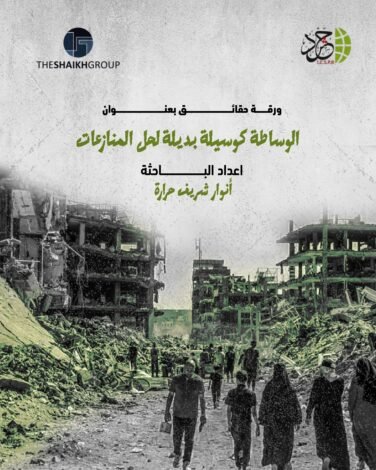
The International Commission to Support Palestinian Rights (ICSPR), in partnership with The Shaikh Group (TSG) and as part of the Youth Civil Society Activists Diploma Program, has issued a fact sheet titled: “Mediation as an Alternative Means of Dispute Resolution in the Gaza Strip.” The paper examines the reality of legal and community mediation amid the war, the disruption of justice institutions, and the accumulation of family, civil, economic, and criminal disputes across the Gaza Strip.
The paper explains that, since 7 October 2023, the Gaza Strip has experienced one of the most difficult periods in its history, amid the total or partial destruction of formal judicial institutions, the disruption of regular and Sharia courts, and the near-complete interruption of access to judicial redress. It indicates that more than 70% of justice facilities have been destroyed and that most courts and police stations have ceased operating, creating a wide legal and security vacuum at a time when disputes are increasing and the need for fair and swift solutions is growing.
According to the data reviewed in the paper, more than 28 judicial and prosecution facilities have been destroyed or put out of service since the beginning of the war. The judiciary became unable to receive or adjudicate disputes during the early stages of the aggression. The proportion of Palestinian families in the Gaza Strip facing legal problems during the war also rose to 60%, compared with 23% before the war, reflecting a 2.6-fold increase in demand for alternative dispute resolution mechanisms.
The paper notes that reliance on alternative dispute resolution mechanisms, particularly mediation, conciliation, arbitration, and community reconciliation, has grown considerably during the war in terms of public awareness, practical use, and satisfaction with outcomes. According to the data presented, community reconciliation bodies handled approximately 16,000 new disputes during the first year of the war, representing around 38% of all reported disputes.
The paper explains that civil disputes, including property ownership, possession, rental, debt, labour rights, and contractual disputes, were the most common, accounting for 45%. Personal status disputes ranked second at 42%, including maintenance, divorce, judicial separation, dowries, child custody, guardianship, inheritance, and travel with children. Criminal disputes accounted for 30%, including fraud, harassment, sexual exploitation, theft, assault, property damage, and other offences.
The paper states that more than 70% of study participants resorted to alternative mechanisms for resolving disputes. Meanwhile, 84% described their experience with these mechanisms, including mediation, as successful or very successful. Some 89% of participants viewed alternative mechanisms as effective tools for dispute resolution, while nearly 75% of those who had experienced mediation or conciliation reported full or partial satisfaction with the outcomes reached.
The paper indicates that women recorded higher levels of satisfaction with mediation than men, with 74.6% of women reporting satisfaction compared with 70.1% of men. Women aged between 30 and 39 recorded the highest satisfaction levels, and 37.5% of them described the experience as very successful, compared with 17.9% of men in the same age group.
The paper defines mediation as a non-judicial process involving the intervention of a neutral third party, the mediator, to facilitate dialogue between disputing parties, bring their views closer, and assist them in reaching a consensual, fair, and sustainable solution. It affirms that mediation is based on confidentiality, neutrality, independence, voluntariness, and transparency, enabling parties to choose their own solutions rather than having them imposed upon them.
The paper explains that mediation is distinguished by its flexibility, speed, and relatively low cost. It can be completed within days or a few months, compared with judicial procedures that may take years. It also helps reduce judicial congestion, saves time and effort, and promotes mutually beneficial solutions that strengthen civil peace and preserve social relationships.
It further explains that the mediation process begins by identifying the parties to the dispute and selecting an appropriate mediator. The mediator then introduces the parties to the concept, principles, and rules of mediation, allows each party to present its perspective, clarifies positions, promotes communication, and explores possible options and alternatives. This is followed by negotiations aimed at reaching a consensual agreement, which is documented and monitored for implementation.
The paper warns that, despite its importance amid war and the disruption of the judiciary, mediation cannot serve as a complete substitute for the formal justice system. It faces multiple challenges, including weak capacity to enforce mediation agreements in the absence of a competent enforcement authority, difficulty securing safe and suitable venues for mediation sessions amid displacement and bombardment, and the absence of an official registry of qualified male and female mediators.
It also points to the lack of systematic training and supervision for mediators, the absence of unified procedures for conducting mediation sessions and documenting their outcomes, weak monitoring and evaluation tools, and the absence of academic and professional specialisation in this field. The paper further warns that external pressure and family or clan interference may affect the independence of parties and the impartiality of mediation, or lead to superficial settlements that fail to address the root causes of disputes.
The paper recommends that civil society organisations launch emergency training programmes to equip community workers, public figures, and activists to carry out mediation roles effectively, while enhancing public awareness of mediation as a peaceful mechanism for resolving disputes.
It also calls on local institutions to establish a unified electronic registry of accredited mediators and to develop clear standards for their selection that guarantee impartiality, competence, and the prevention of conflicts of interest. It further calls for adopting unified procedures for conducting mediation sessions and formally documenting their outcomes.
The paper urges relevant bodies to strengthen monitoring and evaluation mechanisms to measure the effectiveness of mediation processes and continuously improve them. It also calls on international organisations to support judicial and non-judicial institutions, improve their transparency and public trust, and provide a safe and appropriate environment for mediation sessions, particularly in exceptional circumstances and complex disputes.
ICSPR affirms that this fact sheet, issued in partnership with The Shaikh Group (TSG), is part of efforts to promote access to justice and support civil peace in the Gaza Strip by developing mediation and alternative dispute resolution mechanisms. These efforts aim to safeguard rights and strengthen society’s capacity to confront the consequences of war, division, and the disruption of justice institutions.
It should be noted that this fact sheet does not necessarily reflect the views of ICSPR or The Shaikh Group (TSG).