
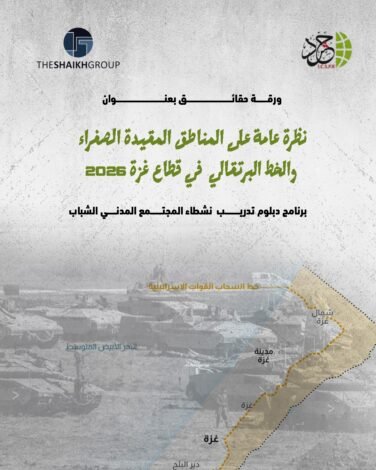
fact sheet titled “An Overview of the Yellow Restricted Zones and the Orange Line in the Gaza Strip 2026”

Date: 2 June 2026
Press Release
As part of the Youth Civil Society Activists Diploma Program
ICSPR issues a fact sheet titled: “An Overview of the Yellow Restricted Zones and the Orange Line in the Gaza Strip 2026”
The International Commission to Support Palestinian People’s Rights (ICSPR), in partnership with The Shaikh Group (TSG), and as part of the Youth Civil Society Activists Diploma Program, has issued a fact sheet titled: “An Overview of the Yellow Restricted Zones and the Orange Line in the Gaza Strip 2026,” examining the geographic, humanitarian, and legal realities resulting from the expansion of restricted areas in the Gaza Strip and the serious consequences for civilians, freedom of movement, and access to land, property, and essential services.
The fact sheet explains that the so-called “Yellow Line” and “Orange Line” constitute vast areas that Israeli occupation forces have carved out from deep inside the Gaza Strip during the genocidal war, after forcibly displacing residents and imposing field control over these lands as part of the de facto arrangements following the 2025 ceasefire. It adds that these boundaries were physically marked using yellow concrete blocks, earthen berms, and military watchtowers, turning them into closed military zones and reinforcing a separating belt across the Strip.
The fact sheet indicates that the yellow restricted areas account for approximately 53% to 58% of the total area of the Gaza Strip, while the so-called “Orange Line” emerged in March 2026 as an additional security belt extending 200 to 500 meters behind the Yellow Line, deeper into Palestinian areas. According to the paper, this additional belt has cut off roughly 11% more of Gaza’s area, raising the total proportion of restricted areas to around 64% of the Strip. It further notes that the Yellow Line extends 2 to 7 kilometers along the eastern border and includes major neighborhoods and areas in Gaza City, northern Gaza, Khan Younis, and Rafah, while in May 2026 further land seizure occurred through moving the yellow concrete blocks westward by up to 400 meters in some locations, including the Netzarim axis and Shuja’iyya neighborhood.
According to the fact sheet, this reality has resulted in the forced displacement of around one million displaced persons, who are barred from returning to their homes and agricultural lands located within the Yellow Line areas. It states that Palestinians are completely prohibited from entering the areas behind the Yellow Line, which are treated as lethal zones or sensitive operational areas where anyone approaching may be shot directly. The paper also notes that Israeli forces require prior coordination from international organizations to cross these lines, obstructing the delivery of vital humanitarian aid.
The fact sheet adds that the expansion of the Orange Line has pushed around 2.1 million displaced Palestinians into an area no larger than 35% of the Gaza Strip, amid the collapse of humanitarian services and worsening health and environmental conditions. It warns of growing risks of disease and epidemics due to severe overcrowding, devastated infrastructure, and the deterioration of medical and humanitarian services across large parts of Gaza.
The fact sheet also points out that the ceasefire was violated through the targeting of Palestinians merely for approaching areas designated as military zones near the Yellow Line, with at least 224 Palestinians, including women and children, documented as killed in the vicinity of the line by the end of February 2026.
On the legal level, the fact sheet argues that the Israeli army’s control over land in the Gaza Strip constitutes the crime of forcible displacement and a policy of collective punishment against Palestinian civilians, depriving them of their right to life by transforming areas of life into areas of death. It states that this amounts to a grave violation of Article 6 of the International Covenant on Civil and Political Rights and is also contrary to the Fourth Geneva Convention.
The paper further argues that the forced confinement of more than two million Palestinians into 35% of the territory along Gaza’s western coastal strip has led to the collapse of the health and environmental system and to the spread of disease and epidemics among the displaced, amounting to a clear violation of the rights to health and life as recognized in the International Covenant on Economic, Social and Cultural Rights. It also states that the occupation’s control and continuous expansion across the Yellow and Orange Line areas, together with the confiscation of agricultural lands regarded as Gaza’s food basket, have deepened the use of starvation as a weapon of war in violation of Additional Protocol I to the Geneva Conventions.
The fact sheet adds that the imposition of restrictive rules and burdensome conditions by occupation forces on relief, international, and UN organizations, preventing the flow of medical and food supplies to civilians, constitutes a breach of the obligations of the occupying power under international humanitarian law.
The paper concludes with a set of urgent recommendations, most notably the withdrawal from the Yellow Line and Orange Line areas, a return to the pre-2023 boundaries, and an end to the shooting and killing of civilians. It also calls for allowing residents to return to their agricultural lands and homes and for reconstruction efforts to proceed. In addition, it urges the activation of international accountability mechanisms and the facilitation of the work of UN commissions of inquiry and the Prosecutor of the International Criminal Court to document crimes of forcible displacement and the establishment of buffer zones as war crimes. The fact sheet further calls on relief organizations, international actors, and the United Nations to reject the policy of imposed facts on the ground, including prior coordination requirements for access to these areas, and to press for lifting restrictions on the movement of humanitarian aid behind these lines without prior or arbitrary conditions.
ICSPR affirms that this fact sheet comes within the framework of efforts aimed at shedding light on the catastrophic impact of restricted areas in the Gaza Strip and promoting legal and human rights awareness of the dangers arising from policies of forced displacement, isolation, and coercive territorial control, in a way that supports international accountability efforts and the protection of Palestinian civilians.
It should be noted that this fact sheet does not necessarily reflect the views of ICSPR or The Shaikh Group (TSG).