
ICSPR Warns of Escalating Internal Violations, Kidnapping, Extortion, and Security Breakdown in the Gaza Strip, Calls for the Protection of Citizens, Freedoms, Civil Peace, and the Rule of Law

Date: 26 November 2026
Press Release
ICSPR Warns of Escalating Internal Violations, Kidnapping, Extortion, and Security Breakdown in the Gaza Strip, Calls for the Protection of Citizens, Freedoms, Civil Peace, and the Rule of Law
The International Commission to Support Palestinian Rights (ICSPR) is following with grave concern the escalating and increasingly diverse internal violations and practices affecting human rights, public freedoms, and community security in the Gaza Strip during the period from 1 October to 27 November 2026, amid the ongoing war of genocide, Israeli aggression, blockade, displacement, and widespread destruction of the basic conditions of life. In this context, the Commission has documented a troubling pattern of incidents affecting citizens, public employees, lawyers, journalists, activists, and children. These incidents have included assaults on physical integrity and human dignity, arbitrary summonses and detentions, threats and coercion, restrictions on professional, political, and youth freedoms, attacks on private property, and, ultimately, kidnapping, financial extortion, and the use of firearms in community disputes. This pattern signals a worsening state of security and social fragility and threatens civil peace and the national social fabric.
The Commission stresses that the seriousness of these incidents lies not only in their number and diversity, but also in their impact on citizens’ lives, their trust in public institutions, and their ability to exercise their rights and freedoms. These practices foster an atmosphere of fear, intimidation, and coercion at a time when Palestinian society needs the highest levels of cohesion, solidarity, and mutual support to confront the consequences of war, displacement, poverty, insecurity, and the loss of essential living conditions. The Commission believes that protecting the internal front cannot be achieved by restricting freedoms, subjecting citizens to threats, or tolerating violence and disorder. Rather, it requires respect for the law, protection of rights, strengthening accountability, and ensuring equal protection for all citizens without discrimination or exception.
First: Child Kidnapping, Financial Extortion, and Threats to Community Security
The Commission strongly condemns and denounces the kidnapping of the minor Fayez Iyad Salim, who was abducted while returning home from school and remained forcibly detained for five days under unclear circumstances, according to the information available. This occurred alongside threats made by his abductors against his father and demands that he pay a large sum of money in exchange for his son’s release. The Commission considers the kidnapping and detention of children, the financial extortion of their families, and the terrorization of their relatives to be extremely serious crimes and grave violations of the rights to liberty, personal security, physical and psychological integrity, childhood, and human dignity.
The Commission emphasizes that this crime does not target the Salim family alone; rather, it constitutes a threat to the security of society as a whole and exposes the dangers associated with the growing practices of kidnapping, intimidation, and financial extortion outside the framework of the law. Terrorizing peaceful citizens, extorting them, and threatening their children and families are dangerous and aberrant practices that contradict Palestinian social customs and traditions, as well as religious, humanitarian, and national values. They require concerted efforts by official institutions, national and community forces, tribal representatives, and human rights organizations to put an end to such crimes, ensure the protection of children and citizens, pursue those responsible, and hold them accountable.
Second: Armed Assaults, Community Violence, and Security Breakdown
The Commission documented reports concerning an armed group storming Al-Najjar Mall, located on Salah Al-Din Street, on 21 November 2026, vandalizing its contents and setting it on fire following a family dispute. This constitutes a serious assault on private property and community security and highlights the dangers of the continued use of force and firearms to settle disagreements and disputes.
The Commission also monitored an armed family dispute in Nuseirat Refugee Camp on 18 October 2026, which resulted in several citizens being injured. Police subsequently announced that a suspect had been apprehended and a Kalashnikov rifle confiscated. On 1 October 2026, the city of Deir al-Balah witnessed another family dispute involving gunfire into the air. Police announced the arrest of a suspect and the confiscation of a firearm in connection with the incident.
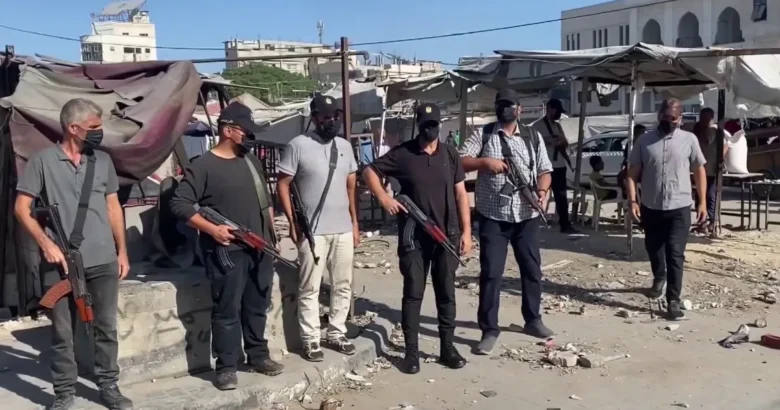
The Commission believes that the recurrence of these incidents, alongside kidnapping, extortion, and attacks on private property, reflects the dangers posed by the spread of armed violence and the declining reliance on the rule of law in resolving community disputes. Such practices threaten citizens’ lives and safety and undermine social stability. The Commission stresses that firearms must never become tools for imposing influence, settling scores, or extorting citizens. The responsibility of the competent authorities is to uphold the rule of law, control illegal weapons, and protect citizens and their property.
Third: Assaults on Lawyers and Restrictions on Professional and Human Rights Freedoms
The Commission condemns the assault against Mr. Yousef Arafat Ashour, Deputy Head of the Sharia Lawyers Syndicate in the Gaza Strip, on 13 November 2026, near Nasser Medical Complex in Khan Younis. According to circulating reports, he was beaten and coerced into issuing an apology and deleting a post from his Facebook page before being shot in the leg.
The Commission considers this incident a serious assault on physical integrity and human dignity, an act of intimidation against members of the legal profession, and a violation of the right to freedom of opinion and expression. It also undermines the independence of the legal profession and its role in protecting rights and freedoms and ensuring justice. The Commission calls for an independent and serious investigation to uncover the circumstances of the assault, identify those responsible, hold them accountable, and guarantee that such practices are not repeated.
Fourth: Interference in Governmental and Humanitarian Work and Pressure on Employees
The Commission documented reports revealed through testimonies and media sources on 15 November 2026 concerning the summoning of several public employees working in governmental and relief sectors affiliated with the government in the West Bank, where they were reportedly pressured to stop working with ministries and institutions affiliated with the Palestinian National Authority, with some allegedly being forced to sign written pledges to that effect.
Among the cases raised in this context is that of Engineer Ahmad Al-Talouli, an employee working within the teams of the Ministry of Public Works and Housing, who was reportedly summoned and subjected to pressure following his participation in assessing the conditions of displaced persons’ camps in preparation for providing emergency shelter alternatives.
The Commission stresses that subjecting employees to threats or coercion because of the nature of their professional work, or interfering with the performance of their official and humanitarian duties, risks disrupting public services and relief efforts and undermining the rights of citizens and displaced persons. Such practices must be stopped immediately, and accountability must be ensured.
The Commission emphasizes the need to keep humanitarian and relief work, as well as public services, separate from political and security disputes. Employees and workers must be guaranteed the right to perform their professional and humanitarian duties without threats, extortion, or unlawful interference, in order to protect citizens’ interests and ensure the continuity of essential services.
Fifth: Restrictions on Political and Youth Freedoms and Peaceful Assembly
The Commission is following the reported summoning of activist and journalist Mohammed Muhanna in the city of Deir al-Balah in connection with youth activities, alongside reports concerning restrictions imposed on the Fatah Movement’s commemoration of the anniversary of the martyrdom of President Yasser Arafat. These restrictions reportedly included requiring prior authorization, specifying the venue and date of the event, and prohibiting the display of flags and the use of loudspeakers outside the hall.
The Commission believes that such practices, where they lack a legitimate legal basis, constitute unjustified interference in public freedoms and political and community life. It emphasizes that freedom of opinion and expression, peaceful assembly, and participation in political and youth activities are fundamental rights that may only be restricted in accordance with the law and in compliance with the principles of necessity and proportionality.
The Commission also warns that continued restrictions on young people and political and community actors risk deepening tensions and divisions and weakening public trust in institutions.
Sixth: Death in Custody and Allegations of Torture and Ill-Treatment
The Commission is following with grave concern the death of citizen (M. A.), aged 26 and a resident of northern Gaza, on 3 October 2026, while in detention at Asdaa Correction and Rehabilitation Center.
According to the available information, he was detained on 24 September and transferred to the center on 25 September, before being admitted to the intensive care unit on 27 September. The Correction and Rehabilitation Centers Administration announced that his death followed an attempted suicide, while his family raised suspicions that he had been subjected to torture and ill-treatment during interrogation.
While emphasizing that these allegations require an independent and impartial investigation, the Commission stresses the need to uncover all the circumstances surrounding the death, the conditions of detention and interrogation, and whether the legal and medical safeguards afforded to the detainee were respected. It also calls for legal accountability should any responsibility or negligence be established, and insists that no person involved be allowed to escape punishment.
The Commission further emphasizes that protecting the right to life and physical integrity of detainees is a direct legal responsibility of the authorities in charge of detention facilities.
Seventh: National and Legal Responsibility for Protecting Society and Preserving Civil Peace
The International Commission to Support Palestinian Rights (ICSPR) affirms that the rights to life, physical integrity, personal liberty, freedom of opinion and expression, peaceful assembly, freedom of professional, trade union, and human rights activities, and the protection of children from kidnapping, exploitation, and extortion are fundamental rights guaranteed under the Palestinian Basic Law, national legislation, and international human rights conventions to which the State of Palestine is a party.
The Commission believes that arbitrary summonses and detentions, coercion to sign pledges, assaults on lawyers, journalists, and activists, unlawful interference in governmental and humanitarian work, the use of firearms in community disputes, the kidnapping of children and extortion of their families, and allegations of torture and ill-treatment collectively constitute troubling indicators of the erosion of legal and community protection guarantees. Such practices undermine the rule of law and weaken citizens’ trust in public institutions.
The Commission stresses that protecting the internal front and preserving civil peace cannot be achieved by restricting freedoms, subjecting citizens to threats and coercion, or tolerating disorder, weapons, and extortion. Rather, these objectives require respect for human dignity and rights, strengthening trust in institutions, consolidating the principle of accountability, and ensuring that the law is applied to everyone without exception or selectivity.
The Palestinian people, who are facing aggression, displacement, blockade, and the destruction of the basic conditions of life, are in greater need than ever of responsible institutions that protect their rights, safeguard their freedoms, strengthen their resilience, unite efforts, and preserve the social fabric, rather than practices that deepen divisions, undermine civil peace, and increase citizens’ suffering.
The people of Gaza are in particular need of stronger solidarity and social cohesion to confront all the threats to their lives, security, and safety, rather than having new forms of fear, extortion, assault, or violations of their dignity added to their existing suffering.
Accordingly, the International Commission to Support Palestinian Rights (ICSPR) calls upon the competent authorities and national and community forces in the Gaza Strip to:
- Take immediate and urgent action to determine the whereabouts of the minor Fayez Iyad Salim, ensure his safe release and return to his family, and undertake all necessary security and community efforts to end his detention, protect his family from threats and extortion, and pursue and prosecute the kidnappers in accordance with the law.
- Immediately halt all forms of arbitrary summonses and detentions motivated by political considerations or linked to the exercise of public rights and freedoms; annul any pledges obtained through coercion; guarantee the release of anyone detained without a legal basis; and respect the legal safeguards governing personal liberty.
- Launch independent, transparent, and impartial investigations into all the incidents and violations referred to in this statement, particularly the kidnapping of Fayez Salim, the death of citizen (M. A.) in custody, the assault against lawyer Yousef Arafat Ashour, and the storming and burning of Al-Najjar Mall. The findings of these investigations must be made public, and anyone found responsible or complicit must be held accountable in accordance with the law.
- Guarantee freedom of governmental, professional, humanitarian, human rights, trade union, journalistic, and youth activities; put an end to all forms of threats, coercion, and unlawful interference in the performance of professional and humanitarian duties; and ensure that humanitarian work and public services remain separate from political and security disputes.
- Respect freedom of opinion and expression, the right to peaceful assembly, and the exercise of political and youth activities; end arbitrary restrictions imposed on national and community events; and ensure that security measures are not used to restrict legally guaranteed rights and freedoms.
- Adopt practical and decisive measures to control illegal weapons, prevent their use in family and community disputes, pursue those responsible for armed assaults, gunfire, and attacks on private property, and provide the necessary protection for citizens and their property.
- Strengthen oversight of detention facilities and correction and rehabilitation centers, ensure respect for detainees’ dignity and physical and psychological integrity, prevent torture and ill-treatment, and investigate all cases of death or injury in custody in a manner that guarantees the right to an effective remedy and accountability.
- Strengthen legal and community protection for children, take the necessary measures to prevent their kidnapping, exploitation, or exposure to extortion and threats, develop rapid-response mechanisms for reports of missing and kidnapped children, and ensure protection for victims and their families.
-
Call upon national and community forces, tribal representatives, human rights institutions, and prominent public figures to assume their responsibilities in protecting civil peace, rejecting violence, extortion, and disorder, and promoting a culture of respect for the law, dialogue, tolerance, and the peaceful resolution of disputes.