
ICSPR: Six Palestinians Killed and More Than 30 Injured in Israeli Massacre Targeting the Surgical Department at Nasser Medical Complex, Including a Child and a Doctor

Date: 12 November 2026
Press Release
ICSPR: Six Palestinians Killed and More Than 30 Injured in Israeli Massacre Targeting the Surgical Department at Nasser Medical Complex, Including a Child and a Doctor
The International Commission to Support Palestinian Rights (ICSPR) strongly condemns the continued Israeli crimes and violations against the Palestinian people in the Gaza Strip, the West Bank, and occupied Jerusalem, as well as the escalating targeting of civilians, medical facilities, civilian institutions, and holy sites. These violations are taking place amid the worsening humanitarian and winter crisis and the continued restrictions on the entry of humanitarian aid, fuel, medical supplies, rescue equipment, and shelter materials. ICSPR stresses that these developments form part of the ongoing crime of genocide against the Palestinian people in the Gaza Strip, accompanied by widespread killing and destruction, siege, starvation, forced displacement, and the systematic targeting of the basic necessities of life, amid the absence of effective international measures to stop these crimes, protect civilians, and enforce international law.
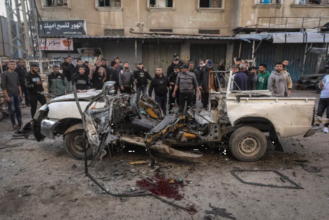
In the Gaza Strip, shelling and gunfire continued in several areas, including northern Al-Bureij refugee camp, eastern Khan Younis, and the neighborhoods of Al-Zaytoun, Al-Daraj, and Sheikh Radwan. Displaced persons’ tents and the vicinity of Musa bin Nusayr School were also targeted. In addition, the homes of Dr. Iyad Abdul Jawad and Hajj Abu Hussein Al-Shanti, east of Al-Maghazi refugee camp, were demolished. These attacks, alongside the deliberate targeting of civilians, resulted in the killing of 23 Palestinians and dozens of injuries, including women and children, according to information received regarding the latest field developments.
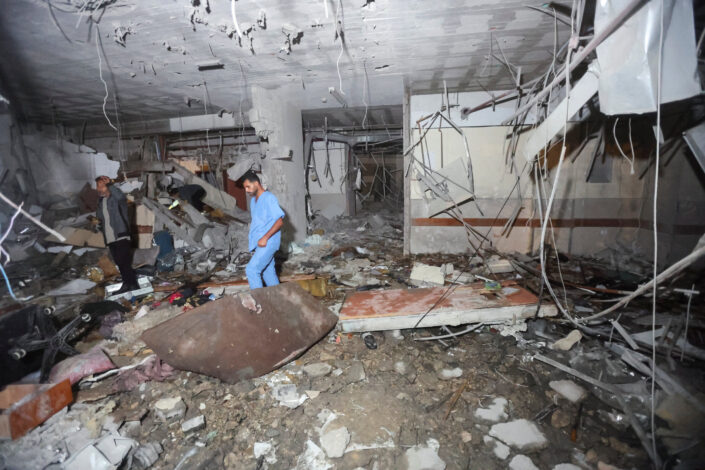
In a particularly grave crime, Israeli occupation forces targeted the surgical department in the Yassin Building at Nasser Medical Complex in Khan Younis last night, killing six Palestinians and injuring more than 30 others as a result of the Israeli bombardment of the medical complex. The victims were identified as: Jihad Naeem Mohammed Abu Teilkh (13), a child; Khaled Suleiman Ibrahim Abu Anza (53); Dr. Rizq Ahmed Ibrahim Abu Shuaireh (52); Murad Tawfiq Mahmoud Abu Zarifa (45); Saif Ghazi Muslim Abu Hatab (28); and Mohammed Nafeth Musa Abu Awwad (27).
This crime is particularly grave because it targeted a medical facility that plays a central role in treating the wounded and sick, and because a child and a doctor were among those killed. It also caused casualties and damage to vital medical departments, threatening the hospital’s ability to continue providing healthcare services amid the ongoing collapse of Gaza’s healthcare system. Hospitals, medical facilities, patients, wounded individuals, and healthcare personnel enjoy special protection under international humanitarian law. Attacks against them or the disruption of their medical functions are prohibited, while the principles of distinction, proportionality, and precaution remain binding under all circumstances. ICSPR considers the targeting of medical facilities and the disruption of their ability to provide treatment, amid the widespread destruction of the healthcare system, part of an ongoing pattern of crimes against Palestinians for the fourth consecutive year.
According to data issued by the Palestinian Ministry of Health on 11 November 2026, the cumulative toll of the aggression reached 74,653 fatalities and 176,007 injuries. Since the ceasefire announced on 11 October 2025, the Ministry has recorded 1,622 fatalities and 5,878 injuries, in addition to the recovery of 850 bodies. These figures predate the field developments that took place in the early hours of 12 November and therefore require updating in accordance with subsequent official medical reports. The victims of the attack on Nasser Medical Complex should not be included in these figures until an official update is issued.
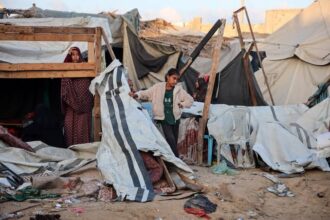
Alongside the killing and destruction, the humanitarian catastrophe is worsening with the arrival of winter. Approximately 1.6 million Palestinians are living in tents, shelters, and temporary accommodation that lack even the most basic protection, amid reports that around 70,000 tents have been flooded by rainfall and flash floods. Khan Younis alone hosts more than 770 displacement camps and approximately 2,100 structurally damaged and potentially hazardous buildings, while risks continue to increase for tens of thousands of displaced people in low-lying areas. Occupancy at Al-Shifa Hospital has also exceeded 250%, according to medical reports, amid shortages of medicines, medical supplies, and operational capacity, alongside growing healthcare and humanitarian needs.
Furthermore, continued restrictions on the entry of mobile homes, fuel, cooking gas, heavy machinery, Civil Defense equipment, pumps, sewage suction tankers, spare parts, medicines, and infrastructure repair materials are obstructing humanitarian response efforts and increasing the risks of death, disease, building collapses, and the disruption of essential services. Preventing access to the necessities required for the population’s survival and rescue raises serious legal responsibilities, including those arising from the obligations of the occupying power and the prohibitions against collective punishment, starvation, and deprivation of the basic necessities of life. These practices are connected to the broader context of the crime of genocide and the imposition of destructive living conditions on the Palestinian population.
Regarding Palestinian prisoners and detainees, ICSPR expresses grave concern over the health condition of Dr. Hussam Abu Safiya and reports by Physicians for Human Rights – Israel concerning the deterioration of his health and the obstacles preventing an independent medical examination. The organization has also reported that 14 Palestinian doctors are being detained without charge or trial, some of whom have been held for more than two years. ICSPR calls for disclosure of the fate and places of detention of all detainees, guarantees of their safety and legal and humanitarian rights, access to independent medical care, the release of those arbitrarily detained, and accountability for those responsible for torture, ill-treatment, and denial of medical treatment.
In the occupied West Bank and Jerusalem, settler attacks and policies of settlement expansion and displacement continue. These include the incursion of 305 settlers into Al-Aqsa Mosque in a single day and their performance of religious rituals within its courtyards; the closure of Burj Al-Laqlaq for six months for the second time, following the closure of Al-Quds Sons Club and the raid on Al-Hakawati Theatre; as well as the raid on Abu Shukheidim village and the injury of photojournalist Alaa Badarna in Qusra. Plans to establish shooting ranges at 31 locations are also continuing, alongside escalating pastoral settlement attacks in Tubas and Ramallah. According to data from the Wall and Settlement Resistance Commission, 1,182 arson attacks were recorded, including 809 targeting property, vehicles, and facilities, and 373 targeting land. These developments threaten the Palestinian presence, livelihoods, rights to land, and holy sites, reflecting the expansion of settlement, displacement, and attacks against Palestinians and their property.
ICSPR believes that the continuation of these Israeli crimes and violations, despite international condemnation, exposes the widening gap between declared positions and practical commitments. Statements of condemnation and expressions of concern cannot protect civilians unless translated into concrete measures to stop crimes and attacks, lift the siege, ensure the delivery of humanitarian aid, and hold those responsible accountable. It is also essential to enable Palestinian institutions, municipalities, and the National Committee for the Administration of Gaza to fulfil their responsibilities, while ensuring the central role of the United Nations and its agencies, particularly UNRWA, in a manner that preserves the unity of Palestinian institutions and the Palestinian people’s right to self-determination.
In light of these developments, ICSPR calls for the following:
- An immediate end to the crime of genocide and all Israeli crimes and violations, and the provision of international protection for civilians: Throughout the Gaza Strip, the West Bank, and occupied Jerusalem, including the protection of hospitals, medical facilities, ambulances, healthcare personnel, patients, wounded individuals, holy sites, and civilian institutions, as well as confronting settlement expansion, forced displacement, and settler attacks and terrorism.
- The opening of border crossings and the immediate and regular entry of humanitarian assistance: Including food, water, medicines, fuel, cooking gas, tents, mobile homes, rescue equipment, heavy machinery, spare parts, and infrastructure repair materials. ICSPR also calls for independent verification of the actual delivery, adequacy, and distribution of announced humanitarian assistance, and an end to restrictions that prevent the saving of lives and the provision of basic necessities.
- The protection of the healthcare system, patients, detainees, and the most vulnerable groups: By ensuring the continuity of intensive care and surgical services, conducting an independent investigation into the targeting of Nasser Medical Complex, providing Dr. Hussam Abu Safiya with an independent medical examination, releasing arbitrarily detained doctors and other detainees, disclosing the fate of all detainees and guaranteeing their rights, and holding those responsible for torture and denial of medical treatment accountable.
- Enabling Palestinian institutions to manage the response and recovery process, leading to reconstruction: By supporting municipalities and the National Committee for the Administration of Gaza, providing the necessary resources and capabilities for their work, ensuring respect for the unity of Palestinian institutions, and supporting UNRWA’s international mandate and the continuation of its humanitarian and legal role.
- Activating international accountability and justice mechanisms without selectivity or delay: By supporting the work of the International Criminal Court, the International Court of Justice, and relevant United Nations mechanisms; activating universal jurisdiction and pursuing those responsible for international crimes; preserving evidence and protecting witnesses and victims; and adopting effective measures and sanctions against the occupying power to compel it to end its crimes and violations, respect its obligations under international law, and implement relevant international judicial measures and orders.
ICSPR also issues an urgent appeal to free peoples, human rights and humanitarian organizations, trade unions and federations, universities, political forces, religious and media institutions, solidarity movements, and people of conscience around the world to intensify humanitarian, human rights, political, and popular efforts to pressure governments and parliaments, organize solidarity activities, bring an end to the crime of genocide and Israeli crimes, and protect civilians.