
Deir al-Balah Tragedy: Collapse of the Healthcare System and Flooding of Thousands of Tents Threaten the Lives of Hundreds of Thousands of Displaced People and Deepen Gaza’s Humanitarian Catastrophe

Date: November 10, 2026
Press Statement
Deir al-Balah Tragedy: Collapse of the Healthcare System and Flooding of Thousands of Tents Threaten the Lives of Hundreds of Thousands of Displaced People and Deepen Gaza’s Humanitarian Catastrophe
The International Commission to Support Palestinian Rights (ICSPR) is following with grave concern and outrage the escalating humanitarian catastrophe facing the population of the Gaza Strip, amid continued Israeli crimes and attacks, the worsening consequences of the blockade, destruction, and forced displacement, and the repercussions of the recent severe weather system. These developments have once again exposed the extreme vulnerability of hundreds of thousands of displaced people, leaving them exposed to rain, flooding, cold temperatures, building collapses, and soil erosion, without even the most basic shelter, protection, or necessities of life.
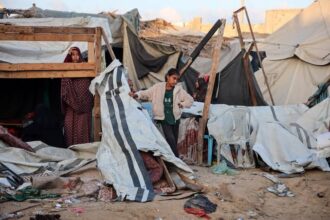
The tragedy in Deir al-Balah, which claimed the lives of civilians and left others missing following the collapse of a sandy embankment onto displaced families’ tents, is not an isolated incident. Rather, it is inseparable from the catastrophic humanitarian conditions created by years of aggression, destruction, displacement, and blockade. It serves as a serious warning about the growing dangers threatening the lives of women, children, and families who have been forced to erect their tents on sand dunes, in low-lying areas, and along coastal zones after their homes were destroyed and they were deprived of safe shelter, while the entry of essential shelter materials, rubble-removal equipment, and reconstruction supplies continues to be delayed.
The severity of this tragedy is compounded by the widespread damage caused by the recent weather system. According to the Ministry of Social Development, 18,860 displaced families across 339 camps have been affected, including 8,319 families in Gaza Governorate, while 141 camps are located in the central governorate. Rainwater has also flooded tens of thousands of tents, severely worsening the living conditions of hundreds of thousands of displaced people, amid a clear lack of emergency response and relief capacities. Civil Defense data have revealed the enormous gap between needs and available resources, as thousands of distress calls were received, yet only a limited proportion could be addressed.
ICSPR warns that the danger extends far beyond tents. Thousands of buildings have been damaged and are at risk of collapse, while parts of residential structures have already collapsed during the recent storm. The risks of soil displacement and landslides are also increasing, particularly in areas where displaced families have erected their tents on sand dunes. UNRWA’s warnings regarding the concentration of approximately two million Palestinians within an area of no more than 100 square kilometers, amid deteriorating infrastructure and severe shortages in rubble-removal and emergency response capacities, are particularly significant in assessing the scale of the threat facing civilians as winter approaches.
What is happening is not merely a weather-related crisis or a shortage of humanitarian assistance. It is a direct consequence of the ongoing genocide, forced displacement, destruction of homes and infrastructure, and continued restrictions on the entry of shelter materials, equipment, fuel, and machinery required by municipalities and Civil Defense teams. Furthermore, the continued reduction of areas available to displaced people and their forced concentration in unsuitable locations significantly increases the risks, turning rain and cold weather into daily threats to human life.
The humanitarian catastrophe cannot be separated from the continued killings and Israeli attacks despite the announcement of a ceasefire. Data published on November 9 indicated that the death toll since the ceasefire took effect had risen to 1,613 martyrs, with 5,833 people injured. This is a grave indication that the ceasefire has not translated into effective protection for civilians, and that attacks and violations continue to claim lives and keep the population exposed to danger. ICSPR stresses that a ceasefire cannot be meaningful merely through its announcement; it must be fully respected through an end to attacks and gunfire, the protection of civilians, and the removal of restrictions preventing the delivery of humanitarian assistance and essential supplies.
At the same time, the healthcare crisis in the Gaza Strip is deteriorating to levels that threaten the lives of hundreds of thousands of patients. According to published health data, the shortage of essential medicines has reached approximately 42%, with 263 out of 622 items completely out of stock. The shortage of medical consumables has reached approximately 50%, with 508 out of 1,006 items unavailable. Meanwhile, the shortage of laboratory reagents has reached approximately 71%, with hundreds of items out of stock. A complete shortage has also been recorded in certain public health laboratory, immunology, and tumor marker testing services.
These figures have a direct impact on patients’ lives. Cancer patients face interruptions in chemotherapy and are unable to complete their prescribed treatment protocols. Patients with kidney failure are suffering from shortages of dialysis filters, solutions, and medicines, threatening the regular provision of dialysis sessions and their lives. Meanwhile, patients with diabetes, hypertension, and heart disease face increasing difficulties in obtaining their essential medications. Maternal and child healthcare, emergency services, surgery, intensive care, vaccination programs, and primary healthcare services are also facing accumulated shortages, at a time when health, psychological, and humanitarian needs continue to increase.
ICSPR further warns of the consequences of disruptions to medical transportation services due to unsettled financial dues, fuel shortages, and a lack of spare parts. These circumstances may prevent healthcare personnel from reaching hospitals and medical centers, placing the continuity of essential departments, surgical operations, and intensive care units at additional risk. Denying hospitals access to medicines, medical consumables, and laboratory supplies, while obstructing the movement of healthcare workers and patients, is not merely an administrative or logistical failure; it further deepens the collapse of the healthcare system and threatens the fundamental rights to life and healthcare.
ICSPR affirms that the primary responsibility for this catastrophe lies with the Israeli occupying power, which is responsible for the destruction of homes and infrastructure, the imposition of the blockade and restrictions on the entry of humanitarian assistance and essential supplies, and the continuation of attacks and violations. States that provide political or military cover for, or continue to support, the policies of the occupation also bear legal and moral responsibilities for contributing to the continuation of these violations, each according to the nature and extent of its role and contribution.
In this context, ICSPR condemns and rejects the so-called “Board of Peace” for shirking its responsibilities in ensuring the implementation of the ceasefire agreement and ending the humanitarian catastrophe. The Board must not become a framework for managing statements, shifting responsibilities, or providing political cover for the continuation of the existing situation, while civilians remain exposed to killing, blockade, and displacement, and humanitarian aid, shelter, and medical treatment remain subject to Israeli restrictions. Any international or political framework claiming to oversee the implementation of the agreement must demonstrate its effectiveness through concrete measures that ensure an end to attacks, the opening of border crossings, the delivery of humanitarian assistance, the protection of civilians, and the removal of obstacles to recovery and reconstruction.
The prevailing policies and their consequences raise serious concerns about the entrenchment of conditions that make life in Gaza unsustainable, thereby serving the continuation of forced displacement and undermining Palestinians’ right to remain on their land and exercise self-determination. Accordingly, ICSPR calls for a serious review of the role and mechanisms of the Board of Peace and urges that it not be granted political or operational legitimacy unless it fulfills its obligations to ensure the ceasefire, end Israeli aggression, and strengthen humanitarian response, recovery, and reconstruction efforts. ICSPR also stresses the need for the United Nations and the UN Security Council to assume their responsibilities and not leave the protection of civilians and the relief of the population hostage to political understandings that are not implemented or statements that do not change people’s reality.
At the same time, ICSPR emphasizes the urgent need to enable the National Committee for the Administration of Gaza to carry out its civilian and humanitarian responsibilities, providing it with the necessary powers, resources, and capacities to restore essential services, organize humanitarian response efforts, and rehabilitate institutions and infrastructure. This must take place within a Palestinian national framework that respects the unity of the land, institutions, and national representation, does not become a form of external trusteeship or an alternative to the Palestinian people’s right to self-determination, and does not absolve the occupying power or international parties of their legal obligations.
ICSPR believes that the situation in Gaza requires moving beyond crisis management toward addressing its root causes; moving beyond statements toward imposing practical measures; moving beyond seasonal responses to severe weather toward providing sustainable shelter and protection solutions; and moving beyond promises of reconstruction toward the immediate commencement of rubble removal and the rehabilitation of homes and infrastructure. These measures are essential to ensure that civilians are no longer left to face death beneath collapsing buildings, drown in their tents, or lose their lives because of interrupted medical treatment.
The International Commission to Support Palestinian Rights (ICSPR) affirms that the continuation of the blockade and restrictions preventing the provision of food, medicine, shelter, and healthcare, together with attacks on civilians and the destruction of property and infrastructure, necessitates investigations and accountability under international humanitarian law and international human rights law.
As the occupying power, Israel has clear obligations under the Fourth Geneva Convention, particularly Articles 55 and 56, concerning the provision of food and medical supplies and the maintenance of medical services and public health. Furthermore, deliberately subjecting a population to destructive conditions of life, where the remaining elements and specific intent are established, may constitute underlying acts of genocide, in addition to potentially amounting to war crimes and crimes against humanity, depending on the facts, evidence, and legal elements of each crime. A ceasefire must not become a means of suspending the rules of protection or obstructing accountability for past and ongoing crimes and violations.
ICSPR also commends all popular, human rights, and humanitarian movements and initiatives that stand in solidarity with the Palestinian people. It particularly appreciates the solidarity marches and events held in European cities, including popular mobilizations in the Netherlands. ICSPR emphasizes that international solidarity must translate into sustained political, legal, and economic pressure, producing tangible results in protecting civilians, ending the genocide and Israeli crimes and violations, lifting the blockade, and safeguarding the Palestinian people’s right to life, dignity, and security.
Accordingly, the International Commission to Support Palestinian Rights (ICSPR) calls for the following:
- An immediate end to Israeli attacks: Ensure full compliance with the ceasefire agreement, halt gunfire and military attacks, and provide effective protection for civilians throughout the Gaza Strip.
- Opening border crossings and ensuring unrestricted humanitarian access: Compel the occupying power to open border crossings and allow humanitarian assistance without restrictions or politicization, ensuring the adequate and regular entry of food, water, fuel, medicines, medical supplies, and shelter materials in quantities proportionate to the scale of the catastrophe and the actual needs of the population.
- Providing safe and urgent shelter for displaced people: Allow the entry of suitable tents, prefabricated housing units, insulation materials, blankets, winter clothing, and heating supplies, and establish appropriate shelter centers that take into account the needs of children, women, older persons, persons with disabilities, and patients.
- Allowing the entry of heavy machinery, equipment, fuel, and spare parts: Provide Civil Defense, municipalities, and rescue teams with the necessary machinery, fuel, and spare parts, enabling them to pump out floodwater, clear and open rainwater drainage channels, repair water and sewage networks, and eliminate hazards threatening displacement camps and shelters.
- Establishing urgent engineering and technical assessment teams: Assess damaged buildings and structures at risk of collapse, evacuate unsafe buildings, reinforce those that can be repaired, and evaluate the locations of displaced people’s tents, particularly those situated on sand dunes and in low-lying and coastal areas, while taking immediate measures to protect residents.
- Rescuing the healthcare system from collapse: Facilitate the entry of essential medicines, medical consumables, laboratory supplies, diagnostic reagents, and medical equipment, prioritizing cancer medications, dialysis supplies, insulin, medicines for chronic diseases, and supplies required for anesthesia, surgery, and intensive care.
- Ensuring urgent medical evacuations for patients and injured persons: Facilitate the immediate transfer and travel of patients and wounded individuals who cannot receive adequate treatment inside the Gaza Strip, without obstacles or delays, and refrain from using security approvals and restrictions as a means of depriving patients of their right to treatment and life.
- Addressing the crisis in medical transportation and supporting health services: Settle the outstanding financial dues owed to medical transportation companies and provide fuel, spare parts, oils, and tires to ensure that healthcare personnel can reach hospitals and medical centers and that essential medical departments continue operating.
- Enabling the National Committee for the Administration of Gaza: Allow the Committee to assume its civilian and humanitarian responsibilities and provide it with the necessary resources and powers within a Palestinian national framework that respects institutional unity and the right to self-determination, without absolving the occupying power of its obligations or entrenching any form of trusteeship.
- Calling on the Board of Peace, mediators, and guarantors to fulfill their responsibilities: In particular, Egypt, Qatar, and Türkiye must exert serious and direct pressure to ensure the full implementation of all provisions of the agreement, halt violations, open border crossings, facilitate humanitarian assistance, and begin shelter and reconstruction efforts, rather than limiting their response to statements and declarations.
- Calling on the United Nations, the Security Council, and the international community to take urgent and effective action: Ensure international protection for civilians, guarantee humanitarian access, hold the occupying power accountable for its violations, and activate relevant international mechanisms, including investigative, judicial, and human rights accountability mechanisms.
- Expanding international popular and human rights mobilization in solidarity with Gaza: Call upon trade unions, federations, universities, human rights and humanitarian organizations, solidarity movements, and Palestinian, Arab, and Muslim communities to organize continuous events, marches, and sit-ins, and pressure their governments to adopt practical measures, including ending forms of support that contribute to the continuation of violations and holding those responsible accountable under the law.
- Calling on religious scholars, preachers, and civil and media institutions to maintain public awareness of Gaza’s tragedy: Dedicate platforms, public spaces, and activities to highlighting the scale of the humanitarian catastrophe, encourage communities to support affected people and provide urgent relief, and ensure that such efforts remain free from political exploitation, discrimination, and hate speech.
- Immediately commencing rubble removal and the rehabilitation of homes and infrastructure: Create the necessary conditions for displaced people to return to their areas and homes whenever they become safe, and reject any arrangements that would entrench displacement or transform temporary displacement into a permanent reality.
The International Commission to Support Palestinian Rights (ICSPR)