
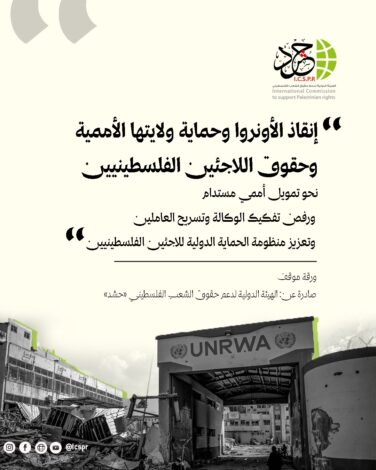
ICSPR Issues a Position Paper on Saving UNRWA and Protecting Its UN Mandate, Calling for Sustainable Funding, Rejecting the Agency’s Dismantling and Staff Layoffs

Date: 8 November 2026
Press Release
ICSPR Issues a Position Paper on Saving UNRWA and Protecting Its UN Mandate, Calling for Sustainable Funding, Rejecting the Agency’s Dismantling and Staff Layoffs
The International Commission to Support Palestinian Rights (ICSPR) has issued a position paper entitled “Saving UNRWA and Protecting Its UN Mandate and the Rights of Palestinian Refugees: Towards Sustainable UN Funding, Rejecting the Dismantling of the Agency and Staff Layoffs, and Strengthening the International Protection Framework for Palestinian Refugees.” The paper examines the financial, institutional and political crisis facing the United Nations Relief and Works Agency for Palestine Refugees in the Near East (UNRWA), and presents a vision for protecting its role and independence and ensuring the continuity of its services, without making its staff and refugees bear the cost of financial shortfalls and donor pressure.
ICSPR stressed that the current crisis goes beyond a shortage of resources and declining contributions from donor countries. It threatens the Agency’s ability to fulfil its UN mandate, the stability of its workforce, and the continued provision of education, healthcare, relief and protection services to millions of Palestinian refugees across its five fields of operation. The Commission warned against using the financial crisis as a pretext to reshape UNRWA’s role or strip its mandate of its substance through service cuts, staff layoffs and the transfer of core responsibilities to alternative entities.
The paper explained that this crisis is unfolding amid an Israeli escalation aimed at delegitimising the Agency, drying up its funding and undermining its presence, alongside international political and financial pressure and attempts to redistribute its responsibilities. These developments threaten to weaken the UN framework addressing the Palestinian refugee question and open the door to attempts to circumvent their rights, foremost among them the right of return and compensation.
The Commission noted that the paper addresses a reported funding shortfall estimated at approximately USD 70 million, as well as media reports concerning a proposal to lay off between 7,000 and 8,000 employees out of approximately 15,000 staff members in the Gaza Strip and the West Bank, representing nearly half of the workforce in the two territories. Other reports have also referred to discussions about transferring some of the Agency’s responsibilities to UN entities or to arrangements relating to the future administration of the Gaza Strip. The Commission emphasised that, unless and until official decisions or clarifications are issued, such information remains media reporting that requires urgent verification and clarification and must not be presented as formally announced final decisions.
ICSPR called on UNRWA’s management and the United Nations to provide clear answers regarding the substance, reasons and scope of these reported directions, the alternatives considered, and the safeguards relating to staff rights and the continuity of services. It stressed that the absence of official clarification does not justify silence, given the potential humanitarian and institutional consequences of any large-scale measures affecting the Agency’s employees and core functions.
The paper explained that UNRWA’s primary reliance on voluntary contributions, without a stable core funding system commensurate with refugee needs and the Agency’s obligations, has left its services, programmes and staff salaries vulnerable to fluctuations in international politics and changes in donor priorities. The Commission considered that the financial crisis is not an isolated development linked solely to the recent war on Gaza, but rather the result of accumulated structural shortcomings, in which declining funding has coincided with expanding humanitarian needs and the continued occupation, blockade and aggression.
The Commission called for a shift away from reliance on temporary funding appeals and donation campaigns towards the establishment of a sustainable and regular UN funding system, based on stable institutional appropriations within the UN regular budget or a guaranteed, multi-year UN funding mechanism. Such a system would reduce the Agency’s dependence on unilateral donor decisions and protect its independence and capacity to plan and respond.
ICSPR stressed that addressing the shortfall through staff layoffs and service reductions is not a sustainable solution. Rather, it threatens to weaken the Agency from within and create a substantial humanitarian and institutional vacuum. It affirmed that employees are not a financial burden to be discarded, but constitute the backbone of UNRWA’s capacity to fulfil its mandate. The continued presence of its local workforce in the Gaza Strip is a humanitarian and operational necessity, given the widespread destruction, the collapse of vital sectors, and the growing numbers of displaced people and those in need.
The paper explained that laying off thousands of employees amid the humanitarian catastrophe in Gaza and the growing needs in the West Bank and Jerusalem would undermine the education, healthcare, relief and protection sectors, widen the gap between refugees’ needs and institutions’ capacity to meet them, and impose further hardship on families already affected by the loss of income and job security.
The Commission called for any measures affecting employees to be governed by the principles of fairness, transparency, proportionality and non-discrimination, and to comply with the UN employment rules and regulations, while respecting acquired rights, job security, and the rights to trade union organisation, representation and collective bargaining. It also rejected the use of the financial crisis as a pretext for mass layoffs without a genuine assessment of alternatives, emphasising the need to safeguard trade union independence and broaden participation, including by strengthening women’s representation.
At the legal and institutional levels, ICSPR affirmed that UNRWA was established pursuant to UN General Assembly Resolution 302 of 1949, and that any amendment to its mandate, termination of the Agency, or institutional decision to transfer its core responsibilities falls within the authority of the General Assembly and its resolutions. Such decisions do not fall within the unilateral authority of the Commissioner-General or the Agency’s executive management.
The Commission explained that the Commissioner-General’s administrative, operational and organisational powers must be exercised within the limits of the authority delegated to the office and the applicable UN rules and resolutions. These powers do not confer independent authority to abolish the Agency’s mandate or relinquish its core responsibilities in a manner that would bring its institutional existence to an end. ICSPR stressed that any arrangements affecting the substance of the mandate require a clear UN-level mandate, transparent procedures, and the participation of Member States, host countries and the relevant parties concerned with refugee rights.
The paper distinguished between legitimate cooperation and complementarity with UN agencies and humanitarian institutions, on the one hand, and institutional substitution and the transfer of responsibilities in ways that would gradually dismantle UNRWA, on the other. It affirmed that service coordination and the sharing of roles must not become a means of depriving the Agency of its staff, resources and programmes, or of creating a situation in which it becomes unable to perform its functions without a decision from the competent UN authority.
In this context, ICSPR rejected any attempt to turn recovery and reconstruction arrangements in the Gaza Strip into a gateway for bypassing or excluding UNRWA, or placing refugee services under a new political and administrative trusteeship, including the arrangements discussed in the paper concerning the “Board of Peace”. The Commission stressed that institutional cooperation must be based on transparency and respect for the UN mandate and refugee rights, rather than on redistributing responsibilities in a way that empties the Agency’s role of its substance.
The Commission also called for stronger cooperation and complementarity between UNRWA, the Office of the United Nations High Commissioner for Refugees (UNHCR), and other UN agencies, each within its respective mandate and area of competence, in order to expand legal and humanitarian protection and prevent gaps in assistance, particularly for Palestinian refugees residing outside UNRWA’s fields of operation.
ICSPR emphasised that expanding protection must take into account the specific legal status of the Palestinian refugee question and the provisions of Article 1D of the 1951 Convention relating to the Status of Refugees. Such efforts must not become a pretext for merging the two agencies or replacing UNRWA with UNHCR in its fields of operation. The Commission explained that what is required is complementarity of roles and expanded assistance, without changing the legal status of refugees or imposing resettlement and integration solutions at the expense of the right of return and compensation.
The paper addressed the Israeli campaign against the Agency, including attacks on its facilities and personnel, incitement against its educational curricula, questioning its neutrality, pressure to suspend its funding, and legislation targeting its activities, privileges and immunities. ICSPR considered that these practices are part of broader attempts to dismantle the international framework addressing the Palestinian refugee question and weaken its legal and political standing. It called for the protection of the Agency and its employees, respect for its immunities, and accountability for those responsible for attacks against it.
The Commission stressed the need to distinguish between UNRWA’s mandate and the rights of Palestinian refugees, affirming that the Agency is not the source of the right of return, and that any change to its mandate or its termination would not extinguish the rights to return, compensation and reparation. It referred to the relevant international legal frameworks, foremost among them paragraph 11 of UN General Assembly Resolution 194 of 1948.
ICSPR concluded its paper by emphasising that protecting UNRWA does not mean perpetuating the refugee condition or reducing the Palestinian question to its relief dimension. Rather, it means preserving international responsibility towards refugees until a just and lasting solution is reached that guarantees their rights. The Commission stressed that saving the Agency requires addressing the root causes of its financial crisis, safeguarding its mandate, independence and employees’ rights, ensuring the continuity of its services, and expanding the international protection framework for Palestinian refugees, without dismantling the institution or undermining the distinctive legal nature of their cause.