
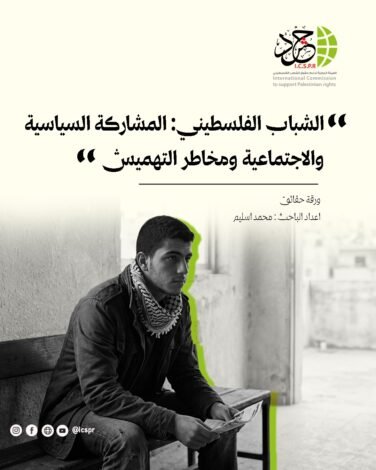
(ICSPR) Publishes a Fact Sheet Entitled “Palestinian Youth Political and Social Participation and the Risks of Marginalization”

Date: 4 November 2026
Press Release
(ICSPR) Publishes a Fact Sheet Entitled: “Palestinian Youth: Political and Social Participation and the Risks of Marginalization”
The International Commission to Support Palestinian Rights (ICSPR) has published a new fact sheet entitled “Palestinian Youth: Political and Social Participation and the Risks of Marginalization,” prepared by researcher Mohammed Osleem. The paper examines the realities facing Palestinian youth and the economic, political, and social challenges that restrict their participation. It also highlights the impact of war, occupation, political division, and the absence of democratic renewal on their rights, opportunities, and future.
The paper begins by emphasizing that young people represent a fundamental force within Palestinian society; however, their demographic presence is not proportionately reflected in decision-making positions and representative institutions. It indicates that approximately 64% of the population is under the age of 30, while young people aged 18–29 account for approximately 21% of the population, equivalent to nearly 1.2 million young men and women. This makes their empowerment and meaningful inclusion essential to building a more just and sustainable political and social future.
The paper highlights the multidimensional marginalization crisis facing Palestinian youth: economically, through unemployment and limited employment opportunities; politically, through declining opportunities for participation and the prolonged absence of general elections; and socially, through diminishing trust in institutions, increasing feelings of alienation, and growing aspirations to emigrate. These challenges are compounded by the direct consequences of war on education, mental health, and personal security.
In its economic analysis, drawing on the data presented for 2025, the paper indicates that unemployment among young people aged 15–29 reached approximately 85.5% in the Gaza Strip, compared to 37.3% in the West Bank. It also highlights the compounded marginalization experienced by young women, whose unemployment rate in Gaza reached approximately 94%, compared to 81.3% among young men. These figures reflect the profound disparities in access to employment, income, and economic independence.
The paper notes that higher educational attainment does not necessarily guarantee young people’s transition into the labour market, given the gap between educational outcomes and available employment opportunities. It also highlights that the proportion of young people not in education, employment, or training (NEET) in the West Bank reached 37.1% in 2025, with a higher rate among females. The paper stresses that addressing this phenomenon requires policies that effectively link education and training with employment and social protection.
The paper explains that the war on the Gaza Strip has further deepened these challenges through the destruction of educational institutions and economic facilities, the disruption of income sources, displacement, the loss of years of education, and growing psychosocial needs. It argues that the consequences of war extend beyond immediate losses, threatening an entire generation’s ability to complete its education, establish professional careers, and participate in recovery and reconstruction efforts.
Regarding political participation, the paper examines the crisis of trust between young people and representative institutions, as well as the frustration and declining interest in public affairs resulting from the prolonged absence of general elections and the obstruction of democratic renewal.
It stresses that restoring this trust requires opening meaningful opportunities for young people to participate in candidacy, voting, and decision-making, while protecting public freedoms and political pluralism and ensuring that their participation is not reduced to merely symbolic or occasional roles.
The paper also highlights the digital space as an alternative platform for expression, organization, advocacy, and human rights documentation, particularly given the limited availability of traditional channels for participation. It indicates that internet usage among young people aged 18–29 in the West Bank reached 97.7% during the first quarter of 2026, offering significant opportunities to strengthen youth participation, provided that digital rights and freedom of expression are protected.
The paper warns that the accumulation of economic and political marginalization, coupled with insecurity, is driving growing segments of Palestinian youth to consider emigration. It presents survey findings indicating that 64.1% of young people aged 18–29 are seriously or repeatedly considering emigration. The paper regards this as an indicator of a crisis of confidence in the future and a threat to Palestinian human capital at a time when young people’s capabilities and energies are urgently needed for reconstruction and recovery.
The paper draws on United Nations Security Council Resolution 2250 on Youth, Peace and Security, calling for its implementation at the national level through the development of a youth-inclusive action plan, the adoption of a rights-based national policy, strengthening young people’s role in conflict prevention, civil peacebuilding, and reconciliation, and ensuring their inclusion across all decision-making levels.
As part of its recommendations, the paper calls for expanding political participation among young men and women, removing restrictions that undermine pluralism, protecting freedom of expression and peaceful assembly, ending political division, and developing employment, vocational training, and entrepreneurship programmes, with particular priority given to young women, graduates, and young people in the Gaza Strip. It also stresses the importance of ensuring their participation in recovery and reconstruction plans.
The paper further recommends protecting the right to education, addressing learning losses, rehabilitating educational institutions, expanding psychosocial support services, supporting youth-led documentation and advocacy initiatives, strengthening representative youth structures, documenting violations committed against young people and students, and calling for international protection for them.
The paper concludes that empowering Palestinian youth is not a separate sectoral issue, but rather a fundamental pathway toward restoring public trust in institutions, strengthening civil peace, and rebuilding the political and social system. It emphasizes that treating young people as partners in planning, decision-making, and implementation, rather than merely as recipients of services, is essential to protecting Palestinian society and strengthening its resilience and capacity for recovery.