
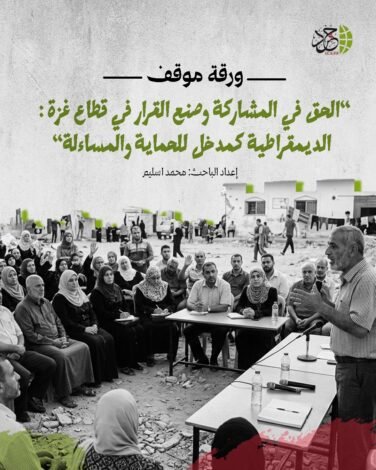
ICSPR Issues a Position Paper on the Right to Participate in Decision-Making in the Gaza Strip

Date: 26 September 2026
Press Release
ICSPR Issues a Position Paper on the Right to Participate in Decision-Making in the Gaza Strip
The International Commission to Support Palestinian Rights (ICSPR) has issued a position paper titled “The Right to Participate in Decision-Making in the Gaza Strip.” It affirms that Palestinians’ right to influence decisions concerning relief, recovery, reconstruction, and the future governance of the Strip is not a formality. It is an essential condition for protecting their rights and holding those responsible for such decisions accountable.
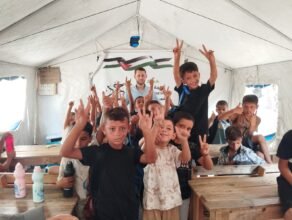
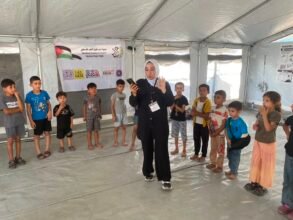
The paper explains that Gaza’s residents, who directly bear the consequences of war, displacement, and destruction, are best placed to identify their communities’ needs and priorities. Yet decisions about opening crossings, distributing aid, planning reconstruction, and establishing future governance arrangements are often discussed without their meaningful participation, or their views are sought only after the main choices have been made.
The paper warns against treating Palestinians in Gaza solely as recipients of aid or subjects of protection, rather than recognising them as partners in shaping policies that affect their lives. It argues that excluding them from planning and implementation weakens the community’s sense of ownership over recovery efforts and increases the risk of decisions that fail to address residents’ actual needs.
The paper affirms that democracy in Gaza’s circumstances cannot be reduced to holding elections, important though the right to free elections remains. It also encompasses people’s rights to access information, express themselves, organise, and participate in public affairs. Enabling local communities to set priorities for relief and reconstruction, it argues, provides a practical form of protection by helping to identify shortcomings, inequitable resource distribution, and violations at an early stage.
The paper notes that involving community organisations, local councils, trade unions, and representative bodies in setting priorities and overseeing implementation can make humanitarian programmes more transparent, reduce the misuse of resources for narrow political purposes, and enable harm and violations to be documented through residents’ firsthand knowledge.
On accountability, the paper stresses that survivors and affected people should not remain mere sources of testimony whose experiences are recounted by others. It calls for enabling them to participate in documenting and investigating violations and in setting priorities for justice. Such participation can strengthen the credibility of accountability efforts and help build more accurate records of what they have experienced, while respecting their rights and safety.
The paper warns that discussions about “the day after,” reconstruction, and the future governance of the Strip may reproduce exclusion if they are developed without representative and influential Palestinian participation. It affirms that any plan, regardless of its technical quality, risks failure or public rejection unless residents are involved from the outset in defining its goals, setting its priorities, and monitoring its implementation.
The paper explains that meaningful participation requires more than consultations or listening to residents’ views. It requires timely, clear information about plans, resources, and decisions, as well as a genuine ability for community representatives to influence them. It also requires regular channels for submitting complaints, comments, and proposals; public explanations of how they are addressed; and opportunities for residents to assess outcomes and demand corrections where programmes fall short.
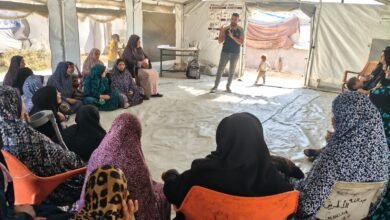
The paper stresses that participation must be inclusive and must ensure representation for women, young people, persons with disabilities, displaced people, and others who have been most affected or have the least access to decision-making. Excluding these groups’ voices deprives protection and recovery plans of an understanding of their needs and weakens the fairness and sustainability of those plans.
The paper recommends recognising Palestinian public participation as a condition for the legitimacy of any relief operation, reconstruction effort, or future arrangement. It calls for involving active civil society and community organisations in Gaza from the earliest planning stages in the design, implementation, and monitoring of programmes. It also calls for strengthening their capacity in documentation, participatory planning, and local decision-making.
The paper calls for ensuring that survivors and affected people take part in documenting and investigating violations, and for preventing the exclusion of local Palestinian voices from any discussion about Gaza’s future governance. It also urges the publication of information about relief, recovery, and reconstruction programmes; the establishment of transparent mechanisms to receive and respond to residents’ complaints; and the representation of the most affected groups in consultations and decision-making.
ICSPR affirms that denying Gaza’s people a voice in decisions that determine their future deprives them both of a means of protection today and of a greater opportunity for accountability and justice tomorrow. It stresses that no humanitarian response or reconstruction project can achieve its goals fairly and sustainably without genuine and influential Palestinian participation.lHq-fy-lmshrk-wSn-lqrr-fy-qT-Gz.pdf
To read the full paper, click here.