
ICSPR Issues a Policy Paper on Enhancing the Efficiency of the Humanitarian Response for Displaced People in the Gaza Strip

Date: 17 September 2026
Press Release
ICSPR Issues a Policy Paper on Enhancing the Efficiency of the Humanitarian Response for Displaced People in the Gaza Strip
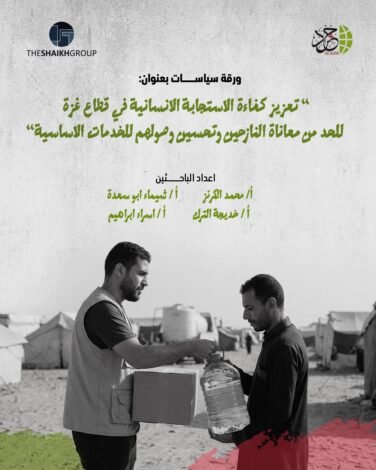
The International Commission to Support Palestinian Rights (ICSPR) has issued a policy paper titled: “Enhancing the Efficiency of the Humanitarian Response for Displaced People in the Gaza Strip.” The paper examines the reality of humanitarian response amid the ongoing genocide and analyses the factors that have weakened the capacity of relief and humanitarian institutions to deliver aid and essential services fairly, safely, and sustainably to hundreds of thousands of displaced people across the Gaza Strip.
The paper explains that, since 7 October 2023, the Gaza Strip has endured an unprecedented humanitarian catastrophe. As of the preparation of the paper, more than 73,250 Palestinians had been killed and over 173,751 injured, most of them women and children, in addition to approximately 9,000 people missing beneath the rubble. The war has also caused widespread destruction of infrastructure and civilian and service facilities, resulting in the severe collapse of vital sectors, particularly health, water, electricity, food, and shelter.
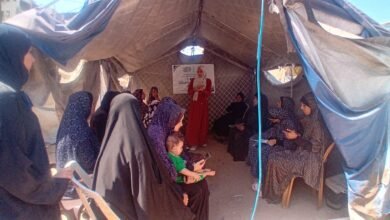
The paper notes that approximately two million Palestinians, equivalent to around 90% of the Gaza Strip’s population, have been forcibly displaced during the war. About one million displaced people continue to live in shelters, worn-out tents, or damaged homes that lack minimum conditions for dignified life, amid severe shortages of food, safe drinking water, health care, and rising poverty and unemployment.
The paper affirms that humanitarian assistance has become the principal lifeline for displaced civilians, with more than 90% relying on aid to meet their basic needs for food, water, medicine, and shelter. However, according to the paper, the efficiency of humanitarian response has deteriorated dangerously due to the continuation of military operations, control over crossings, restrictions on the entry of assistance, and the targeting of humanitarian facilities and aid workers.
The paper explains that the weakness of the humanitarian response is not only a result of limited available resources. It is also linked to the dispersal of displaced people across thousands of informal tents, shelters, unsafe buildings, and scattered displacement sites, making it difficult to update beneficiary databases and exchange information among humanitarian organisations. This has affected the accuracy of needs assessments and field access to the most vulnerable groups.
It notes that repeated forced displacement, evacuation orders, restrictions on residents’ return to their areas, and control over wide areas of the Gaza Strip have created a complex geographic and humanitarian reality that makes safe and organised access to displaced communities increasingly difficult. This has widened the gap between humanitarian needs and the actual capacity of institutions to respond, particularly for women, children, older persons, and persons with disabilities.
The paper highlights that the widespread destruction of civilian infrastructure has undermined the ability of humanitarian actors to deliver aid. Roads, streets, bridges, and logistical facilities have been damaged, obstructing civilians’ movement towards aid-distribution points, disrupting the movement of relief trucks and humanitarian-response teams, and delaying the delivery of food, medicine, and essential supplies to affected and isolated areas.
It explains that the targeting of electricity networks has disrupted the preservation and storage of food, medicines, vaccines, and temperature-sensitive supplies. The destruction of water and sanitation networks, the accumulation of waste, and the large amounts of rubble have further aggravated health and environmental risks. The destruction of economic and commercial facilities, warehouses, markets, and agricultural land has also caused widespread paralysis of the local economy and disrupted supply chains and production, deepening the population’s dependence on external aid.
The paper states that restrictions imposed on crossings and on the entry of humanitarian assistance and essential supplies, including food, medicine, fuel, shelter materials, and medical supplies, are among the principal factors weakening the humanitarian response. According to the paper, only around 58,664 trucks of assistance, fuel, and cooking gas were allowed to enter out of 165,000 trucks that were expected to enter under the 2025 humanitarian protocol, representing a compliance rate of no more than 36%.
The paper affirms that this shortage of supplies has directly affected food security and health care and intensified the difficulties faced by humanitarian institutions in providing assistance in quantities sufficient to meet the needs of displaced people across the Gaza Strip.
The paper highlights the targeting and undermining of the work of the United Nations Relief and Works Agency for Palestine Refugees in the Near East (UNRWA), which is one of the main pillars of the humanitarian response in the Gaza Strip due to the services it provides in shelter, food, health care, education, and emergency relief.
It explains that the war has involved incitement campaigns, restrictions on UNRWA’s funding and operations, and attacks on its facilities and staff, directly affecting its operational capacity to meet growing needs. The paper reports the killing of more than 310 UNRWA staff members and the destruction of more than 312 of its facilities, including schools, shelters, and service and health facilities, which has resulted in reduced relief programmes and diminished capacity to provide food, shelter, and essential services to hundreds of thousands of displaced people.
The paper warns that the targeting of humanitarian workers, relief organisations, and aid-transport vehicles undermines the protection afforded to humanitarian work under international humanitarian law. It notes that 46 aid-distribution centres have been targeted and that more than 556 humanitarian workers and volunteers have been killed. Relief convoys have also been subjected to looting and attacks, obstructing the delivery of aid to those in need and widening the gap between available resources and actual needs.
The paper explains that attacks on relief convoys, community kitchens, and charitable food kitchens have contributed to the reduction of daily food-distribution programmes and deprived thousands of displaced families of basic sources of support. It refers to the killing of seven World Central Kitchen staff members and the targeting or disruption of at least 48 charitable kitchens, affecting the continued provision of meals for displaced families.
The paper notes that the deterioration of humanitarian response has led to greater deprivation and inequality in access to aid, particularly for children, women, older persons, persons with disabilities, and families that have lost their main provider or have been separated due to killing, injury, detention, or displacement. It indicates that the number of orphaned children in the Gaza Strip has exceeded 58,800, while at least 7,300 children are unaccompanied or separated from their families, a large proportion of whom are living in displacement sites.
The paper highlights that the decline in humanitarian response has worsened starvation and malnutrition among displaced people. At least 1.6 million people, representing 77% of the population, face acute food insecurity, while around 95% of residents rely on humanitarian assistance and charitable kitchens as a primary source of food. Approximately 70% of households are unable to access the minimum daily water requirements.
The paper highlights the grave risks facing children, pregnant women, and breastfeeding mothers. More than 650,000 children face the risk of starvation, while over 800,000 displaced children face growing risks of malnutrition and disease. It further notes that more than 40,000 infants under one year old are at risk of death due to shortages of infant formula, and that around 37,000 pregnant and breastfeeding women suffer from acute malnutrition, alongside rising miscarriage rates and the spread of malnutrition-related diseases.
ICSPR affirms that the weakening of humanitarian response has deepened poverty, unemployment, and the erosion of livelihoods among displaced people, leaving large numbers of families almost entirely dependent on aid at a time when local capacity for production, employment, and rebuilding sources of income continues to decline.
The paper calls for urgent measures to improve the efficiency of humanitarian response, foremost among them ensuring a permanent ceasefire, opening all crossings and access routes fully, safely, and regularly, and allowing the unrestricted entry of humanitarian aid, medical supplies, fuel, shelter materials, construction materials, and essential equipment.
It also recommends establishing a unified and regularly updated humanitarian database for displaced people to facilitate coordination between humanitarian institutions, information exchange, accurate identification of needs and priorities, and regular and equitable access to the most vulnerable groups.
The paper stresses the need to protect humanitarian workers, facilities, aid convoys, and distribution centres; guarantee freedom of movement and safe access for humanitarian organisations; end attacks on UNRWA facilities and personnel; and ensure that UNRWA can continue fulfilling its mandate and providing essential services in shelter, food, health, and education.
The paper calls on the international community and donor bodies to increase urgent and sustainable humanitarian funding, provide direct support to local institutions and community initiatives, and strengthen their participation in designing and implementing the humanitarian response, thereby ensuring a response that is closer to the needs of affected populations and better able to reach displacement sites.
It further calls for transparent and equitable mechanisms for aid distribution that take into account the needs of women, children, older persons, persons with disabilities, and families that have lost their main provider, and that prevent exploitation or discrimination in access to services and essential supplies.
ICSPR affirms that enhancing the efficiency of the humanitarian response in the Gaza Strip is not merely a relief or logistical matter. It is an urgent legal and humanitarian obligation linked to protecting the rights to life, dignity, health, food, and shelter, and to ending policies that obstruct civilians’ access to their basic needs.
ICSPR affirms that this paper is issued in partnership with The Shaikh Group (TSG) as part of efforts to expose the obstacles facing the humanitarian response in the Gaza Strip and promote effective international action that protects civilians, ensures the unobstructed delivery of aid, strengthens the resilience of displaced people, and enables them to restore the conditions for a dignified life.
It should be noted that this paper does not necessarily reflect the views of ICSPR or The Shaikh Group (TSG).