
ICSPR Issues a Policy Paper on the Seizure of UNRWA’s Qalandiya Training Centre and Calls for Urgent International Action

Date: 6 September 2026
Press Release
ICSPR Issues a Policy Paper on the Seizure of UNRWA’s Qalandiya Training Centre and Calls for Urgent International Action
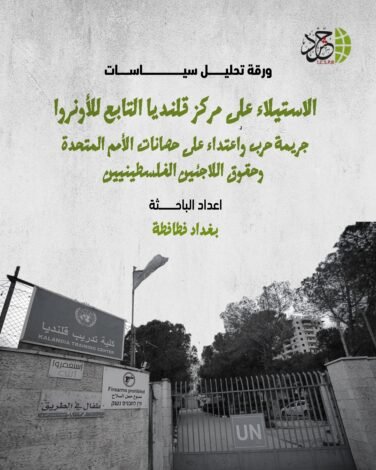
The International Commission to Support Palestinian Rights (ICSPR) has issued a policy paper prepared by researcher Baghdad Fatafta on the seizure by Israeli occupation authorities of the Qalandiya Training Centre, affiliated with the United Nations Relief and Works Agency for Palestine Refugees in the Near East (UNRWA), north of Jerusalem. The paper warns that this measure constitutes a grave violation of the legal immunity of UNRWA and its property, as well as a direct assault on Palestinian refugees’ rights to education, vocational training, work, and protection.
The paper explains that the Qalandiya Training Centre is one of UNRWA’s oldest and most important educational and vocational institutions. Established in 1952 on an area of approximately 45 dunams, the Centre provides vocational and educational programmes for Palestinian refugees, including training for young men and women in multiple technical and professional specialisations. It accommodates hundreds of students annually and provides essential opportunities for vocational qualification and economic inclusion, particularly for young people and refugees from Qalandiya Refugee Camp and surrounding areas.
The paper affirms that the seizure of the Centre is not an isolated administrative or property-related incident. Rather, it forms part of a broader effort to undermine UNRWA’s role in East Jerusalem, target its legal and institutional presence, and weaken its educational, health, and relief services. This threatens the future of tens of thousands of Palestinian refugees and affects their social and economic stability.
The paper states that Israeli occupation authorities closed the Centre, raised Israeli flags over it, and prevented staff and students from accessing the premises. It describes these measures as a direct assault on a UN facility that enjoys legal immunity and an attempt to deprive Palestinian refugees of one of the most important vocational training and qualification centres in Jerusalem and its surrounding areas.
The paper notes that the Qalandiya Training Centre does not merely provide vocational and technical programmes; it also serves as an educational and developmental space that enables Palestinian youth to acquire skills that help them access employment, confront unemployment and poverty, and strengthen their resilience amid restrictions on movement, work, and education in East Jerusalem and refugee camps.
Researcher Baghdad Fatafta stresses in the paper that the seizure of the Centre threatens the educational and vocational paths of hundreds of students, deprives them of access to specialised training, negatively affects teaching, administrative, and other staff, and weakens UNRWA’s capacity to continue delivering services to Palestinian refugees in an area among the most affected by occupation, settlement expansion, and displacement policies.
The paper explains that UNRWA was established pursuant to United Nations General Assembly Resolution 302 of 1949 to provide relief and essential services to Palestinian refugees. Its existence and services reflect the international community’s continuing responsibility toward the refugee question until a just solution is reached, in accordance with international legitimacy resolutions, foremost among them Resolution 194.
It further notes that the Centre is protected as property of the United Nations and its specialised agencies and may not be seized, confiscated, or subjected to local administrative measures. This protection is based on the UN Charter and the 1946 Convention on the Privileges and Immunities of the United Nations, which guarantees the immunity of UN property, buildings, and records from search, confiscation, or unlawful interference.
The paper stresses that the International Court of Justice, in its advisory opinion issued on 19 July 2024, affirmed the unlawfulness of the continued Israeli presence in the Occupied Palestinian Territory, including East Jerusalem, and stated that Israel must cease policies and practices contrary to international law and end its unlawful presence. The paper considers the seizure of the Qalandiya Training Centre to be inconsistent with these principles and an extension of policies aimed at imposing Israeli sovereignty over East Jerusalem, contrary to its legal status as occupied territory.
The paper explains that protection for UNRWA in East Jerusalem and the Occupied Palestinian Territory is also grounded in international humanitarian law, particularly the Fourth Geneva Convention. The Convention requires the occupying power to protect civilians and civilian objects and not obstruct the work of impartial humanitarian bodies. It also prohibits measures that harm civilian and educational institutions or undermine services essential to the population under occupation.
The paper notes that the closure of the Centre deepens the educational, social, and economic crisis facing Palestinian refugees, exacerbates unemployment and poverty, restricts young people’s opportunities to access education, training, and employment, and undermines one of the most important tools of economic empowerment and community development for refugee communities, particularly in light of the limited educational and vocational alternatives available.
ICSPR warns that this measure does not target a UN facility alone; it also targets the international protection system provided to Palestinian refugees and paves the way for undermining UNRWA’s institutional presence in East Jerusalem. This carries serious consequences for refugees’ educational, social, and economic rights, as well as for the protection of their national identity and inalienable rights.
The International Commission to Support Palestinian Rights (ICSPR) calls on the United Nations and UNRWA to take urgent and effective measures to protect the Centre and restore its operations, and to reject any measures that violate the immunity of UN property or diminish UNRWA’s mandate and services for Palestinian refugees.
The Commission also calls on the international community to exert immediate political, legal, and diplomatic pressure on Israeli occupation authorities to revoke the decision to seize the Centre and ensure that staff and students can return to it and resume educational and vocational activities without obstruction.
ICSPR calls on States Parties to the Geneva Conventions, the UN Security Council, the UN General Assembly, and the High Commissioner for Human Rights to take practical measures to protect UNRWA institutions in East Jerusalem, prevent their targeting or disruption, and ensure the continuation of their humanitarian, educational, and health services for Palestinian refugees.
The Commission further calls for the establishment of an independent international commission of inquiry into violations committed by the occupation against United Nations institutions and UNRWA in East Jerusalem and the Occupied Palestinian Territory, and for its findings to be referred to the competent judicial bodies in order to ensure accountability and prevent impunity.
ICSPR affirms that protecting UNRWA’s Qalandiya Training Centre is a direct international responsibility, and that any silence or failure to confront its seizure risks encouraging further measures targeting the UN presence and the rights of Palestinian refugees. It stresses that safeguarding UNRWA’s role and services is an integral part of protecting Palestinian refugees’ rights to education, work, and dignity, as well as upholding their right to return to the homes from which they were displaced.