

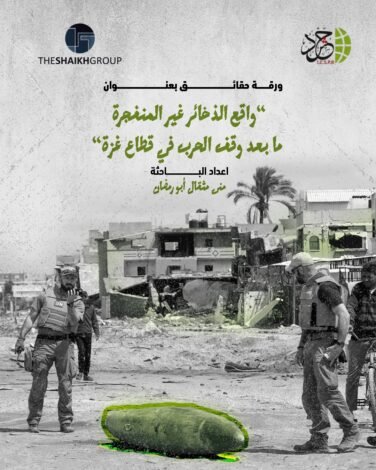
ICSPR Issues a Fact Sheet on the Risks of Unexploded Ordnance in the Gaza Strip

Date: 10 August 2026
Press Release
In Partnership with The Shaikh Group (TSG) and as Part of the Youth Civil Society Activists Diploma Program
ICSPR Issues a Fact Sheet on the Risks of Unexploded Ordnance in the Gaza Strip
The International Commission to Support Palestinian Rights (ICSPR), in partnership with The Shaikh Group (TSG) and as part of the Youth Civil Society Activists Diploma Program, has issued a fact sheet on the risks of unexploded ordnance in the Gaza Strip. These remnants have become a continuing threat to civilian lives, obstructing rubble removal, reconstruction efforts, and the safe return of displaced people to their areas, even after the cessation of hostilities.
The fact sheet explains that, since 7 October 2023, the Gaza Strip has been subjected to widespread destruction through the use of various types of weapons on land and from the air. It notes that the ceasefire announced in October 2025 did not end the crises caused by the war, including extensive infrastructure destruction, displacement, the disruption of essential services, and the spread of unexploded ordnance in residential and agricultural areas and on public roads.
The paper explains that unexploded ordnance includes bombs, munitions, and shells that were fired, dropped, or placed during an armed conflict but failed to explode. They remain an ongoing danger that may detonate at any time. It stresses that their presence in Gaza poses a direct threat to civilians, particularly children, women, people returning to their homes, farmers, scrap collectors, and rubble-removal workers.
The fact sheet affirms that responsibility for clearing explosive remnants of war and addressing their risks lies, under international humanitarian law and the principle of international responsibility for internationally wrongful acts, with the Israeli occupation as the party whose military operations left these munitions in the Gaza Strip.
The paper notes that Protocol V to the 1980 Convention on Certain Conventional Weapons, concerning explosive remnants of war, requires parties to a conflict to take all feasible measures to identify, mark, clear, remove, or destroy unexploded ordnance as soon as possible after the end of active hostilities, thereby reducing the danger posed to civilians.
The fact sheet refers to estimates indicating that between 65 and 70 million tonnes of rubble have accumulated as a result of the destruction of thousands of homes, facilities, and vital infrastructure in the Gaza Strip. It further notes that more than 20,000 pieces of ordnance have failed to explode and have become time bombs scattered across different areas of the Strip.
According to the data presented in the paper, the results of a recent survey conducted by the United Nations Mine Action Service in April 2026 indicate that more than 1,000 people have lost their lives in the Gaza Strip due to explosive remnants of war and unexploded ordnance, with the actual number of victims likely to be higher. The data also show that approximately one unexploded item of ordnance has been identified every 600 metres in areas that could be accessed.
The paper warns that children are among the groups most exposed to danger, as unexploded ordnance may appear visually attractive and prompt children to pick it up or approach it without understanding the risks. It also notes that Save the Children reported that unexploded ordnance causes injuries to approximately 475 children every month, resulting in disabilities that may last throughout their lives.
The fact sheet documents increasing injuries among civilians, scrap collectors, people searching through rubble, and farmers due to the spread of unexploded ordnance. It also warns of field indications that some materials and civilian objects, including cans and children’s toys, may have been used in booby traps, further increasing risks to civilians and requiring specialised efforts for documentation, verification, and clearance.
The paper explains that the geographic distribution of unexploded ordnance extends across wide areas of the Gaza Strip. Khan Younis is among the most contaminated areas, with an estimated 2,000 tonnes of explosive remnants, and clearance operations there may require more than 12 years due to the scale of destruction. Affected areas also include the Nuseirat, Al-Maghazi, and Al-Bureij refugee camps and Deir al-Balah in the central governorate, as well as Rafah, Gaza City, and northern Gaza, where munitions, shells, and rubble contaminated by explosive remnants are spread throughout neighbourhoods and areas that witnessed intensive military operations.
The fact sheet notes that the removal of unexploded ordnance faces major challenges, foremost among them the continued Israeli military control over more than half of the Gaza Strip, high population density in accessible areas, the scale of destruction, difficulties accessing contaminated areas, and shortages of specialised technical equipment and the required permits.
The paper further indicates that clearing the Gaza Strip of unexploded ordnance may take around ten years under the best estimates and require no less than 541 million US dollars. It stresses that clearing these remnants is a fundamental prerequisite for beginning effective rubble removal and reconstruction and ensuring the safe return of civilians to their homes and land.
The paper warns of the humanitarian, health, economic, and environmental consequences of unexploded ordnance, including civilian casualties and severe injuries that frequently result in amputations and permanent disabilities, increased pressure on an already exhausted health sector, and the obstruction of people’s return and the resumption of normal life.
It adds that contamination of agricultural land by unexploded ordnance isolates farmers from their fields and threatens food security and livelihoods. The spread of explosives, toxic metals, and chemical substances in the rubble can also contaminate soil and groundwater, leaving long-term consequences for the environment and public health.
The fact sheet recommends launching a comprehensive, long-term field awareness programme in partnership with international organisations and civil society institutions. The programme should target local communities and groups most exposed to danger, particularly children, farmers, and scrap collectors, to raise awareness of suspicious ordnance, methods of reporting it, and ways of avoiding its risks.
It also calls for serious and direct international pressure on the Israeli occupation authorities to fulfil their legal responsibilities and allow the entry of technical equipment and specialised international teams without obstruction, enabling the detection, clearance, and removal of unexploded ordnance.
The paper calls on donor countries and international financial institutions to provide urgent and sufficient funding for the clearance of explosive remnants of war, considering it a priority that must precede rubble removal and reconstruction projects. It also stresses the need to establish a joint national and international coordination mechanism involving the United Nations Mine Action Service, government bodies, civil society institutions, and local communities to unify data and determine geographic priorities for clearing residential and agricultural areas and vital facilities.
ICSPR affirms that this fact sheet, issued in partnership with The Shaikh Group (TSG), is part of ongoing efforts to document the continuing risks posed by explosive remnants of war in the Gaza Strip and to promote an urgent international response that protects civilians, clears the Strip, and paves the way for humanitarian relief, reconstruction, and safe and dignified living conditions.
It should be noted that this fact sheet does not necessarily reflect the views of ICSPR or The Shaikh Group (TSG).