
ICSPR Issues a Fact Sheet on Protection in Shelters in the Gaza Strip

Date: 9 August 2026
Press Release
In Partnership with The Shaikh Group (TSG) and as Part of the Youth Civil Society Activists Diploma Program
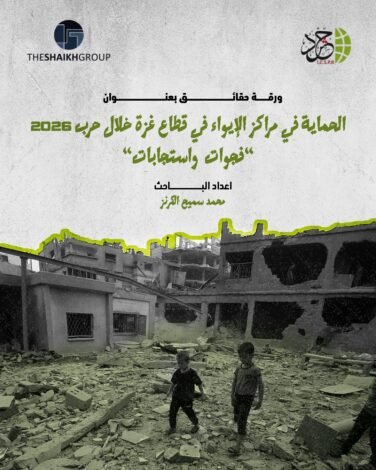
ICSPR Issues a Fact Sheet on Protection in Shelters in the Gaza Strip
The International Commission to Support Palestinian Rights (ICSPR), in partnership with The Shaikh Group (TSG) and as part of the Youth Civil Society Activists Diploma Program, has issued a fact sheet on the reality of protection in shelters and displacement sites in the Gaza Strip, amid the ongoing war, widespread destruction of infrastructure, and the near-total collapse of essential services and protection systems.
The fact sheet explains that damaged schools, makeshift tents, and uninhabitable buildings have become shelters for thousands of families repeatedly forcibly displaced, in an environment lacking minimum standards of safety, privacy, and basic services. It also indicates that more than two million Palestinians have been confined to less than half of the Gaza Strip’s area amid continuing mass displacement caused by bombardment and repeated evacuation orders.
The paper notes that most displaced people are living in worn-out tents, overcrowded schools, informal displacement sites, and partially damaged and unsafe buildings. According to the data presented, around 65,000 displaced people are residing in 82 collective shelters managed by the United Nations Relief and Works Agency for Palestine Refugees, amid severe shortages of shelter materials, blankets, and fuel, as well as continued displacement and severe overcrowding.
The fact sheet highlights that winter storms and strong winds during early 2026 caused dozens of tents to collapse, particularly in coastal areas, with children dying from extreme cold and the lack of heating. The destruction or damage of more than 371,000 housing units, the closure of more than half of hospitals, and the destruction or severe damage of most schools have led to unprecedented overcrowding in shelters and reduced the capacity of humanitarian organisations to manage displacement sites effectively.
The paper affirms that women and girls in shelters face increasing risks due to the absence of safe spaces, insufficient separate bathing facilities, poor lighting in camps, and the lack of privacy. These conditions expose them to violence, exploitation, and harassment, and restrict their ability to move freely and access basic services with dignity.
The fact sheet includes field testimonies from emergency protection responders confirming that overcrowding and the lack of effective protection measures have contributed to heightened family tensions, gender-based violence, and psychological and social pressures on women, particularly women who are the primary providers for their families.
The paper also highlights the grave impact of displacement on children, who are among the groups most affected by war and continuing displacement. They face insecurity, prolonged interruption of education, severe psychological distress, and the absence of safe environments for healthy development. Nearly one million children in Gaza have been exposed to war and repeated trauma, while almost all children in the Strip require psychosocial support to varying degrees.
The fact sheet further documents growing indicators of psychological distress among children in shelters, including bedwetting, sleep disorders, panic attacks, fear of loud noises, aggressive behaviour, and social withdrawal. It explains that the absence of privacy in tents and overcrowded sites not only causes distress to families, but also threatens children’s psychological and social development and increases their need for protection, support, and awareness programmes.
The paper notes that persons with disabilities and older persons face compounded difficulties in shelters due to the absence of safe pathways, accessible toilets, assistive devices, and wheelchairs, as well as difficulties in accessing health services. Repeated displacement has also isolated many older people in unsuitable tents or overcrowded sites that lack even minimum levels of services and care.
The fact sheet warns of the serious collapse of water and sanitation services in displacement sites, amid shortages of clean water, accumulated waste, sewage overflow, and the spread of insects and rodents. Restrictions on the entry of hygiene and pest-control materials have further exacerbated the spread of skin diseases, scabies, and lice, creating a dangerous health environment for displaced people, particularly children, women, and older persons.
The paper states that the humanitarian response remains far below actual needs, as only 10% of the funding required for humanitarian response was available during the first months of 2026. Humanitarian organisations also face restrictions on the entry of fuel, generators, and spare parts, difficulties accessing displacement areas, and direct security risks to humanitarian personnel.
Despite limited resources, protection teams and community organisations continue to provide psychosocial support sessions, case-management services, child-protection activities, community-awareness sessions, and legal and medical referrals. Local initiatives have also emerged within camps, including educational activities for children, basic recreational activities, group-support sessions, and youth initiatives to organise camps and distribute assistance.
ICSPR and The Shaikh Group call on the international community to ensure the protection of civilians and shelters in accordance with international humanitarian law, press for safe and sustained humanitarian access, and increase funding for protection, mental health, shelter, water, and sanitation sectors.
They also call on humanitarian organisations to expand psychosocial support services for children and women, develop safe facilities that take into account the needs of women, girls, persons with disabilities, and older persons, and strengthen community-based protection programmes inside camps. They stress the importance of involving displaced people in managing shelters, supporting local volunteer initiatives, and activating protection and reporting mechanisms in displacement sites.
ICSPR affirms that this fact sheet, issued in partnership with The Shaikh Group (TSG), is part of ongoing efforts to document the deteriorating protection conditions in shelters and displacement sites in the Gaza Strip and to promote an effective humanitarian and human rights response that guarantees displaced people’s right to safety, dignity, and humane living conditions.
It should be noted that this fact sheet does not necessarily reflect the views of ICSPR or The Shaikh Group (TSG).