

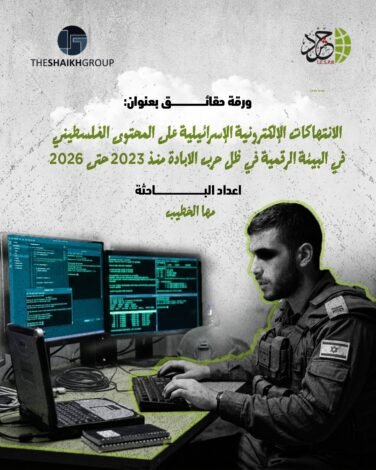
ICSPR issues a fact sheet titled: “Israeli Electronic Violations against Palestinian Content in the Digital Environment during the Genocidal War from 2023 to 2026”

Date: 20 July 2026
Press Release
In partnership with The Shaikh Group and as part of the Youth Civil Society Activists Diploma Program
ICSPR issues a fact sheet titled: “Israeli Electronic Violations against Palestinian Content in the Digital Environment during the Genocidal War from 2023 to 2026”
The International Commission to Support Palestinian People’s Rights (ICSPR), in partnership with The Shaikh Group and as part of the Youth Civil Society Activists Diploma Program, has issued a new fact sheet titled: “Israeli Electronic Violations against Palestinian Content in the Digital Environment during the Genocidal War from 2023 to 2026.” Prepared by researcher Maha Al-Khatteb, the paper sheds light on the most prominent digital crimes and violations targeting Palestinian content over the past years in the context of the ongoing war against the Palestinian people.
The fact sheet explains in its introduction that, in parallel with the continuous on-the-ground assault, the battle has expanded into cyberspace. Palestinian content has been subjected to extensive campaigns of deletion, restriction, and disinformation, while journalists, activists, and media institutions have faced account suspensions, page closures, and hacking attempts. The paper notes that these practices form part of a systematic effort to limit the spread of the Palestinian narrative and to restrict freedom of expression and access to information in the digital sphere. It defines electronic crimes and violations as digital practices and measures that result in restricting, blocking, or removing Palestinian content, or targeting Palestinian accounts in ways that undermine the rights to freedom of opinion and expression and access to information.
The paper presents figures and statistics documenting the escalation of these violations. It reports that the “Sada Social” Center monitored 849 violations against Palestinian content in April 2026, an increase of approximately 7.7% compared with March, which saw 788 violations. Of the 803 user-initiated violations targeting Palestinian content during that month, the Telegram platform topped the list with 406 cases (50.6%), followed by X (formerly Twitter) with 238 cases (29.6%), Facebook with 157 cases (19.5%), and two cases on Instagram. At the level of violations committed by the platforms themselves, 46 incidents were recorded, with Instagram accounting for 29 cases (63%), Facebook 14 cases (30.4%), and X three cases (6.5%).
The fact sheet identifies several major categories of Israeli electronic violations. The first concerns racist incitement and hate speech in Hebrew, where the “7amleh” Center documented more than 12.8 million violent posts against Palestinians on digital platforms in 2024 an average of 23.6 posts per minute with 79% of this inciting content posted on X and 21% on Facebook. Among these were 9,289 posts in which Israeli users openly expressed joy at the killing of Palestinians in airstrikes.
The second category involves direct targeting of journalists and media institutions. The “Sada Social” Center received more than 1,200 complaints from journalists about hacking attempts against their accounts on social media platforms, particularly Meta platforms such as Facebook, Instagram, and especially WhatsApp, in addition to 236 complaints concerning Hebrew incitement messages via WhatsApp, SMS, and comments on news posts. The fact sheet notes that 13% of recorded violations targeted Palestinian journalists and media outlets, as part of campaigns aimed at defamation, incitement, and silencing Palestinian media voices online. It also records an Israeli Defense Minister’s military order banning and shutting down at least five media pages specializing in coverage of Jerusalem, in what the center described as a clear escalation in digital targeting of Palestinian media.
The third category relates to surveillance, espionage, and tracking. The paper notes that Israel possesses a large number of surveillance and spying companies and tools, including the Israeli firms Cellebrite and BriefCam, which own the “Corsight” facial recognition system used to track, monitor, and detain thousands of Palestinian civilians passing through checkpoints in Gaza and the West Bank. It explains that advanced artificial intelligence systems are employed to impose close monitoring and control over all Palestinians, including collecting iris scan data from around two million individuals in Gaza and the West Bank. These data are used to categorize individuals, predict their movements, affiliations, and behaviors, and are integrated with facial recognition cameras, surveillance drones, and predictive algorithms. The paper further points out that Cellebrite, a company closely linked to the Israeli army, developed software capable of bypassing passwords and security protocols on smartphones and computers to access stored data, and that the Israeli army has used these tools extensively against Palestinians, including extracting data from thousands of detainees’ phones, many of whom were subjected to systematic torture.
The fourth category concerns content moderation policies applied to Palestinian content. The fact sheet cites reports by Human Rights Watch documenting unjustified removal or restriction of pro-Palestinian content on Facebook and Instagram, including the deletion of posts and comments, suspension or disabling of accounts, limiting engagement, and reducing reach through so-called “shadow banning”. It notes that these practices have been systematic and global, targeting peaceful content related to human rights and the Palestinian cause in more than 60 countries. The paper states that Meta’s policies, inconsistent enforcement of content standards, and heavy reliance on automated monitoring systems and content removal requests have contributed to restricting the Palestinian narrative and undermining freedom of expression and access to information, in violation of international human rights standards.
The fifth category highlighted by the paper is media and digital disinformation targeting the Palestinian narrative. It reports that, according to the Political and Developmental Studies Center, Israel has waged systematic disinformation campaigns since the start of the war on Gaza in October 2023, aiming to justify military operations, smear Palestinians and the resistance, and influence international public opinion. These campaigns have relied on traditional media, official spokespeople, digital accounts, and public relations firms, as well as the dissemination of false information and the re-framing of events and terminology to serve the Israeli narrative.
The fact sheet also examines the impact of this “electronic war” on Palestinian digital security at various levels. Physically, it notes that Israel has used AI technologies and digital platforms to enhance military targeting and spread war-supporting content and hate speech, while also attacking Gaza’s telecommunications infrastructure, causing around 75% of cell towers to go offline by mid-April 2024 and reducing information and communications sector activity by 91%, effectively isolating Palestinians from the outside world and disrupting their ability to seek help. Psychologically, the paper highlights the intensification of digital surveillance and the enlistment of Israeli civilians to monitor Palestinian online content, turning the digital sphere into a tightly controlled space and deepening existing power imbalances. It also points to the use of illegally obtained images and data to threaten and blackmail Palestinians, transforming digital platforms into arenas of psychological warfare and coercion.
The paper further explores cognitive effects, such as restricting Palestinians’ access to accurate information while amplifying the Israeli narrative, distorting facts about the Palestinian cause, and creating a state of informational chaos and confusion that fuels anxiety and compels Palestinians to exert continuous effort to defend their true narrative. Additional sections address impacts on Palestinian linguistic identity through criminalizing certain words and expressions under the pretexts of “hate speech” or “antisemitism,” as well as impacts on social cohesion, where platform restrictions deepen isolation, hinder collective organizing, and reinforce feelings of loneliness and powerlessness. The paper also discusses economic effects, including exacerbated poverty and unemployment, limited access to the digital economy, and severe restrictions on Palestinians’ ability to benefit from online economic opportunities, along with legal effects arising from Israeli emergency laws that have expanded digital prosecutions and led to hundreds of arrests or legal actions based on social media posts and interactions.
In its recommendations, the fact sheet calls on social media companies and platforms to ensure fair and non-discriminatory enforcement of content moderation policies and to refrain from targeting, restricting, or deleting Palestinian content or accounts belonging to journalists, influencers, and activists supporting the Palestinian cause. It urges the United Nations and the Human Rights Council to monitor and document digital violations against Palestinians, include them in international human rights reports, and hold accountable those responsible for digital abuses that restrict freedom of expression and access to information in the occupied Palestinian territories. The paper also calls on the international community to pressure Israel to stop targeting telecommunications and internet infrastructure and to respect Palestinians’ digital rights and freedoms in line with international law.