
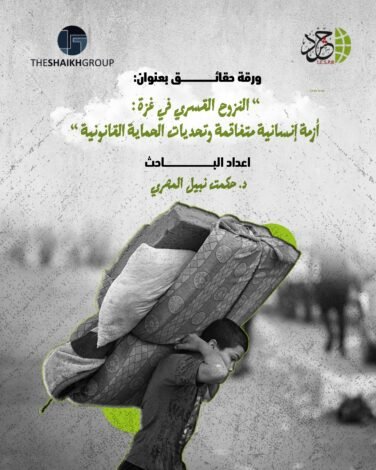
ICSPR issues a fact sheet titled“Forced Displacement in Gaza A Worsening Humanitarian Crisis and Legal Protection Challenges”

Date: 6 July 2026
Press Release
In partnership with The Shaikh Group and as part of the Youth Civil Society Activists Diploma Program
ICSPR issues a fact sheet titled: “Forced Displacement in Gaza: A Worsening Humanitarian Crisis and Legal Protection Challenges”
The International Commission to Support Palestinian People’s Rights (ICSPR), in partnership with The Shaikh Group and as part of the Youth Civil Society Activists Diploma Program, has issued a fact sheet titled: “Forced Displacement in Gaza: A Worsening Humanitarian Crisis and Legal Protection Challenges.” Prepared by researcher Dr. Juma Nabil Al-Maghribi, the paper addresses the escalation of forced displacement in the Gaza Strip as one of the most dangerous humanitarian and legal crises resulting from the ongoing war on the Strip.
The paper explains that since October 2023, the Gaza Strip has witnessed one of the largest waves of forced displacement in contemporary Palestinian history, as a result of large-scale military operations, repeated evacuation orders, and the widespread destruction of homes and civilian infrastructure. This has turned the majority of the Strip’s population into internally displaced persons living in extremely difficult humanitarian conditions that lack the minimum requirements for a dignified life.
It further notes that most of the population of the Strip has been displaced at least once, while hundreds of thousands have been forced to flee repeatedly several times in the absence of safe areas and amid the continuation of military operations.
According to the figures and indicators presented in the paper, the number of displaced people in the Gaza Strip has reached nearly two million Palestinians out of a population of about 2.2 million, meaning more than 85% of the Strip’s population. The estimates also confirm that thousands of families have been displaced more than five times during the war, while official and unofficial shelters are hosting tens of thousands of displaced persons under overcrowded conditions and with inadequate basic services. In addition, hundreds of thousands were displaced again following the collapse of ceasefire agreements and the resumption of military operations during 2025.
The paper shows that the current displacement in Gaza differs from previous waves of displacement in terms of the unprecedented scale of those affected, the wide geographic scope, the repeated displacement over short periods of time, the absence of stable safe areas, and the fact that it has occurred alongside a broad collapse of infrastructure and public services.
Regarding the main causes of forced displacement, the paper indicates that airstrikes, artillery shelling, and ground operations have destroyed entire residential neighborhoods and forced residents to leave their areas in search of safety. It adds that repeated evacuation orders covering large areas of northern Gaza, Gaza City, Khan Younis, and Rafah, together with the destruction of homes and civilian facilities and the damage to water, electricity, sewage, and road networks, have imposed a continuing reality of forced displacement on the civilian population.
The paper highlights the harsh humanitarian conditions endured by displaced persons, with hundreds of thousands living in temporary tents or overcrowded schools and shelters, while some are forced to stay in the open or inside partially destroyed buildings. Displaced families also suffer from severe food shortages, an acute water and sanitation crisis, and a dangerous deterioration in the health system due to the damage to hospitals and the shortage of medicines, fuel, and medical supplies.
The paper stresses that children, women, and the elderly suffer from deep psychological and social effects, including anxiety, constant fear, post-traumatic stress disorders, loss of a sense of safety, and the breakdown of family and community ties. It also notes that the large waves of displacement have led to the loss of income sources for hundreds of thousands, increased poverty and unemployment, disruption of education, decline in economic and productive activities, greater dependence on humanitarian aid, and higher levels of social vulnerability among the most fragile groups.
In the context of the humanitarian response, the paper explains that addressing the displacement crisis in Gaza faces extremely complex challenges due to the continuation of military operations, repeated displacement, the limited entry of humanitarian aid, lack of international funding, and the collapse of infrastructure, in addition to the crisis of legal protection and the weakness of international law enforcement and accountability mechanisms in situations of armed conflict. It also points out that the health challenges include the spread of infectious diseases, malnutrition, shortages of medicine, limited reproductive health services, and the decline of vaccination and primary care services.
Within the framework of international law, the paper affirms that the forced displacement of civilians is one of the central issues regulated by international humanitarian law and international human rights law. It explains that Article 49 of the Fourth Geneva Convention of 1949 prohibits the individual or mass forcible transfer or deportation of protected persons from occupied territory, except when required by temporary military necessity or the protection of civilians, and it also obliges the occupying power to ensure the safety of civilians and provide for their basic needs.
The paper adds that Additional Protocol I of 1977 prohibits the targeting of civilians and civilian objects and requires parties to a conflict to take the necessary precautions to minimize harm to civilians. It also prohibits the use of methods or means of warfare that lead to the displacement of civilians or expose them to disproportionate danger. The paper further notes that the Rome Statute of the International Criminal Court classifies deportation or forcible transfer of population as a crime against humanity when committed as part of a widespread or systematic attack against civilians, and that it may also constitute a war crime if linked to serious violations of international humanitarian law.
The paper emphasizes that fundamental human rights remain applicable during armed conflicts, including the right to life, adequate housing, food, water, health, education, and human dignity. It also affirms that the occupying power is obligated to protect civilians, facilitate the delivery of humanitarian aid, protect hospitals, schools, and shelters, ensure that starvation is not used as a method of warfare, and enable السكان to return to their areas when conditions permit.
In light of this, the paper identifies a number of urgent humanitarian priorities, most notably an immediate and sustained ceasefire, unimpeded access for humanitarian aid, the provision of safe and properly equipped shelters, the entry of sufficient quantities of food, water, fuel, and medicine, support for mental health and social protection services, rehabilitation of basic infrastructure, support for children’s education, and the development of a comprehensive plan for the return of displaced persons and reconstruction.
The paper concludes that forced displacement in Gaza represents one of the largest contemporary humanitarian crises, not only because of the size of the affected population, but also because of its repeated and prolonged nature and its connection to the broad collapse of infrastructure and essential services. It also stresses that the seriousness of the situation requires effective international action to ensure the protection of civilians, provide sustainable humanitarian assistance, and create the necessary conditions for the return of displaced persons and the reconstruction of the Strip in a manner that preserves human dignity and social stability.
It should be noted that this paper does not necessarily reflect the views of ICSPR or The Shaikh Group.