
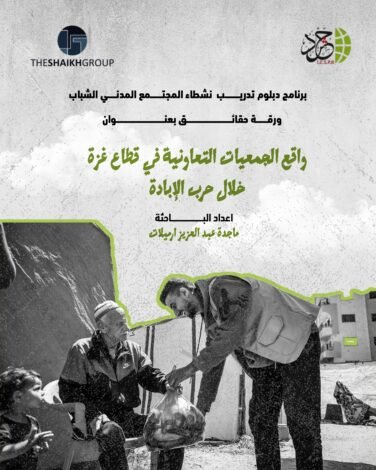
As part of the Youth Civil Society Activists Diploma Program ICSPR issues a fact sheet titled: “Cooperative Societies in the Gaza Strip A Lever for Economic Resilience in the Face of War and Collapse

Date: 3 June 2026
Press Release
As part of the Youth Civil Society Activists Diploma Program
ICSPR issues a fact sheet titled: “Cooperative Societies in the Gaza Strip: A Lever for Economic Resilience in the Face of War and Collapse”
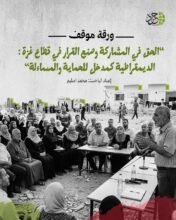
The International Commission to Support Palestinian People’s Rights (ICSPR), as part of the Youth Civil Society Activists Diploma Program, has issued a fact sheet on the reality of cooperative societies in the Gaza Strip and their role in mitigating the effects of war and economic collapse. Prepared by researcher Majda Abdel Aziz Armailat, the paper focuses on the structural, legal, and financial challenges that limit the effectiveness of this sector despite its growing importance as a tool for community and economic resilience.
The fact sheet explains that cooperative societies in the Gaza Strip have helped save many people from deteriorating economic conditions amid more than 16 years of blockade and division, and the absence of official policies capable of addressing the catastrophic consequences of the war. It notes in particular that unemployment during the war reached around 80% in the Gaza Strip, compared with about 34% in the West Bank, making cooperatives a practical outlet for a growing number of individuals and families.
The paper indicates that the number of cooperative societies in the Gaza Strip reached 25, operating in agricultural, service, consumer, housing, and craft sectors, alongside youth-led entrepreneurial initiatives and simple cooperative models that emerged in recent years in response to difficult living conditions. It also notes that the total number of active cooperative societies in Palestine stands at around 369, including 344 in the West Bank and 25 in the Gaza Strip, distributed across five main sectors, while the contribution of Palestinian cooperatives to cooperative production remains below 1% compared with a global average of about 12%, reflecting the need for greater development and institutional support for this sector.
The fact sheet reviews a number of practical examples of the role cooperatives play in alleviating the humanitarian and economic crisis, noting that bread cooperatives in Khan Younis produce around 7,000 loaves of traditional bread daily and distribute them free of charge to displaced people. It also highlights the important role played by women’s cooperative associations in supporting dozens of women economically, socially, and psychologically through income-generating initiatives, including the manufacture and sale of toys, fabric recycling, and similar activities.
The paper shows that this role faces complex challenges related to blockade and closure, difficulty in accessing markets, the energy crisis, declining purchasing power, the weakness of the official support environment for cooperative work, and poor coordination among actors in the sector. It further points to shortages in marketing, management, and technical advisory expertise, as well as the insufficient use of government budget allocations and available financial and tax support mechanisms. The fact sheet also states that cooperative societies face legal and financial constraints linked to registration procedures, membership requirements, share values, and annual fees, at a time when poverty rates have exceeded 93%, more than 75% of the population suffers from food insecurity, and over 95% of the population depends on humanitarian assistance.
The paper further notes that the war caused a decline in gross domestic product of more than 84% and a drop in economic activity ranging between 83% and 98% due to Israeli restrictions, the isolation of the Strip, and the continued closure of humanitarian and commercial crossings. It adds that labor force participation fell to around 38%, while the number of unemployed persons in Palestine rose to about 550,000, including more than 250,000 who lost their jobs after the war. According to the fact sheet, these indicators reflect an extremely harsh environment that makes support for the cooperative economy an urgent national necessity rather than merely a development option.
On the legal and institutional level, the paper highlights that the currently applicable cooperative law imposes financial and procedural conditions that are burdensome under the existing economic collapse, including a minimum requirement of 15 members to register a cooperative, a share value of around 350 Jordanian dinars, in addition to membership fees of approximately 150 dinars and around 500 dinars annually. It adds that these conditions limit the establishment of new cooperatives and place further burdens on existing ones, while legal provisions related to share valuation and annual profit allocations also require amendment in order to ensure fairness to new members and strengthen engagement in cooperative work.
The fact sheet concludes with a set of recommendations, most notably urging the competent authorities to amend the legislation regulating cooperative work by lowering the minimum number of members required for establishment, reducing share values and annual membership fees, and changing the official designation from “cooperative society” to simply “cooperative” in order to end the conceptual confusion between cooperatives and charitable associations. It also recommends simplifying procedures for opening bank accounts and conducting withdrawals and deposits, accelerating the disbursement of due tax exemptions and rebates, allocating part of the government budget and Ministry of Labor funds to finance the activities and projects of struggling cooperatives, and integrating and supporting women’s groups working in the unregulated cooperative sector.
ICSPR affirms that this fact sheet comes within the framework of efforts aimed at enhancing awareness of the vital role that cooperatives can play in protecting the Palestinian social and economic fabric and in developing tools of local resilience amid war, blockade, and economic collapse, in a way that supports people’s steadfastness on their land and strengthens the foundations of a resilient economy.
It should be noted that this fact sheet does not necessarily reflect the views of ICSPR or The Shaikh Group (TSG)