
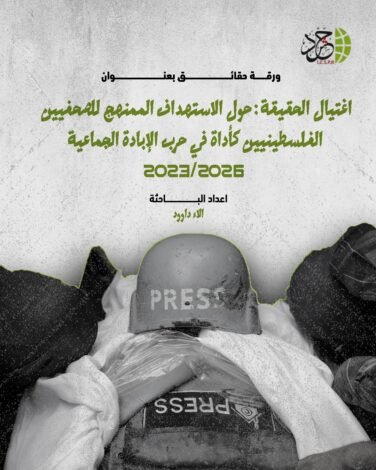
“ICSPR” Issues a Fact Sheet Titled Assassinating the Truth: The Systematic Targeting of Palestinian Journalists as a Tool in the Genocidal War (2023–2026)

Date: 2 June 2026
Press Release
The International Commission “ICSPR” Issues a Fact Sheet Titled: “Assassinating the Truth: The Systematic Targeting of Palestinian Journalists as a Tool in the Genocidal War (2023–2026)”
The International Commission to Support Palestinian Rights “ICSPR” has issued a fact sheet prepared by researcher Alaa Dawood titled: “Assassinating the Truth: A Fact Sheet on the Systematic Targeting of Palestinian Journalists as a Tool in the Genocidal War (2023–2026).” The paper examines the dangerous escalation in crimes targeting Palestinian journalists during the ongoing genocidal war, viewing this targeting as a systematic policy aimed at isolating the Gaza Strip informationally, erasing evidence, and eliminating witnesses to the crimes committed against civilians.
The paper affirms that journalism in Palestine is no longer merely a profession for conveying news, but has become an act of survival and resistance for which journalists are paying with their lives, bodies, and families. In this context, the Palestinian journalist has moved from being a “conveyor of events” to becoming the “direct target” within a strategy aimed at assassinating the Palestinian narrative and preventing the truth from reaching the world.
According to the data reviewed in the paper, 262 Palestinian journalists and media workers have been killed since October 2023, a highly unprecedented figure that reflects the scale of the systematic targeting of Palestinian media workers and indicates that these crimes cannot be treated as incidental events or collateral damage. The paper also documents the killing of 713 family members of journalists, in a dangerous indication of the use of collective punishment and psychological terror to pressure journalists and deter them from continuing their media work.
The paper explains that the violations have not been limited to killings, but have also included 188 arrests of journalists, 50 of whom remain in detention, in addition to cases of enforced disappearance, as well as the destruction of 187 media institutions and 140 homes belonging to journalists. This reflects an organized effort to dismantle the infrastructure of Palestinian media and strip it of its ability to document, publish, and function institutionally. It also notes that the total number of violations committed against journalists between 2023 and 2026 reached 3,983, including direct gunfire, physical assaults, confiscation of equipment, travel bans, and the use of tear gas and sound bombs against press crews.
In analyzing these figures, the paper argues that the numerical intensity of the targeting of journalists within a narrow geographic area and over a short period reveals a premeditated intent to eliminate “eyewitnesses” who document criminal evidence of genocide, and to create an information vacuum that allows the Israeli narrative to dominate without field-based rebuttal. It also considers the targeting of journalists’ families to be a form of “moral assassination” and psychological terror, constituting a compound war crime that combines the targeting of civilians with unlawful pressure on freedom of expression and journalistic work.
The paper further highlights that the destruction of media institutions is not limited to buildings and equipment, but falls within a broader attempt to uproot the Palestinians’ visual memory and eliminate the logistical and organizational capacity of media institutions, thereby forcing journalists to work individually in extremely dangerous conditions and without protection or institutional support. It also stresses that administrative detention, inhuman conditions of confinement, and enforced disappearance are tools used to silence the word and suppress the Palestinian media voice.
On the legal level, the paper affirms that journalists in areas of armed conflict enjoy dual legal protection as civilians under Article 79 of Additional Protocol I to the Geneva Conventions, in addition to the broader protections guaranteed by international humanitarian law and international human rights law. It notes that UN Security Council Resolution 2222 emphasized the need to protect journalists, media professionals, and media facilities as civilian objects, which makes the direct targeting of journalists or media institutions an intentional war crime.
The paper argues that attempts by the occupation to strip journalists of legal protection by labeling them as terrorists or inciters merely for reporting on the facts of the aggression constitute a legal manipulation aimed at justifying their physical liquidation and removing their international immunity. It also stresses that the continued targeting of journalists despite their wearing clearly marked PRESS protective gear proves criminal intent and deliberateness, transforming these acts from isolated incidents into crimes against humanity falling within the jurisdiction of the International Criminal Court.
The paper concludes with a set of demands and recommendations, foremost among them urging the International Criminal Court to expedite investigations into the killings of Palestinian journalists, treat them as an integral part of the genocide case, and issue arrest warrants for the Israeli officials responsible. It also calls on the International Federation of Journalists and UNESCO to take legal and professional punitive measures, on the International Committee of the Red Cross to act to clarify the fate of missing journalists and visit imprisoned journalists, and on the international community to impose a ban on the export of military technologies used in the targeted killing of journalists.
The International Commission “ICSPR” affirms that this paper comes within the framework of its efforts to expose the systematic crimes committed against Palestinian journalists, protect the right to truth, and defend press freedom as an inseparable part of the protection of civilians and the accountability of perpetrators of international crimes.