
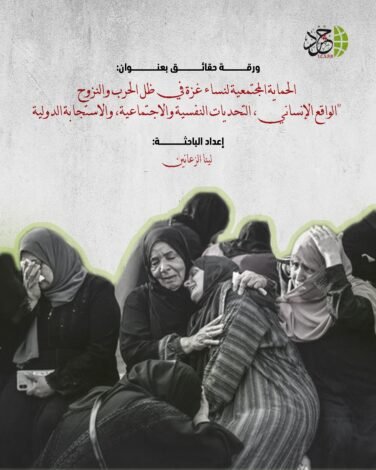
ICSPR Issues a Fact Sheet Titled “Community Protection for Women in Gaza Amid War and Displacement”

Date: 26 May 2026
Press Release
The International Commission “ICSPR” Issues a Fact Sheet Titled: “Community Protection for Women in Gaza Amid War and Displacement”
The International Commission to Support Palestinian Rights “ICSPR” has issued a fact sheet prepared by researcher and psychologist Dr. Lina Al-Za’anin titled: “Community Protection for Women in Gaza Amid War and Displacement: The Humanitarian Reality, Psychological and Social Challenges, and the International Response.” The paper addresses the catastrophic humanitarian conditions facing Palestinian women in the Gaza Strip since the outbreak of the war on 7 October 2023, amid intense bombardment, repeated forced displacement, and the near-total collapse of infrastructure and basic services.
The paper explains that women and girls in Gaza face compounded and escalating risks, including gender-based violence, insecurity, starvation, and deprivation of healthcare, in addition to severe psychological and social deterioration at the family and community levels. At the same time, women are carrying multiple burdens beyond human capacity, including the loss of family members, caring for children, the sick, and the wounded, and the daily struggle to secure food and water in displacement settings that lack the minimum standards of privacy and human dignity.
The paper indicates that repeated mass displacement has led to the breakdown of traditional family and community support networks and has contributed to rising levels of chronic fear, anxiety, and deep psychological trauma among women and girls, amid an almost complete absence of mental health services and specialized protection mechanisms. It also affirms that women in Gaza are subjected to grave and systematic violations of international humanitarian law and international human rights law, ranging from direct targeting and deliberate deprivation of basic biological and health needs to exposure to violence and exploitation in overcrowded displacement centers.
In its presentation of the reality of community protection, the paper explains that displaced women are living in worn-out tents or overcrowded shelters that lack the conditions for safe life, with a total absence of privacy, severe water and environmental insecurity, increasing risks at night, and heightened exposure to harassment and exploitation due to the absence of safe spaces and the weakness of community protection systems. It also points to the worsening of gender-based violence, including domestic violence, exploitation linked to the need for aid, and forced early marriage, amid the collapse of the legal and security system and the difficulty of accessing reporting and support mechanisms.
The paper highlights that the policy of siege and starvation has aggravated women’s suffering in an unprecedented manner, as women bear the responsibility for managing the family’s daily shortages of resources, including the lack of quality food and safe drinking water, as well as the crisis of hygiene and menstrual health and the related skin diseases and infections caused by the absence of sanitary supplies, water, and privacy. It also addresses the near-total collapse of the healthcare system and the tragic consequences this has had for women’s reproductive and mental health, especially pregnant women who face the risk of death or miscarriage and who are often forced to give birth in tents or shelters in unsafe conditions and without adequate medical care.
On the psychological and social level, the paper stresses that women in Gaza are experiencing acute and complex trauma as a result of repeated loss, exposure to scenes of bombardment and destruction, and the experience of displacement under fire. This has led to the widespread prevalence of chronic anxiety, panic attacks, sleep disorders, severe depression, and post-traumatic stress disorder, in addition to the psychological burnout suffered by mothers who are unable to protect their children from fear, hunger, and death. It further notes that the war has destroyed the traditional social structure that used to serve as a source of protection and support for women, deepened forced isolation and loneliness, and pushed women to assume new economic and social burdens, especially as the number of households headed by women has increased due to the killing, injury, or detention of husbands.
The paper discusses the importance of community protection as a fundamental safety valve to reduce the risks facing women and girls amid the collapse of formal institutions, stressing the need to establish safe spaces in or near displacement centers, rebuild local protection committees and women-led initiatives, activate early warning and violence prevention mechanisms, and launch initiatives to support women heads of household economically and reduce their resort to negative coping strategies.
The paper also sheds light on the international legal framework governing the protection of women in armed conflict, noting that the violations committed against women in Gaza constitute a flagrant breach of the Fourth Geneva Convention, UN Security Council Resolution 1325 on Women, Peace and Security, the Convention on the Elimination of All Forms of Discrimination against Women (CEDAW), as well as the rules of international humanitarian law and international human rights law, which prohibit the targeting of civilians and health facilities and the use of starvation and siege as weapons of war.
The paper concludes with a number of urgent demands and recommendations, most notably the immediate cessation of the aggression, the opening of crossings and humanitarian corridors in a safe and sustainable manner, the activation of international accountability for the crimes and violations committed against women, the expansion of protection programs for women and girls in displacement centers, the provision of menstrual hygiene and sanitation supplies, direct economic support for women heads of household, the documentation of violations in preparation for accountability, and the strengthening of reproductive health services and psychological first aid as part of the emergency humanitarian response.
The International Commission “ICSPR” affirms that this paper comes within the framework of its efforts to highlight the gendered dimensions of the war on the Gaza Strip, expose the compounded violations to which women are subjected, and push for an urgent international response that guarantees protection, dignity, and psychological, social, and legal support for women in Gaza.