
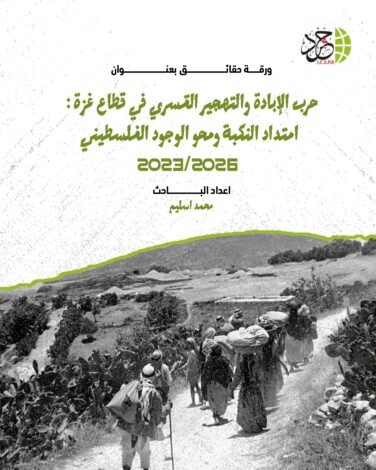
ICSPR Issues a Fact Sheet Titled: “The War of Genocide and Forced Displacement in the Gaza Strip: The Continuation of the Nakba and the Erasure of the Palestinian Presence (2023–2026)

Date: 15 May 2026
Press Release
The International Commission “ICSPR” Issues a Fact Sheet Titled: “The War of Genocide and Forced Displacement in the Gaza Strip: The Continuation of the Nakba and the Erasure of the Palestinian Presence (2023–2026)”
The International Commission to Support Palestinian Rights (ICSPR) has issued a fact sheet prepared by researcher Mohammed Aslim titled: “The War of Genocide and Forced Displacement in the Gaza Strip: The Continuation of the Nakba and the Erasure of the Palestinian Presence (2023–2026).” The paper highlights the humanitarian, political, and legal dimensions of the ongoing war of genocide in the Gaza Strip, describing it as a direct continuation of the policies of uprooting and forced displacement that began with the Palestinian Nakba in 1948.
The fact sheet explains that more than 2.4 million Palestinians in the Gaza Strip have faced, since October 2023, an unprecedented war marked by large-scale killing, systematic starvation, and the comprehensive destruction of infrastructure and basic means of life, within a context targeting Palestinian physical, human, and political existence. It links what is happening in Gaza today to the historic Nakba, during which more than 750,000 Palestinians were displaced and hundreds of Palestinian towns and villages were destroyed, revealing the continued logic of displacement and erasure of Palestinian existence.
According to the figures presented in the fact sheet, the ongoing war on the Gaza Strip has lasted for more than 930 days and has resulted in comprehensive destruction exceeding 88 percent, direct economic losses surpassing 70 billion US dollars, military control over roughly 60 percent of the Strip, and repeated bombardment of areas declared “safe,” including Al-Mawasi, dozens of times. ICSPR stresses that these figures reflect a systematic policy that targets not only people, but also the conditions necessary for their survival and continued presence on their land.
Regarding human losses, the fact sheet documents that the total number of those killed and missing has exceeded 72,580 Palestinians, including more than 57,000 killed whose bodies reached hospitals, 9,500 missing persons, more than 20,000 children, 12,500 women, 8,000 mothers, 1,670 medical personnel, and 262 journalists, in addition to more than 16,000 massacres and 22,000 families wiped out in their entirety. These figures demonstrate the scale of the systematic targeting of Palestinian families and the resulting gradual erasure of Palestinian social and national memory.
The paper also records the catastrophic humanitarian impact of the war, noting that the number of wounded has reached 172,237, including more than 6,000 amputees and 19,000 injured persons requiring long-term rehabilitation, in addition to more than 22,057 widows and 64,616 orphans, as well as the widespread spread of infectious diseases and hepatitis cases. ICSPR stresses that these numbers reveal a prolonged catastrophe that does not stop at direct losses, but strikes at the core of Palestinian social structure.
The fact sheet highlights the systematic targeting of the health sector through the destruction of or forced shutdown of 38 hospitals, the targeting of 82 medical centers, 164 health institutions, 144 ambulances, and 54 civil defense vehicles. It further notes that this destruction has also affected Palestinian educational infrastructure, with 145 educational institutions completely destroyed and 367 partially destroyed, more than 13,500 students and 830 teachers killed, and over 785,000 students deprived of their right to education.
On housing and displacement, the fact sheet confirms the complete destruction of 268,000 housing units, 148,000 units rendered uninhabitable, and 135,000 partially damaged units, leaving 290,000 families without shelter and displacing more than 1.7 million Palestinians. It also notes that the targeting of shelters, including those run by UNRWA, carries not only a humanitarian dimension but also a political one, as it targets the international institution historically associated with the Palestinian refugee question and the right of return since the Nakba of 1948.
The paper further indicates that starvation and siege have become central features of this war, amid the prolonged closure of the Rafah crossing, the prevention of the entry of more than 100,000 aid trucks, and the existence of tens of thousands of children at risk of dying from hunger, alongside thousands of patients in need of treatment abroad, including cancer patients, people with chronic illnesses, and pregnant women facing severe danger. ICSPR emphasizes that the use of siege and starvation in this manner constitutes a compound international crime aimed at breaking the will of the population and pushing them toward forced displacement.
With regard to infrastructure and national identity, the fact sheet records the destruction of 725 water wells, 5,080 kilometers of electricity networks, more than 350,000 meters of water networks, more than 700,000 meters of sewage networks, and 227 government buildings. It explains that the destruction of these facilities is not limited to their service function, but also aims to undermine the Palestinian administrative and political structure and weaken the ability of Palestinian society to manage its civil and service affairs, reflecting an attempt to dismantle the institutional Palestinian entity in the Gaza Strip.
The paper also reviews the scale of losses in the agricultural and environmental sector, where losses have exceeded 2.5 billion US dollars, more than 94 percent of agricultural land has been destroyed, vegetable production has dropped from 405,000 tons to 28,000 tons, more than 89 percent of greenhouses have been destroyed, and the fishing sector has been completely devastated. The Commission considers this targeting part of a comprehensive policy aimed at destroying sources of food, life, resilience, and survival.
In conclusion, ICSPR affirms that what is taking place in the Gaza Strip goes beyond a military operation and amounts to a systematic pattern of genocide and forced displacement, expressed through the comprehensive destruction of the conditions of life, the direct targeting of civilians and Palestinian families, the use of starvation and siege as weapons of war, the erasure of Palestinian identity and institutional structure, and the reproduction of Nakba scenes in a more violent and expansive form.
The International Commission “ICSPR” calls on the international community, the United Nations, and the States Parties to the Geneva Conventions to take urgent action to stop the war of genocide, ensure the protection of civilians, open humanitarian corridors, hold accountable those responsible for the international crimes committed against the Palestinian people, and work to end the policies of forced displacement that threaten Palestinian existence and its national future.