
The International Commission “ICSPR” Issues a Position Paper Titled “International Justice in Palestine: Between Exposure, Failure, and Reconfiguration”

Date: 12 May 2026
Press Release
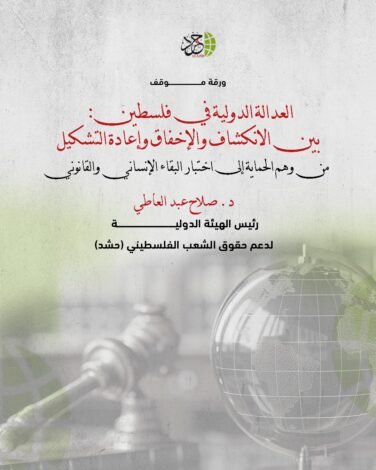
The International Commission “ICSPR” Issues a Position Paper Titled: “International Justice in Palestine: Between Exposure, Failure, and Reconfiguration”
The International Commission to Support Palestinian Rights (ICSPR) has issued a position paper by Dr. Salah Abdel Ati, Chairperson of the Commission, titled: “International Justice in Palestine: Between Exposure, Failure, and Reconfiguration: From the Illusion of Protection to the Test of Human and Legal Survival.” The paper examines how the Palestinian cause, and the Gaza Strip in particular, has shifted from being a political and legal file into a historic test of the international justice system and of the ability of international law and its institutions to protect human beings when they fall outside the maps of global power.
The paper stresses that what has happened and continues to happen in Gaza including large-scale killing, destruction, starvation, displacement, and the full exposure of civilian life no longer raises only a political question, but a deeper one concerning the fate of international justice itself and whether international law can move from the level of texts and principles to actual protection and binding enforcement. It argues that the problem is no longer the absence of legal rules, but the failure to transform them into effective tools of deterrence and protection, making Palestine, and Gaza in particular, a revealing mirror of the gap between law as principle and law as capacity to act.
The paper considers that the modern system of international justice, built around the International Criminal Court and the International Court of Justice, has in the Palestinian case appeared profoundly fragile in terms of executive capacity, despite its dense normative and legal presence. The clearer the crime becomes, the more incapable the international system appears of stopping it, revealing that international justice is not stalled because of a lack of legal definitions, but because of the absence of international political will to transform legal characterization into binding commitment.
In this context, the paper addresses the performance of the International Criminal Court, arguing that while it represents in theory the height of international criminal justice, in practice it remains constrained by the international political environment and by the willingness of states to cooperate in enforcing its decisions and arrest warrants. It notes that the path of justice in the Palestinian case has not been determined by legal texts alone, but has also been shaped by the calculations of major powers and the balance of influence, leaving the Court able to declare some degree of justice without being able to impose or complete it through executive action, even after arrest warrants were issued for Benjamin Netanyahu and Yoav Gallant.
The paper also discusses the role of the International Court of Justice, noting that its rulings and provisional measures in the Palestinian context have acquired major legal and moral significance, especially in light of the orders issued in South Africa v. Israel under the Genocide Convention. However, it argues that the core problem lies in the absence of direct enforcement tools, which leaves the law capable of producing the norm but incapable of imposing it when confronted with the will of international power, turning it into a strong legal and moral voice without the practical ability to stop the bloodshed.
The paper highlights Gaza as the ultimate moment of exposure for international humanitarian law, where the issue is not isolated violations but a comprehensive assault on the conditions of human life itself, including attacks on civilians, children, women, medical teams, journalists, and humanitarian workers, the destruction of civilian infrastructure, the collapse of the health system, the targeting of water, food, and energy networks, and the use of siege, starvation, and forced displacement as tools of coercion and domination. It argues that the cruelest paradox lies not only in the scale of these violations, but in their continuation despite their legal and human clarity, which has stripped the law of its essential protective function and, in many cases, reduced it to a mechanism for documenting catastrophe after the fact.
In its reading of the broader international order, the paper argues that the crisis is no longer a passing incapacity but reflects a structural defect in the United Nations and the institutional international system, especially as the Security Council, because of the American veto, has become a space of systematic political paralysis that has emptied the international security system of effectiveness. It also notes that the European Union has remained in a gray zone between advanced rights-based discourse and limited political practice, without real ability to turn its positions into effective tools of pressure.
The paper stops at proposals that have emerged for managing the post-war phase, including what is referred to as the “Gaza Board of Peace,” arguing that these proposals do not offer a genuine political solution so much as they reorganize and manage the crisis, transforming the Palestinian question from one of liberation, rights, and self-determination into an administrative and technical file focused on relief, reconstruction, population management, and security arrangements without addressing the roots of the conflict in occupation and Palestinian rights. It holds that such formulas open the door to re-engineering international crisis management mechanisms outside the UN framework without guaranteeing protection, ending the war, or addressing the structural causes of the catastrophe.
The paper also addresses the growing trend toward criminalizing solidarity with Palestine in several Western states through restrictions on student movements, targeting of rights-based and civil activism, limitations on freedom of expression, and the reframing of solidarity as a security or ideological threat. It argues that this shift affects not only Palestine, but also strikes at one of the most important foundations of the global human rights system the right to expression, civic action, and human solidarity and confirms that the conflict is no longer managed only on the ground, but also in the realm of consciousness, narrative, and global public space.
The paper further stresses that the Palestinian case has exposed a stark pattern of double standards in the application of international law, where the speed of international response, the level of political pressure, and the nature of sanctions differ according to the actor’s place within the international order rather than the nature of the crime itself. It concludes that when justice becomes selective, it loses its universal meaning and is transformed from a global legal principle into a tool reshaped according to maps of power and influence.
In light of this structural exposure, the paper calls for thinking about alternative paths to reshape tools of pressure and justice outside the traditional formal structure, including activating universal jurisdiction, building cross-border legal alliances, expanding global popular mobilization, activating boycott and sanctions tools, developing transnational digital and rights-based spaces to protect the Palestinian narrative, and building a “global civic league” capable of redefining justice from the bottom up.
In its conclusion, the paper emphasizes that what is happening in Gaza threatens not only Palestinians, but the very idea of shared humanity, and exposes at once the limits of international law and the limits of the global conscience. It stresses that Palestine, and Gaza in particular, is no longer only the site of a humanitarian tragedy, but has become an open historical question as to whether it is still possible to restore international justice as a universal system of equal application, or whether the world is moving toward a multi-speed legal order in which justice is rewritten according to maps of power and influence.