
ICSPR Issues a Policy Paper Titled The Repercussions of the War of Genocide in the Dominance of Monopoly and Economic Distortion as a Tool to Weaken the Economy and Erode Civil Peace in the Gaza Strip

Date: May 11, 2026
Press Release
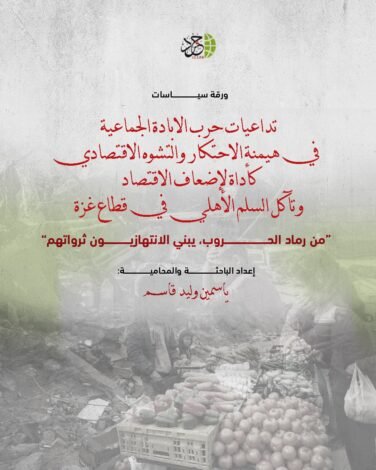
The International Commission “ICSPR” Issues a Policy Paper Titled: “The Repercussions of the War of Genocide in the Dominance of Monopoly and Economic Distortion as a Tool to Weaken the Economy and Erode Civil Peace in the Gaza Strip”
The International Commission to Support Palestinian Rights (ICSPR) has issued a policy paper prepared by lawyer Yasmin Qassem titled: “The Repercussions of the War of Genocide in the Dominance of Monopoly and Economic Distortion as a Tool to Weaken the Economy and Erode Civil Peace in the Gaza Strip.” The paper examines the profound impact of the war of genocide on Gaza’s economic and social structure, and how siege, massive destruction, and the disabling of protection and oversight institutions have created fertile ground for monopoly, market distortion, and expanding patterns of economic exploitation.
The paper stresses that the war of genocide against the Gaza Strip since 7 October 2023 has not been limited to large-scale human and urban destruction, but has also produced a systematic collapse in the foundations of the local economy, in a context that may be described as “economic extermination,” through the destruction of productive sectors, the disruption of trade, the targeting of infrastructure, and the control of crossings and the flow of goods, fuel, and aid, which has weakened resilience and recovery and created a distorted economy based on scarcity, exclusion, and dependency.
It explains that this reality was accompanied by a deep vacuum affecting institutions of protection, oversight, and the rule of law, as a result of the systematic Israeli targeting of legal and administrative structures and enforcement mechanisms, thereby opening the way for the rise of monopolistic networks and parasitic groups that benefited from the general collapse and worked to control the flow of goods and set prices in the local market through coordination mechanisms with the occupation authorities, concentrating wealth and influence in the hands of a limited group at the expense of the overwhelming majority of the population.
The paper notes that monopoly in the Gaza Strip is no longer merely an economic phenomenon linked to starving markets and raising prices, but has become one of the most dangerous manifestations of the war economy, with serious ethical and social dimensions, as it threatens food and health security and pushes the most vulnerable groups to the brink of being unable to secure the minimum requirements for life, at a time when black markets, theft of humanitarian aid, and its resale at inflated prices have increased, reflecting the collapse of economic and social justice.
In reviewing the effects of the war on the Palestinian economy in Gaza between 2023 and 2026, the paper indicates that Israeli policies directly targeted the industrial, agricultural, and commercial sectors and led to a sharp contraction in GDP, a near-total collapse of productive sectors, unprecedented rises in unemployment and poverty, and a dramatic fall in per capita income, alongside the erosion of household purchasing power due to soaring prices, loss of income sources, and widening dependence on humanitarian aid. World Bank-linked reporting cited in recent economic updates indicates that Gaza’s GDP contracted by about 83 percent in 2024, with further decline or stagnation into 2025 despite temporary low-base statistical fluctuations, reflecting destruction rather than recovery.
The paper also addresses the condition of Gaza’s commercial sector under siege policies and Israeli control over crossings, explaining that the occupation has transformed crossings from humanitarian and commercial entry points into primary tools for managing the internal economy and controlling the volume, type, and timing of supplies, which has directly affected the availability of goods and their prices in the market. It adds that tighter restrictions on external trade, and the opening and closing of crossings in a partial and selective manner, have disrupted supply chains, created favorable conditions for the concentration of goods in the hands of a limited number of traders and intermediaries, weakened competition, and deepened economic dependency and daily hardship.
The paper sheds light on the monetary and financial distortions accompanying these transformations, including cash liquidity paralysis, erosion of circulating cash, refusal to deal with certain denominations, and the rise of the “cash-out” phenomenon through which citizens lose a substantial portion of their transfers in exchange for liquidity, producing serious distortions in the financial system, reproducing informal relations based on exploitation and financial brokerage, and increasing the population’s living burdens.
In its conceptual framework, the paper discusses the concept of monopoly and its various forms in economic theory before applying these patterns to the Gaza Strip under the war of genocide, concluding that what is taking place does not fall within the bounds of traditional monopoly, but rather constitutes a “coercive monopoly” resulting from the occupation’s control over crossings and the creation of managed scarcity in a forcibly distorted market, where import and distribution operations are confined to a narrow circle of intermediaries and traders able to access permits and coordination mechanisms, granting them real control over supply and prices.
The paper further stresses that this pattern of coercive monopoly has led to an unequal redistribution of economic influence within society, as a limited commercial class has emerged linked to supply routes and market control, while the role of the rest of the traders has declined, large numbers have been pushed out of effective economic activity, and the market has turned into an unstable black market where prices are managed outside any fair regulatory framework. It adds that this reality has had a direct impact on the social structure by widening gaps between groups, eroding social trust, weakening values of solidarity, and intensifying social tension, in ways that threaten civil peace and undermine social cohesion in the Gaza Strip.
ICSPR concludes in the paper that the continuation of these policies and practices, in the absence of effective intervention and real oversight mechanisms, will further deepen economic and social fragility and contribute to reshaping society on the basis of scarcity, monopoly, and dependency, making the issue not merely an economic crisis but a direct threat to social stability, economic justice, and the future of recovery in Gaza.
In its conclusion, the paper calls for the formulation of urgent economic and social recovery policies to curb the expansion of monopoly, strengthen market oversight, ensure fair access to essential goods, and confront illegal forms of exploitation and brokerage, in parallel with efforts to end the siege and ensure the regular, sufficient, and safe flow of goods and aid through the crossings. It also stresses the need to support the foundations of economic justice, protect civil peace, and strengthen Palestinian societal resilience in the face of policies of impoverishment, subjugation, and systematic dismantling.