
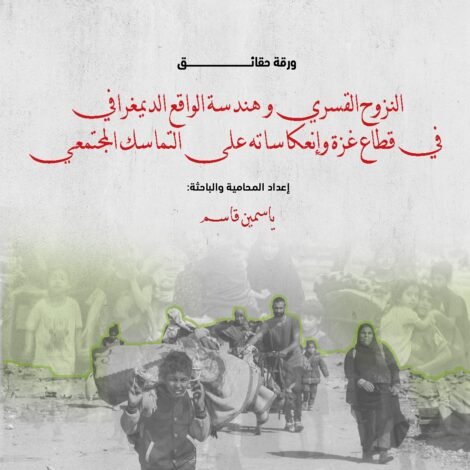
ICSPR Issues Fact Sheet Titled: Forced Displacement and the Engineering of Demographic Reality in the Gaza Strip and Its Implications for Social Cohesion

Date: February 27, 2026
Press Release
ICSPR Issues Fact Sheet Titled: Forced Displacement and the Engineering of Demographic Reality in the Gaza Strip and Its Implications for Social Cohesion
The International Commission to Support Palestinian Rights – ICSPR issued a fact sheet titled “Forced Displacement and the Engineering of Demographic Reality in the Gaza Strip and Its Implications for Social Cohesion,” prepared by researcher Yasmin Qassem. The paper examines the profound demographic and social transformations experienced in the Gaza Strip during two years of ongoing genocide between 2023–2025, and the accompanying policies of forced displacement and systematic destruction targeting both people and the social structure alike.
The paper emphasizes that the war was not limited to military targeting; rather, it constituted a systematic process of social dismantling aimed at the internal fabric of Palestinian society in Gaza. By employing forced displacement as a weapon of war and collective punishment, these policies led to the fragmentation of thousands of families, the collapse of social protection systems, and deep demographic and geographic changes that affected the structure and internal stability of society.
The fact sheet presents alarming figures reflecting the scale of the humanitarian catastrophe. The total number of victims reached 72,027 killed and missing, with more than 171,000 injured. Over 2,800 families were completely wiped out, and nearly two million people were forcibly displaced. Approximately 90% of the Strip’s infrastructure was destroyed, including more than 268,000 housing units completely demolished, leaving hundreds of thousands of families homeless amid widespread targeting of hospitals, schools, shelters, and water and electricity networks.
The paper further notes that children and women constituted approximately 70% of the total victims, with tens of thousands of orphans, thousands of amputation cases, and rising rates of malnutrition and miscarriages—factors that have deepened the fragility of the social structure and exacerbated long-term psychological and social challenges.
Within its conceptual framework, the paper defines social cohesion as the structural bond that unites members of society through trust, solidarity, belonging, and collective action, stressing that in contexts of conflict and occupation, social cohesion shifts from a social value to an essential condition for survival and resilience. It draws on international definitions, including that of UNESCO, which describes social cohesion as the “glue” that binds society together.
The paper explains that social cohesion in Gaza has been severely strained due to forced displacement and geographic fragmentation. However, it has not entirely collapsed; rather, it has manifested through individual and collective community initiatives, particularly led by youth, who played a central role during the war in supporting displaced persons, providing relief assistance, and preserving a minimum level of civil peace under catastrophic conditions.
The fact sheet also addresses Gaza’s demographic framework prior to the war, noting that the Strip covers approximately 365 square kilometers and was home to around 2.2 million people, about 67% of whom are refugees. Any forced alteration in this demographic composition therefore carries profound political and national implications that extend beyond the immediate humanitarian dimension.
The paper concludes that rebuilding social cohesion is no less important than physical reconstruction; indeed, it constitutes a fundamental prerequisite for stability and for preventing long-term societal fragmentation. It stresses that internal unity cannot be achieved in the absence of justice and while the consequences of genocide persist, and that investing in strengthening the social fabric represents a cornerstone for any sustainable recovery process in the Gaza Strip.