
ICSPR: The Reconstruction of the Gaza Strip Between Relief and Political Trusteeship… Reconstruction Is a Legal Right, Not a Conditional Grant

Date: January 31, 2025
Press Release
ICSPR: The Reconstruction of the Gaza Strip Between Relief and Political Trusteeship… Reconstruction Is a Legal Right, Not a Conditional Grant
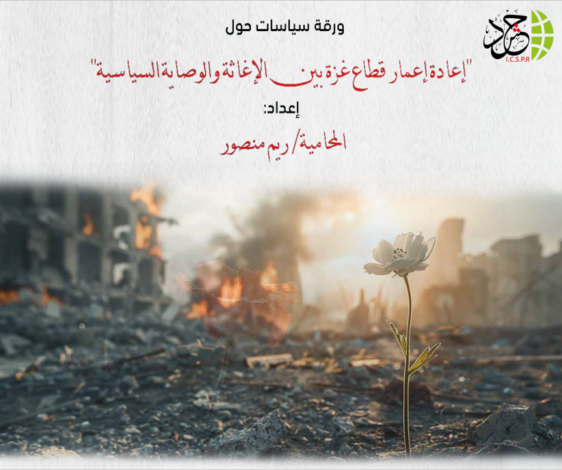
The International Commission to Support Palestinian People’s Rights (ICSPR) has issued a policy paper titled “The Reconstruction of the Gaza Strip Between Relief and Political Trusteeship,” prepared by attorney Reem Mansour. The paper examines the structural and political challenges surrounding the reconstruction of the Gaza Strip, warning against transforming reconstruction from an inherent legal right into a tool of political pressure and international trusteeship imposed outside the Palestinian will.
The paper stresses that the reconstruction of Gaza cannot be treated as a purely humanitarian or technical matter, but rather as a political and legal issue directly linked to the continuation of occupation and siege. It notes that past experiences have revealed a deliberate conflation between emergency humanitarian relief and reconstruction and development processes, which has kept Gaza in a permanent state of emergency and prevented sustainable recovery.
The paper explains that humanitarian relief, by nature, aims to respond to immediate crises by providing food, water, and temporary shelter, whereas reconstruction is a comprehensive development process that includes rebuilding infrastructure, housing, health and educational facilities, and reviving the local economy. Reconstruction, it emphasizes, is a legal and sovereign right of the Palestinian people that must not be subjected to political or security conditions.
The paper highlights the unprecedented scale of destruction caused by the Israeli aggression against the Gaza Strip, during which hundreds of thousands of housing units were completely or partially destroyed, most hospitals, health centers, and schools suffered severe damage, and water and sanitation networks were extensively destroyed. It also points to the presence of tens of millions of tons of rubble and thousands of unexploded ordnance buried under the debris, posing a constant threat to civilians’ lives and obstructing serious reconstruction efforts, particularly amid Israel’s continued ban on the entry of heavy machinery and equipment.
ICSPR affirms that this massive destruction entails a direct legal responsibility on the occupying power under international humanitarian law, particularly the Geneva Conventions, which obligate an occupying power to protect civilians and their property, provide reparations, and rebuild what it has destroyed. The Commission stresses that shifting the burden of reconstruction onto the international community without holding the occupation accountable entrenches impunity and strips international law of its substance.
The paper warns of the growing manifestations of political trusteeship over the reconstruction file, through international and regional mechanisms that bypass Palestinian institutions and authorities, and link reconstruction to ceasefires or prior security conditions, including the disarmament of the resistance and the imposition of international security arrangements—turning reconstruction into a means of political control rather than a path toward recovery and development.
The paper also addresses the U.S. approach advanced during the administration of former President Donald Trump, which explicitly linked Gaza’s reconstruction to the disarmament of Palestinian factions and the imposition of a transitional administration and international oversight mechanisms. It argues that this approach exploits civilians’ humanitarian needs as a tool of political coercion and undermines reconstruction as a non-negotiable legal right.
The paper further notes that the multiplicity of actors involved in Gaza’s reconstruction—including donor states and international organizations—does not reflect a balanced partnership, but rather marginalizes the Palestinian role in setting priorities and implementation mechanisms. Reconstruction projects are often determined according to donor interests and regional security considerations, rather than an independent Palestinian national vision that responds to the real needs of the population.
In this context, the paper proposes a set of policy alternatives, most notably the establishment of an independent Palestinian mechanism to manage reconstruction, the complete separation of reconstruction from any political or security conditions, a shift from relief-based approaches to sustainable development, the strengthening of the local private sector, and the active involvement of civil society in planning and oversight to ensure transparency and accountability.
In conclusion, ICSPR affirms that any serious path toward reconstructing the Gaza Strip must be grounded in the recognition of reconstruction as a legal and sovereign right of the Palestinian people, not a conditional grant, and must be linked to ending the occupation and the siege as the root causes of repeated destruction. The Commission warns that continued political trusteeship over reconstruction will only reproduce crises and keep Gaza hostage to aggression and international blackmail.