
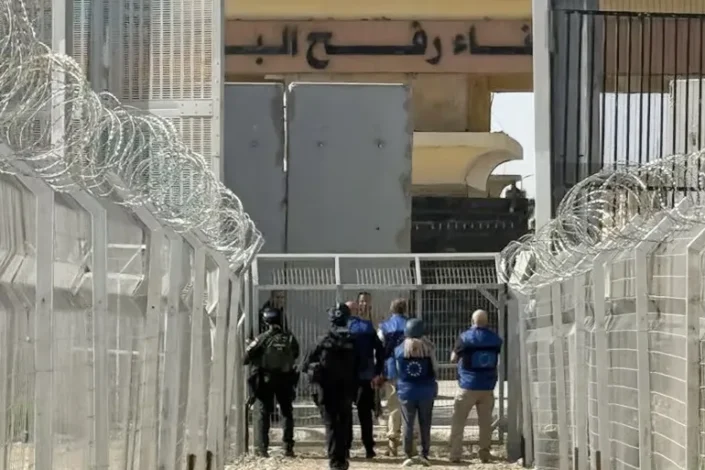
ICSPR Submits an Urgent Briefing Memorandum on Israeli Restrictions at Rafah Crossing and Their Health and Humanitarian Implications in the Gaza Strip
 wasem aa
Send an email
wasem aa
Send an email
Date: February 23, 2025
Press Release
ICSPR Submits an Urgent Briefing Memorandum on Israeli Restrictions at Rafah Crossing and Their Health and Humanitarian Implications in the Gaza Strip
The International Commission to Support Palestinian Rights – ICSPR submitted an urgent and comprehensive briefing memorandum to a number of international and UN bodies, including the UN Special Rapporteur on the situation of human rights in the Palestinian territories occupied since 1967, Francesca Albanese, the Office of the United Nations High Commissioner for Human Rights, the Office of the Prosecutor of the International Criminal Court, the International Court of Justice, the United Nations Human Rights Council, the International Committee of the Red Cross, the European Union Human Rights Mission, ambassadors of the states sponsoring the ceasefire agreement, as well as the League of Arab States, the Organisation of Islamic Cooperation, and international human rights organizations.
In its memorandum, ICSPR affirmed that the restrictions imposed on the operation of the Rafah land crossing from the Palestinian side—still effectively controlled by Israeli occupation forces—have gone beyond mere administrative measures and have become a systematic policy based on stringent security restrictions, humanitarian coercion, and the transformation of fundamental rights, particularly freedom of movement and access to medical treatment, into tools of political and security pressure.
ICSPR explained that the partial reopening of the crossing on February 2, 2026, after being closed since May 2024, took place amid continued effective Israeli control over movement, despite its opening from the Egyptian side since October 2023. The current mechanism, it noted, allows only the passage of individuals without goods or vehicles, requires prior security permits, and subjects returnees to prolonged interrogations and complex inspection procedures—reflecting ongoing Israeli control over civilian movement.
According to the data cited by ICSPR, between February 2 and 18, 2026, only 1,148 travelers were allowed to cross out of 3,400 expected cases (approximately 33%), including 640 departures and 508 returnees. During the first week, only 36 patients were permitted to leave, totaling 196 persons including companions. ICSPR described this number as negligible compared to the scale of the ongoing health catastrophe, with more than 20,000 patients and wounded persons in need of treatment outside Gaza, including thousands of cancer patients and children requiring specialized medical interventions.
The Commission also documented testimonies from returnees who reported being detained for long hours inside military zones, subjected to prolonged interrogations, confiscation of money and belongings, humiliating body and electronic searches, and being held in waiting environments lacking minimum humanitarian standards—constituting, according to ICSPR, patterns of cruel, inhuman, and degrading treatment.
ICSPR stressed that these policies violate the Fourth Geneva Convention, the Universal Declaration of Human Rights, the International Covenant on Civil and Political Rights, and the International Covenant on Economic, Social and Cultural Rights, in addition to contravening the 2005 Agreement on Movement and Access regulating the crossing. It noted that restricting freedom of movement and preventing patients from accessing medical treatment may amount to collective punishment and warrants international accountability.
The Commission called for immediate international pressure to end all forms of Israeli interference in the operation of the crossing and to ensure its permanent and safe opening for patients, the wounded, travelers, and stranded persons without arbitrary security restrictions. It further urged that humanitarian needs be insulated from political bargaining and that international accountability mechanisms be activated to hold those responsible for the continued blockade and obstruction of freedom of movement accountable.
ICSPR concluded by emphasizing that using the crossing as a tool of political pressure endangers civilian lives and undermines the foundations of international humanitarian law, calling on the international community to take urgent and concrete measures to guarantee freedom of travel, safe return for Palestinians, and the protection of their dignity and fundamental rights.