
ICSPR: More than 1,0000 missing and forcibly disappeared in Gaza since October 7… thousands of victims remain under the rubble with an unknown fate

Date: 16 December 2025
Press Release
ICSPR: More than 1,0000 missing and forcibly disappeared in Gaza since October 7… thousands of victims remain under the rubble with an unknown fate
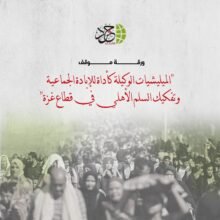
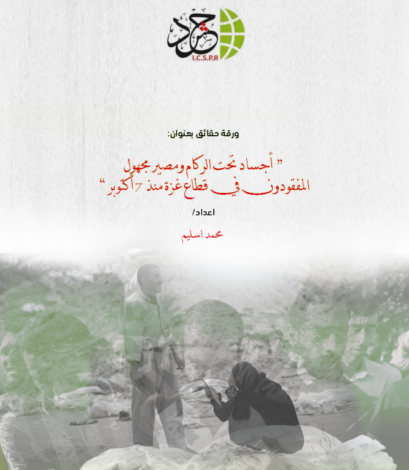
The International Commission to Support Palestinian People’s Rights (ICSPR) issued a new fact sheet entitled “Bodies Under the Rubble and an Unknown Fate: The Missing in the Gaza Strip Since October 7,” prepared by researcher Mohammed Aslim. The paper reveals shocking findings documenting the scale of the crime of enforced disappearance and missing persons in the Gaza Strip since the start of the Israeli assault on October 7, 2023, which has been accompanied by acts of genocide and widespread destruction of civilian and residential infrastructure.
According to the paper, ICSPR documented 10067 reports of missing and forcibly disappeared persons, including 352 cases with a completely unknown fate, amid a lack of official information and the absence of effective search and rescue mechanisms. The data show that 78.37% of the missing are males, while the 18–35 age group represents the highest proportion of recorded cases, reflecting the direct targeting of young people.
The paper indicates that the situation of detainees remains unclear, as 25% of cases received no official response, while other responses stated that no information was available about the reported individuals. In addition, 25 detainees are denied visits, amid the International Committee of the Red Cross being prevented from accessing places of detention.
ICSPR also pointed to international estimates indicating that more than 9,000 victims remain under the rubble, including thousands of children and women, as a result of intensive bombardment, the destruction of residential neighborhoods, the targeting of civil defense teams, and the severe shortage of heavy equipment needed to recover bodies.
The paper confirmed that cases of missing persons and enforced disappearance resulted from a set of overlapping factors, most notably widespread bombardment and civilians being buried under debris, field arrests during ground operations, the transfer of wounded and injured persons to unknown locations, forced displacement and loss of contact between family members, and random burials in mass graves without documentation.
The Commission noted strong indicators of a systematic Israeli policy of enforced disappearance, including the failure to publish detainee lists, the detention of individuals in military bases and undisclosed prisons, the denial of visits, the deliberate use of blackout as a tool of war, and the application of laws that allow detention without trial.
ICSPR stressed that these practices constitute the crime of enforced disappearance under the International Convention for the Protection of All Persons from Enforced Disappearance (2006), and rise to the level of a crime against humanity under Article (7) of the Rome Statute, in addition to forming part of genocide through the imposition of lethal living conditions on the civilian population.
The paper also addressed the catastrophic social, economic, and psychological impacts on families of the missing, including family disintegration, the denial of basic legal rights, worsening economic burdens, and ongoing psychological trauma—especially among women and children who live in a constant state of anxiety and uncertainty.
In conclusion, ICSPR emphasized that the file of missing and forcibly disappeared persons in the Gaza Strip represents one of the most dangerous facets of the ongoing genocide, calling on the international community to take urgent measures, including the formation of an independent international commission of inquiry, pressure on the occupying power to disclose the fate of the missing and detainees, and enabling the Red Cross to visit places of detention without restrictions.
ICSPR further affirmed that continued international silence regarding these crimes contributes to entrenching impunity, urging the United Nations, international justice institutions, and relevant Palestinian authorities to act immediately to guarantee the right to truth and to provide justice to thousands of families who continue to live in hope of finding their loved ones alive or learning their fate.