
ICSPR: Livelihoods of Families in Gaza Have Collapsed After the War… Life After the Rubble Has Become a Daily Struggle for Survival
 wasem aa
Send an email
wasem aa
Send an email
Date: 31 December 2025
Press Release
ICSPR: Livelihoods of Families in Gaza Have Collapsed After the War… Life After the Rubble Has Become a Daily Struggle for Survival
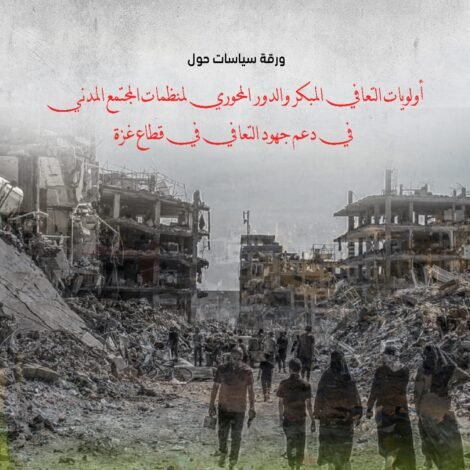
The International Commission to Support Palestinian People’s Rights (ICSPR) has issued a new policy paper entitled “Livelihoods of Families in the Gaza Strip After the War (Life After the Rubble),” prepared by lawyer Reem Mahmoud Mansour. The paper reveals the scale of the social, economic, and humanitarian collapse facing Palestinian families in the Gaza Strip in the post-war phase, amid widespread destruction, loss of income sources, the spread of famine, and the transformation of daily life into continuous attempts to survive.
The paper confirms that the Gaza Strip is experiencing an unprecedented phase of comprehensive deterioration. The impacts of the war have gone beyond human losses and material destruction to strike at ways of life themselves, with the near-total disappearance of traditional livelihoods and the disintegration of the social and economic fabric of families.
ICSPR noted that approximately 2.1 million Palestinians remain in the Gaza Strip out of a total population of 2.4 million, amid ongoing forced displacement. More than 1.7 million displaced persons are living in temporary shelters and rudimentary tents that lack the minimum requirements of life, with dangerous levels of overcrowding reaching more than 15 people per room, a near-total absence of privacy, and severe deterioration in health conditions.
The paper pointed to the near-total collapse of basic services, including a complete electricity blackout, contamination of more than 88% of water wells, and the discharge of sewage directly into streets and the sea. Municipalities, public institutions, and banks have ceased operations, exacerbating the spread of epidemics and diseases and threatening public health, particularly for children and the elderly.
ICSPR stressed that 90% of Palestinian families suffer from food insecurity, while more than 650,000 children face the risk of death by starvation due to shortages of food and infant formula. Rates of acute malnutrition among children and infants have risen to life-threatening levels.
Regarding the health and education sectors, the paper explained that more than 38 hospitals and 96 health centers are out of service, while the few remaining facilities operate without medicines or fuel. Meanwhile, the educational process has completely collapsed, depriving more than 785,000 students of their right to education, in addition to the killing of more than 13,500 students and 830 teachers since the beginning of the aggression.
The paper also highlighted the dangerous economic transformations following the war, as Gaza has witnessed a near-total collapse of productive sectors, with the destruction of 94% of agricultural land and more than 268,000 housing units. Poverty has risen to 90%, and unemployment to 75%, forcing the vast majority of families to rely entirely on humanitarian aid.
ICSPR explained that daily life for families after the rubble has turned into a harsh reality, with tents and damaged buildings becoming forced shelters. Families often rely on only one meal per day, cook using firewood and plastic, and fetch water through long queues that is often contaminated. With the absence of electricity, households depend on dangerous means for lighting and heating. Family roles have also changed dramatically: women bear the greatest burden of managing daily life, men have lost their ability to provide for their families, and children have lost their childhoods in a daily struggle for survival.
The paper presented a set of proposed policy alternatives, most notably: expanding the urgent humanitarian response; launching a reconstruction plan free from political conditions; revitalizing livelihoods through support for small projects and cash-for-work programs; urgent environmental intervention to address rubble and pollution; and international pressure to provide protection for civilians and hold perpetrators of crimes accountable.
In its conclusion, ICSPR emphasized that the reality of livelihoods in Gaza after the war represents an unprecedented state of collapse that requires comprehensive policies integrating relief with reconstruction and empowering families to restore their right to a dignified life. The Commission called on the international community, humanitarian actors, and decision-makers to assume their moral and legal responsibilities and to act immediately to save what remains of the foundations of life in the Gaza Strip.