
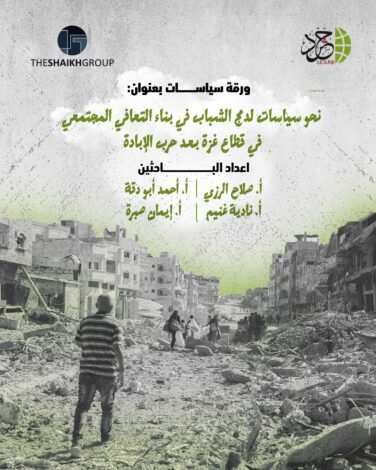
ICSPR issues policy paper titled “Towards Policies for Integrating Youth into Building Community Recovery”

Date: 26 August 2026
Press Release
In partnership with The Shaikh Group (TSG) and as part of the Youth Civil Society Activists Training Diploma Programme
ICSPR issues policy paper titled: “Towards Policies for Integrating Youth into Building Community Recovery”
The International Commission to Support Palestinian Rights (ICSPR), in partnership with The Shaikh Group (TSG) and as part of the Youth Civil Society Activists Training Diploma Programme, has issued a new policy paper titled: “Towards Policies for Integrating Youth into Building Community Recovery.” The paper examines the importance of empowering Palestinian youth and ensuring their meaningful participation in community recovery and reconstruction efforts, amid the catastrophic and multi-dimensional impacts of the ongoing genocide in the Gaza Strip.
The paper proceeds from the recognition that young people constitute a central social force in Palestinian society. At the same time, they are facing unprecedented levels of displacement, loss of education and employment opportunities, destruction of public spaces and educational and cultural institutions, as well as the psychological and social consequences of the continuing war. It stresses that moving beyond emergency humanitarian response towards sustainable recovery requires treating young people as partners in setting priorities and decision-making, rather than merely as recipients of aid.
The paper explains that the war has deepened the vulnerability of young people, particularly through the destruction of infrastructure, disruption of education, collapse of major economic sectors, and the loss by thousands of young people of their homes, livelihoods, and social networks. It warns that continuing to address youth solely through the narrow lens of humanitarian needs risks marginalising their role in the post-war period and limiting their ability to contribute to rebuilding society, the economy, and local institutions.
The policy paper notes that community recovery is not limited to rehabilitating buildings, roads, and services. It also entails restoring social ties, promoting civic participation, providing psychosocial protection and support, and creating realistic pathways for education, employment, and economic initiatives. It emphasises that young people can lead local community initiatives in humanitarian relief, documentation, psychosocial support, alternative education, digital innovation, small enterprises, urban planning, and reconstruction.
The paper calls for a transition from temporary policies and fragmented projects to a comprehensive national policy for integrating youth into recovery programmes. Such a policy should guarantee youth representation in planning and reconstruction committees, local councils, community initiatives, and the design of programmes related to employment, education, health, and psychosocial support. It also stresses the need to include young women and men from the most marginalised groups, including displaced persons, persons with disabilities, university graduates, unemployed youth, and residents of affected and displacement-threatened areas.
The paper affirms that decent employment opportunities for young people are among the most important foundations of recovery. It calls for emergency employment programmes and small grants for youth-led initiatives and projects, as well as linking rubble removal, housing rehabilitation, and infrastructure reconstruction projects to genuine training and employment opportunities for youth. It further advocates supporting digital projects and remote work, and developing vocational and technical training programmes that correspond to the needs of reconstruction and the local economy.
In the education sector, the paper proposes developing flexible alternatives for university, vocational, and technical education to prevent young people from losing access to their educational pathways. These measures include safe learning spaces, digital platforms, programmes to address learning loss, and skills development relevant to the future labour market. The paper stresses that protecting the right to education is essential to preventing an entire generation from being lost to war, displacement, and destruction.
The paper also highlights the profound psychological and social impact of the war on young people, stressing the need to expand psychosocial support programmes and provide specialised services to address trauma, loss, violence, and anxiety about the future. It recommends strengthening cultural, sports, artistic, and community media initiatives that enable young people to express their experiences, reclaim their role in public life, and build networks of solidarity and mutual support within local communities.
Furthermore, the paper calls for a participatory approach to reconstruction that ensures young people are involved in needs assessments, urban planning, and the monitoring of project implementation. It notes that involving youth in the planning of affected neighbourhoods, public facilities, and essential services can produce more equitable and sustainable policies, while preventing the reproduction of the exclusion and marginalisation that young people experienced before the war.
As part of its procedural recommendations, the paper calls on governmental bodies and local and international institutions to develop an integrated national strategy for youth empowerment during recovery and reconstruction. The strategy should include clear objectives, allocated budgets, implementation timelines, accountability mechanisms, and indicators for measuring impact. It also recommends establishing local youth committees in affected and displaced communities to serve as a link between young people, municipalities, official institutions, humanitarian actors, and donors.
The paper further recommends establishing a national fund or programme to support youth initiatives with social and economic impact, prioritising initiatives led by young women and men in humanitarian relief, psychosocial recovery, alternative education, green employment, recycling, technology, and community media. It also calls for fair and transparent employment policies in reconstruction projects to ensure that young people have access to work and training opportunities free from discrimination and favouritism.
The paper stresses the responsibility of the international community and donor agencies to support locally led recovery programmes, link reconstruction funding to respect for the fundamental rights of young people, and ensure their meaningful participation in decisions affecting their present and future. It also calls for sustainable funding for youth institutions and grassroots initiatives, rather than limiting support to short-term interventions that fail to address the scale of accumulated needs.
The paper concludes that integrating youth into building community recovery is neither a secondary nor symbolic option, but rather a national, rights-based, and developmental necessity. Young people are among those most affected by the consequences of war; at the same time, they are best positioned to lead resilience, change, and the rebuilding of life. It affirms that any recovery or reconstruction process that does not place youth at the centre of planning, implementation, and accountability will remain incomplete and incapable of building a just and sustainable future for Palestinian society.