
ICSPR Issues Policy Paper on Israeli Occupation’s Targeting of Rescue Systems During the Genocidal War: Challenges and Recovery Proposals for the Palestinian Civil Defense

Date: 15 February 2026
Press Release
ICSPR Issues Policy Paper on Israeli Occupation’s Targeting of Rescue Systems During the Genocidal War: Challenges and Recovery Proposals for the Palestinian Civil Defense
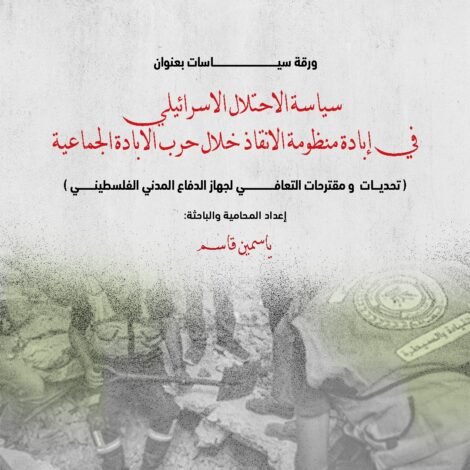
The International Commission to Support the Rights of the Palestinian People – ICSPR, issued a policy paper titled: “Israeli Occupation Policy in Targeting the Rescue System During the Genocidal War: Challenges and Recovery Proposals for the Palestinian Civil Defense”, prepared by lawyer Yasmin Qasim. The paper provides a comprehensive analysis of the violations suffered by the Civil Defense during the two-year genocidal war in the Gaza Strip, the challenges faced in performing its humanitarian and rescue missions, and proposes measures for the recovery and strengthening of the service.
The paper explained that the Civil Defense was systematically targeted by the Israeli occupation forces, including the destruction of its headquarters and field centers, the targeting of vehicles and personnel, despite wearing internationally recognized emblems that guarantee their protection under international humanitarian law. These attacks resulted in severe losses to the operational capacity of the Civil Defense, hindering its ability to respond to emergencies and disasters.
The paper emphasized that these attacks directly contributed to the worsening humanitarian crisis in Gaza, with over 140 Civil Defense personnel killed and at least 330 others injured. Nearly 90% of the Civil Defense’s operational capabilities, including vehicles, equipment, and headquarters, were destroyed, severely impeding relief and rescue operations and increasing both human and material losses.
The paper also outlined the international legal framework protecting Civil Defense personnel, including the 1977 Additional Protocol I to the Geneva Conventions, the Fourth Geneva Convention of 1949, the Hague Conventions, customary international law, and the Rome Statute of the International Criminal Court, affirming that targeting or obstructing Civil Defense personnel constitutes a grave violation of international humanitarian law and qualifies as a war crime and a crime against humanity.
The paper further examined the structure and functioning of the Palestinian Civil Defense, detailing its organizational framework, the distribution of its centers across Gaza’s five governorates, human resources, vehicles, and its legal and humanitarian mandates. It also highlighted the logistical challenges faced during the war, including fuel shortages, equipment destruction, damaged infrastructure, and restricted access to targeted areas.
The paper stressed the urgent need to support the Civil Defense with modern equipment and trained personnel, and to facilitate their access to emergency areas, enabling them to continue their vital role in protecting civilian lives, mitigating the escalating humanitarian crisis in Gaza, and ensuring respect for international humanitarian law and the protection of humanitarian workers.