
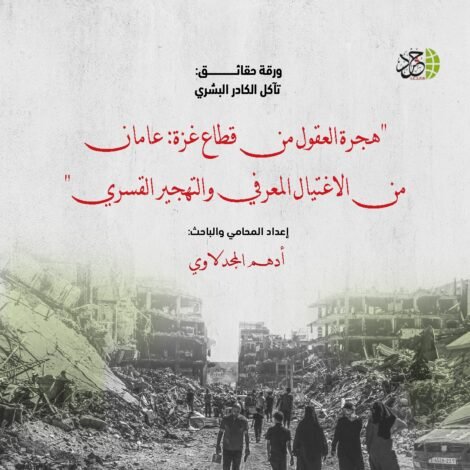
ICSPR Issues Fact Sheet Titled “Erosion of Human Capital – Brain Drain from the Gaza Strip: Two Years of Cognitive Assassination and Forced Displacement”

Date: 19 February 2026
Press Release
ICSPR Issues Fact Sheet Titled: “Erosion of Human Capital – Brain Drain from the Gaza Strip: Two Years of Cognitive Assassination and Forced Displacement”
The International Commission to Support the Rights of the Palestinian People – ICSPR has issued a new fact sheet titled: “Erosion of Human Capital: Brain Drain from the Gaza Strip – Two Years of Cognitive Assassination and Forced Displacement,” prepared by lawyer and researcher Adham Al-Majdalawi. The paper provides an analytical and documented examination of the systematic targeting of Palestinian professionals and intellectuals during the ongoing genocidal war since October 2023, and its structural repercussions on the future of Palestinian society.
The paper stresses that the displacement of intellectuals cannot be separated from the historical context of depopulation policies, noting that the occupation has shifted from attempts at mass displacement to what it describes as a strategy of “erosion of human capital.” This policy operates through targeting scientific and professional elites and creating a coercive environment that compels them to leave, thereby producing a long-term structural vacuum that Palestinian society may be unable to fill for decades.
According to documented figures, more than 80% of university buildings in the Gaza Strip have been totally or partially destroyed, including laboratories, central libraries, and research centers. This destruction has effectively paralyzed the higher education system for over two years and deprived more than 90,000 students of the ability to continue their university studies. The paper also documents the killing of more than 193 scientists, researchers, and academics, in addition to 830 educational staff members, including university presidents, deans, and professors in rare and specialized fields—indicating a deliberate and qualitative targeting of Palestinian intellectual leadership.
The paper further addresses what it terms “soft migration” or “silent displacement,” referring to selective exit corridors that target doctors, engineers, IT specialists, journalists, and intellectuals, amid severe living conditions, salary suspensions, and economic collapse. These conditions have transformed segments of the scientific elite into individuals primarily preoccupied with securing basic survival needs.
From a legal perspective, the paper argues that the creation of a “coercive environment” forcing professionals to leave constitutes the crime of forcible transfer under Article 8 of the Rome Statute of the International Criminal Court. It further contends that the systematic targeting of intellectual elites forms part of the elements of destroying a group in whole or in part, as defined under the 1948 Convention on the Prevention and Punishment of the Crime of Genocide, and represents a clear violation of the right to development and national sovereignty.
In its recommendations, the paper calls for the establishment of a “National Virtual University” to reconnect displaced academics with students inside Gaza, the creation of a national talent retention fund to support remaining professionals, and the development of a comprehensive database of displaced experts to facilitate their engagement in recovery efforts. It also urges the international community, including the United Nations Educational, Scientific and Cultural Organization (UNESCO), to intervene to protect remaining educational institutions, criminalize what it describes as “cognitive assassination,” and guarantee the safe and unconditional right of return for those who left Gaza under the pressures of war.
The paper concludes by emphasizing that the struggle for survival in the Gaza Strip is not only about physical existence, but also about safeguarding the “Palestinian mind.” It warns that the continued hemorrhaging of intellectual capital will transform Gaza into a geographic space stripped of its creative and developmental capacity, underscoring the urgent need for national and international action to halt this structural erosion before it becomes irreversible.
To read the full paper: