
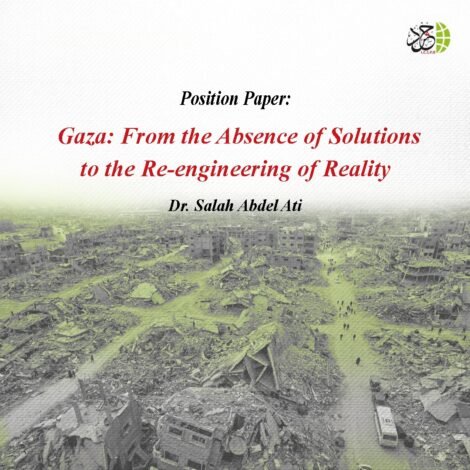
ICSPR Issues a Policy Brief Titled: “Gaza From the Absence of Solutions to the Reengineering of Reality”
 wasem aa
Send an email
wasem aa
Send an email
Date: April 10, 2026
Press Release
ICSPR Issues a Policy Brief Titled: “Gaza From the Absence of Solutions to the Reengineering of Reality”
The International Commission to Support Palestinian Rights (ICSPR) has issued a policy brief prepared by Dr. Salah Abdel Ati, President of ICSPR, titled: “Gaza From the Absence of Solutions to the Reengineering of Reality.” The paper examines the profound transformations taking place in the Gaza Strip amid the ongoing genocide and the entrenchment of policies aimed at managing, rather than resolving, the conflict.
In its introduction, the paper highlights the transformation of Gaza from an emergency humanitarian crisis into a complex model for managing political vacuum through instruments of power and deliberate restructuring of Palestinian reality. This approach is based on obstructing any genuine political process while managing the consequences in a way that ensures continued control.
The paper emphasizes that the international approach has undergone a significant shift in recent times, where the goal is no longer to achieve a just political solution, but rather to redefine the conflict within a manageable framework. This is done by dismantling the traditional political track and marginalizing final-status issues in favor of crisis management and perpetuation, while linking reconstruction and aid to political and security conditions, thereby maintaining Gaza in a constant state of security and humanitarian vacuum.
It further notes that the so-called ceasefire has not ended the war but has instead reorganized it into a low-intensity form, with ongoing violations and hundreds of casualties, alongside the obstruction of reconstruction and recovery efforts. This has rendered the ceasefire a formal framework for managing the humanitarian catastrophe rather than ending it.
In analyzing the field reality, the paper explains that Israeli policies have gone beyond the military dimension to include reshaping geography as a tool of control. This includes reducing livable areas and imposing new facts on the ground, leading to the fragmentation of social structures and the creation of a suffocating humanitarian environment.
The paper also stresses that the humanitarian collapse in Gaza is no longer a byproduct of war but has become part of its management mechanisms. This is carried out through restricting aid entry and limiting essential services, keeping the population at a “minimum survival” level without enabling recovery constituting a systematic policy of starvation and a grave violation of international humanitarian law.
It addresses the shift in international policies toward imposing conditions rather than engaging in negotiations, particularly by linking reconstruction and governance in Gaza to prior security conditions, most notably disarmament. According to the analysis, this reverses the natural logic of conflict resolution, placing responsibility on Palestinians while absolving the occupying power of its legal obligations.
Regarding the international legal framework, the paper points to a clear gap between international resolutions and their implementation due to a lack of political will, which has allowed violations to persist without genuine accountability.
The paper also reviews the positions of Palestinian actors, noting differences in approaches but convergence on rejecting the transformation of national rights into conditional demands and opposing unilateral impositions that undermine Palestinian rights.
It further underscores a dangerous shift within Gaza’s society from political engagement to a struggle for survival amid humanitarian and economic collapse, reflecting the depth of the crisis and its impact on the social fabric.
The paper warns of the strategic risks of the current trajectory, including the dismantling of rights and sovereignty, pushing Gaza toward internal collapse, and entrenching a long-term colonial reality that reshapes the Palestinian cause.
ICSPR stressed that what is taking place in Gaza constitutes an integrated system of crimes, including war crimes, crimes against humanity, and systematic starvation, which may amount to genocide, thus necessitating the urgent activation of international accountability mechanisms.
In conclusion, the Commission called for the development of a unified Palestinian national framework based on consolidating the ceasefire, ensuring unconditional aid access, the immediate activation of the Gaza Administration Committee, and linking any security arrangements to Israeli withdrawal and reconstruction, alongside activating international legal mechanisms to hold perpetrators accountable.
ICSPR affirmed that achieving security and stability cannot be realized through unilateral conditions, but through a comprehensive process that ensures ending the occupation, reconstruction, and international protection. It stressed that any attempts to impose partial solutions will only deepen and reproduce the crisis.