
ICSPR Issues a New Policy Paper on the Food Security Situation in the Gaza Strip After the Aggression and Warns of Systematic Starvation Threatening the Lives of More Than Two Million Civilians

Date: 26 November 2025
Press Release
ICSPR Issues a New Policy Paper on the Food Security Situation in the Gaza Strip After the Aggression and Warns of Systematic Starvation Threatening the Lives of More Than Two Million Civilians
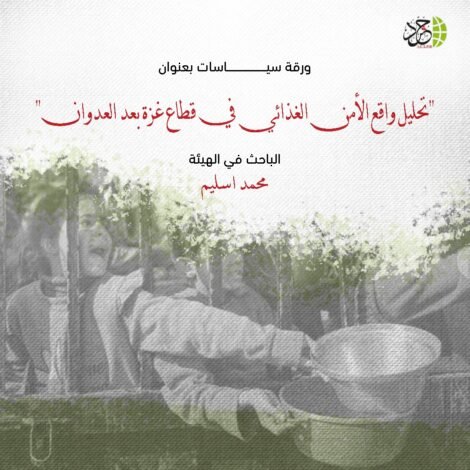
The International Commission to Support Palestinian Rights (ICSPR) has issued a new policy paper titled Analysis of the Food Security Situation in the Gaza Strip After the Aggression, prepared by researcher Mohamed Asleem. The paper provides an in-depth assessment of the food security situation in Gaza from 2023 to 2025, during the ongoing Israeli aggression, which has resulted in the near-total collapse of the food system and an unprecedented worsening of the humanitarian catastrophe.
The paper emphasizes that the Gaza Strip is currently facing one of the most severe food crises in the world. The aggression, coupled with the ongoing blockade and the prevention of the entry of essential goods, has destroyed agricultural infrastructure and livelihoods, creating conditions of forced starvation that threaten the lives of more than two million civilians, most of them children and women. It explains that the crisis is no longer merely a direct consequence of military actions, but rather reflects a systematic pattern based on the use of starvation as a weapon of war through the targeting of agricultural lands, production facilities, food sources, and supply chains.
The paper notes that the pre-aggression situation was already marked by acute vulnerability, with food insecurity affecting approximately sixty-nine percent of households, and poverty and unemployment rates among the highest globally. This placed society in a highly fragile position and susceptible to collapse in the event of any disruption. Following the outbreak of the aggression, this structural fragility escalated into a complete breakdown of the food security system, with thousands of acres of farmland destroyed, storage facilities and irrigation networks damaged, livestock lost, fishing activities halted, and bakeries shut down due to a lack of fuel.
According to the paper, field indicators reveal the scale of the catastrophe. Food insecurity has risen to more than ninety percent, while over ninety-five percent of households now rely on humanitarian assistance. Prices of basic food items have increased more than fourfold. Meanwhile, malnutrition rates among women and children have reached levels that threaten public health and contribute to chronic diseases and long-term developmental impacts.
The paper highlights the legal framework related to the right to food, stressing that Israel, as an occupying power, is legally obliged under international humanitarian law to ensure access to food for the civilian population. Starving civilians or depriving them of essential means of survival constitutes a war crime under the Rome Statute and international protocols. The paper also affirms that the international community bears direct responsibility in ensuring the flow of aid, protecting civilians, and preventing the continuation of violations.
Furthermore, the paper reviews the main challenges currently facing food security in the Gaza Strip, foremost among them the ongoing blockade and denial of essential supplies, the extensive destruction of agricultural infrastructure, soil contamination by explosive remnants of war, severe shortages of water and energy, the collapse of production and storage systems, the deterioration of local markets, reduced international funding, and the absence of a comprehensive national plan for food recovery and sovereignty.
The paper identifies urgent response priorities for the first three months, including ensuring the safe opening of crossing points for the entry of food, medicine, and fuel, providing emergency energy supplies for bakeries and water stations, delivering diversified food parcels to the most vulnerable families, activating emergency nutrition units for children and pregnant women, and guaranteeing the protection of humanitarian workers.
It also outlines medium- and long-term measures spanning from three months to three years, aimed at building a sustainable food system. These include rehabilitating agricultural lands, compensating farmers and fishermen, launching a national plan for food sovereignty, supporting local supply chains, investing in renewable energy for food facilities, and expanding employment programs that restore purchasing power and reduce long-term dependence on aid.
In conclusion, ICSPR affirms that addressing this crisis requires genuine political will to lift restrictions on the entry of food and fuel, hold those responsible for destroying food sources accountable, and rebuild the food security system in a manner that upholds human dignity and ensures the Palestinians’ right to adequate and safe food. The Commission stresses that the humanitarian situation in Gaza is no longer sustainable and that the continuation of the blockade and aggression threatens widespread famine that demands immediate and decisive international intervention.