
ICSPR Issues a New Documentation Study on the Reality of Victims of Genocide in the Gaza Strip, Revealing Catastrophic Humanitarian Dimensions and Urgent Needs of the Most Vulnerable Groups
 wasem aa
Send an email
wasem aa
Send an email
Date: 22 December 2025
Press Release
ICSPR Issues a New Documentation Study on the Reality of Victims of Genocide in the Gaza Strip, Revealing Catastrophic Humanitarian Dimensions and Urgent Needs of the Most Vulnerable Groups
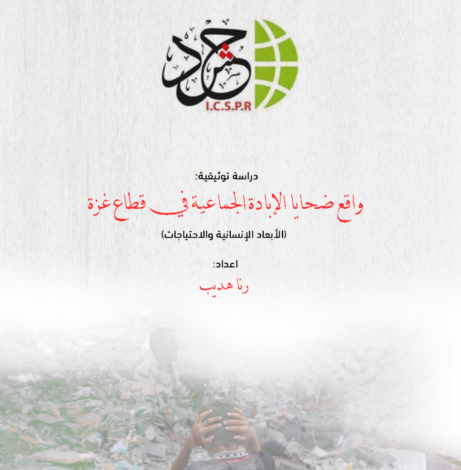
The International Commission to Support Palestinian People’s Rights (ICSPR) has issued a new documentation study entitled The Reality of Victims of Genocide in the Gaza Strip (Humanitarian Dimensions and Needs), prepared by researcher Rna Hdeib. The study provides an in-depth human rights and humanitarian documentation of the devastating impacts of the systematic genocidal war on the most vulnerable groups within Palestinian society, particularly women, children, youth, and the elderly.
The study confirms that the genocidal war in the Gaza Strip has not been limited to material destruction or shocking statistical figures, but has fundamentally targeted human dignity and the right to life and security. Field testimonies and documented data reveal recurring patterns of organized violence deliberately targeting civilians, leaving long-term psychological, social, and economic impacts that extend far beyond the moment of bombardment and direct killing.
The study indicates that women and children constitute approximately 70 percent of the total victims of the genocide, reflecting a direct assault on the Palestinian social fabric. More than 13,000 women and girls have been killed since October 2023, with estimates rising when accounting for those missing. It also highlights that hundreds of thousands of women have been deprived of reproductive healthcare, and that tens of thousands of pregnant women face life-threatening childbirth conditions amid the near-total collapse of the healthcare system and severe shortages of food, water, and medical supplies.
The study sheds light on the transformation of thousands of women into sole breadwinners after losing their spouses, in the context of a collapsed economy and worsening famine, in addition to the deprivation of hundreds of thousands of girls of their right to education due to the destruction of schools and ongoing displacement. It also documents the profound psychological effects on women, including post-traumatic stress disorder, loss of privacy, emotional exhaustion, and increased rates of anxiety and depression, supported by direct testimonies reflecting the depth of daily suffering.
Regarding children, the study affirms that the Gaza Strip has become the most dangerous place in the world for children. The number of child fatalities has exceeded 17,000, and thousands of children have been orphaned after losing one or both parents. The study also documents the existence of the largest concentration of child amputees in the world relative to geographic area, as a result of bombardment and the collapse of the medical system, in addition to the spread of acute malnutrition and deaths caused by hunger and dehydration.
The study further notes that more than 600,000 students have been deprived of education following the destruction of the vast majority of schools, raising the risk of the loss of an entire generation in terms of knowledge and psychological well-being. Testimonies indicate that more than 90 percent of Gaza’s children suffer from symptoms of post-traumatic stress disorder, amid the loss of safety, forced separation from childhood, and repeated exposure to scenes of death and destruction.
The study addresses the reality of workers and youth, documenting that more than 90 percent of the workforce has been unable to continue their original jobs due to the destruction of factories, workshops, and universities. Thousands of young people have been pushed into what the study describes as a “survival economy,” amid blocked educational and professional horizons, accompanied by psychological crises, the erosion of social status, and deep feelings of frustration and loss of future prospects.
The study also devotes a special chapter to the elderly, describing them as the group most exposed to “silent death.” Most suffer from chronic illnesses without access to medications, have been subjected to forced displacement beyond their physical capacity, and endure severe malnutrition due to famine, in addition to profound psychological impacts resulting from the loss of dignity and the repeated experience of displacement, which many have endured since the Nakba of 1948.
The study concludes that the current humanitarian response is insufficient, stressing the need to move beyond conventional relief toward qualitative interventions focused on protection and the preservation of human dignity. It outlines a set of urgent needs, including the establishment of mobile reproductive health clinics, the provision of hygiene kits and psychosocial support for women, the creation of safe educational spaces for children, trauma treatment programs, vaccinations and nutritional supplements, as well as specialized interventions to protect the elderly and reduce indirect deaths.
ICSPR emphasized that this study represents a human rights document and a living humanitarian testimony aimed at conveying the voices of victims, preserving collective memory, preventing the erasure of truth, and calling on the international community and human rights institutions to assume their legal and moral responsibilities to provide protection, ensure accountability, and put an end to policies of genocide and grave violations against civilians in the Gaza Strip.