
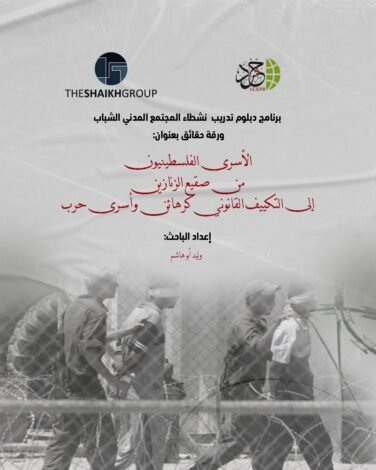
“ICSPR” Issues a Fact Sheet Titled “Palestinian Prisoners: From the Cold of the Cells to Their Legal Classification as Hostages and Prisoners of War”

Date: 22 May 2026
Press Release
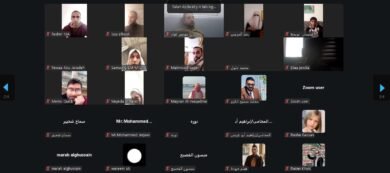
In partnership with The Shaikh Group (TSG) and as part of the Youth Civil Society Activists Diploma Program
The International Commission “ICSPR” Issues a Fact Sheet Titled: “Palestinian Prisoners: From the Cold of the Cells to Their Legal Classification as Hostages and Prisoners of War”
The International Commission to Support Palestinian Rights “ICSPR,” in partnership with The Shaikh Group (TSG) and as part of the Youth Civil Society Activists Diploma Program, has issued a fact sheet prepared by researcher Walid Abu Hashem titled: “Palestinian Prisoners: From the Cold of the Cells to Their Legal Classification as Hostages and Prisoners of War.” The paper highlights the escalating legal and humanitarian dimensions of the issue of Palestinian prisoners and detainees in Israeli occupation prisons, in light of the dangerous transformations their conditions have undergone from late 2023 through 2026.
The paper explains that Israeli prisons are no longer merely places where Palestinians are deprived of their liberty, but have been transformed into spaces of political repression and systematic retaliation, where grave violations are committed beyond effective international oversight. It argues that arrest in the Palestinian context has never been a neutral “security” measure, but rather a systematic tool used to strip Palestinians of their legal and human protections and place them in a gray zone that allows the occupation to evade its obligations under international law.
According to the data reviewed in the paper, more than one million Palestinians have been subjected to arrest since 1967, while the number of Palestinian prisoners and detainees had reached approximately 9,600 by the second quarter of 2026 according to some publicly available rights-based statistics, with other estimates placing the figure higher when Gaza detainees held in military camps and cases of enforced disappearance are included. The paper also draws attention to the unprecedented rise in the number of administrative detainees, whose number ranges from more than 3,500 to over 4,000 in some estimates, in addition to the detention of hundreds of children and dozens of women in conditions lacking the minimum standards of human dignity and privacy.
The paper notes that the years from 2023 to 2026 witnessed a serious escalation in the arrest of people from the Gaza Strip, with thousands of detainees subjected to harsh conditions linked to enforced disappearance and detention in notorious camps, including Sde Teiman, amid increasing documentation of systematic torture, beatings, starvation, denial of medical care, and total isolation from the outside world. It stresses that these realities raise fundamental legal questions regarding the use of Palestinian detainees as political hostages and regarding the extent to which prisoner-of-war status applies to Palestinian resistance fighters in the context of a prolonged armed conflict and foreign occupation.
On the legal level, the paper affirms that there is a deep gap between the politicized Israeli classifications imposed on Palestinian prisoners and the provisions of international humanitarian law. It points out that the occupation authorities deprive them of the fundamental rights guaranteed by the Third Geneva Convention, particularly humane treatment, medical care, and contact with the outside world, while resorting to labels such as “unlawful combatant” to justify torture, detention outside legal guarantees, and deprivation of proper legal status.
The paper argues that the proper legal classification of Palestinian resistance fighters who fall into the hands of the occupation should be based on the rules of international law and on the fact that Palestine has been a state party to a number of international treaties since 2014. This opens the way to regarding them as fighters in a national liberation movement against foreign occupation, which requires granting them the legal protections set out in the Third Geneva Convention, especially Article 13, which requires humane treatment and prohibits torture, humiliation, and mutilation.
The paper also addresses administrative detention as one of the main tools of arbitrary subjugation, noting that the occupation relies on detaining Palestinians on the basis of secret files without clear charges or fair trial guarantees, while repeatedly renewing detention orders for prolonged periods. It stresses that this pattern of detention directly violates the right to know the reasons for arrest, the right to legal defense, and the right to a fair trial, and constitutes a clear breach of the International Covenant on Civil and Political Rights and the Fourth Geneva Convention.
The paper further highlights the classification of Palestinian prisoners and detainees as political hostages when they are held not for law enforcement purposes but to be used as bargaining tools against the Palestinian people or resistance factions, whether through detention for political leverage, collective punishment after political or military developments, or renewed administrative detention aimed at neutralizing active sectors of Palestinian society. It argues that such conduct contradicts the explicit prohibition contained in Article 34 of the Fourth Geneva Convention on the taking of hostages.
In its description of the period following 7 October 2023, the paper states that Israeli prisons and detention centers entered a phase that can be described as “human slaughterhouses,” amid repeated documentation of killings under torture, deliberate medical neglect, systematic starvation, denial of Red Cross visits, and the severing of communication with lawyers and families, all of which fall under patterns of enforced disappearance, torture, and cruel and inhuman treatment. It also points to the alarming increase in the number of deaths among the Palestinian prisoner movement, with recent rights-based sources reporting that at least 84 to 89 prisoners have died since 7 October 2023.
The paper addresses the humanitarian and health consequences of these policies, including severe physical emaciation, the spread of epidemics and skin diseases, and worsening psychological disorders, especially among children, women prisoners, and the sick, in addition to broader legal and political consequences represented by the targeting of community leaders, the destabilization of family life, and the entrenchment of military and discriminatory orders at the expense of international law. It also warns of the danger of advancing Israeli legislation that legitimizes harsh interrogation methods or pushes toward a death penalty law for Palestinian prisoners, which would represent a serious escalation in the legalization of abuse.
In this context, the paper affirms that Israeli authorities and prison system officials can be pursued through international justice mechanisms, foremost among them the International Criminal Court, whether on the basis of war crimes or crimes against humanity, including torture, willful killing, enforced disappearance, and the unlawful transfer of detainees from occupied territory into the territory of the occupying power, which constitutes a grave breach of the Fourth Geneva Convention.
The paper concludes with a number of urgent recommendations, most notably the need for immediate international pressure to end the policy of arbitrary administrative detention, abolish unfair military trials, activate the role of UN mechanisms and special rapporteurs, restore regular access for the International Committee of the Red Cross without restriction, form independent international medical delegations to examine detainees, provide special protection for children, women prisoners, and the sick, and expedite the submission of documented legal files to the International Criminal Court and the International Court of Justice, in addition to building a unified legal and media database to keep the issue of prisoners at the top of the international agenda.
ICSPR affirms that this paper comes within the framework of efforts aimed at strengthening legal and rights-based awareness of the issue of Palestinian prisoners, exposing the occupation’s policies of abuse and deprivation of legal protection, and helping mobilize international pressure to stop violations and hold those responsible accountable.
It should be noted that this paper does not necessarily represent the views of the International Commission “ICSPR” or Sheikh International Group.