
ICSPR Issues a Fact Sheet on Environmental Devastation in the Gaza Strip

Date: 30 September 2026
Press Release
ICSPR Issues a Fact Sheet on Environmental Devastation in the Gaza Strip
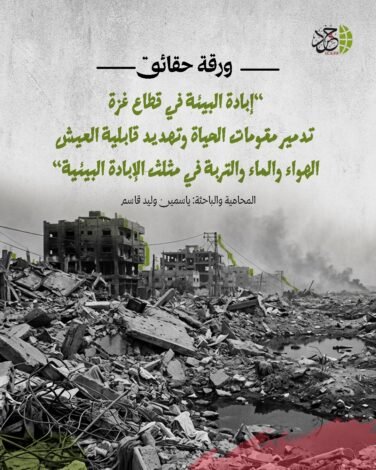
The International Commission to Support Palestinian Rights (ICSPR) has issued a fact sheet on environmental devastation in the Gaza Strip, documenting the extensive destruction inflicted on the environment, its natural resources, and its infrastructure during the war. The paper highlights the grave risks this destruction poses to the rights to life, health, safe water, food, and a clean environment.
The paper affirms that the right to a clean, safe, and sustainable environment including access to usable water, adequate sanitation services, safe waste management, and unpolluted air and soil is directly linked to the fundamental rights of the population. It stresses that the destruction of Gaza’s environmental foundations is no longer a secondary consequence of war; it has become a prolonged crisis that affects the present and threatens the rights of future generations.
The paper explains that widespread destruction of water networks, desalination plants, sanitation systems, and waste-management facilities combined with the accumulation of rubble, remnants of munitions, and hazardous materials has intensified pollution of water, soil, air, and the marine environment. It has also severely reduced the capacity of service providers to deliver even minimum environmental and public-health services to the population.
According to the paper, approximately 90% of water-network infrastructure has been damaged or destroyed, while at least 700,000 linear metres of water networks have been destroyed. More than 203 municipal wells have been wholly or partially damaged or destroyed, causing a sharp decline in the amount of water available to residents and putting large numbers of wells and desalination plants out of service.
The paper further notes that the war has caused extensive damage to the sanitation sector: more than 85% of sanitation infrastructure has been damaged or destroyed, and the main treatment plants have ceased operating. Large numbers of people are living without safe sanitation networks and are compelled to rely on soak pits that repeatedly overflow, increasing the likelihood of groundwater contamination and the spread of disease.
It warns that the deterioration of water and sanitation services has led to wastewater leaking into residential areas and the marine environment, while creating conditions conducive to the spread of insects, rodents, and disease. The continuing obstruction of maintenance and repair work, as well as restrictions on the entry of fuel, spare parts, and equipment, are deepening the crisis and preventing the restoration of minimum essential services.
On waste, the paper reports that large quantities of solid and medical waste have accumulated in residential areas, displacement sites, and temporary or informal dumps, amid damage to waste-management facilities, collection vehicles, and containers. It notes that the mixing of medical waste with ordinary waste, without safe sorting or treatment, compounds the health and environmental risks faced by residents and service-sector workers.
The paper also addresses the damage inflicted on soil, vegetation, and agricultural land as a result of bombardment, military operations, and land levelling, as well as the potential contamination of soil with heavy metals and chemical compounds arising from explosions and remnants of munitions. It warns that these pollutants may enter the food chain and cause long-term health harm.
ICSPR notes that the accumulation of rubble, war remnants, and unexploded ordnance presents a continuing danger to civilians and to all recovery and reconstruction efforts, particularly given the difficulty of accessing extensive areas and the lack of equipment, machinery, and resources needed to safely remove rubble and mitigate its effects.
The Commission affirms that the concept of environmental devastation describes the widespread and continuing destruction of ecosystems and the foundations of life. It stresses that Gaza’s air, water, and soil pollution; the disabling of critical infrastructure; and the accumulation of waste and rubble require an urgent response grounded in environmental protection, human rights, and legal accountability.
ICSPR calls for immediate and safe access for technical teams, municipalities, and personnel working in water, sanitation, and waste-management services. It further calls for the entry of fuel, spare parts, equipment, and materials necessary to repair and operate essential facilities. It urges support for the removal of rubble and unexploded ordnance, the rehabilitation of water and sanitation networks and desalination and treatment plants, and the establishment of safe systems for managing medical and solid waste.
The Commission also stresses the need for independent and comprehensive environmental and health assessments to determine the scale of contamination and damage affecting soil, water, air, and the marine environment, and to develop immediate and long-term plans for environmental remediation and recovery. It further underscores the importance of holding accountable those responsible for violations that have destroyed the foundations of life and the environment in the Gaza Strip, and of ensuring that they do not escape punishment.