
ICSPR Early Recovery in Gaza Is an Urgent Humanitarian Necessity… Civil Society Organizations Are a Cornerstone for Rebuilding Life After Genocide

Date: 31 December 2025
Press Release
ICSPR: Early Recovery in Gaza Is an Urgent Humanitarian Necessity… Civil Society Organizations Are a Cornerstone for Rebuilding Life After Genocide
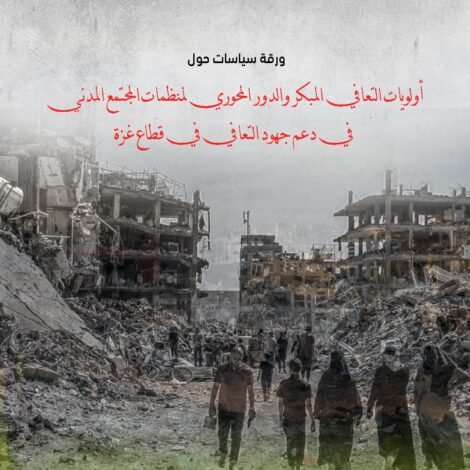
The International Commission to Support Palestinian People’s Rights (ICSPR) issued a new policy paper entitled “Early Recovery Priorities and the Pivotal Role of Civil Society Organizations in Supporting Recovery Efforts in the Gaza Strip,” prepared by researcher Lubna Al-Deeb. The paper examines the reality of the Gaza Strip in the post-genocide phase and highlights the complex challenges hindering recovery efforts amid widespread destruction, the near-total collapse of infrastructure, and the continuation of the Israeli blockade and restrictions.
The paper affirms that the Gaza Strip is facing one of the most dangerous phases in its modern history. The impacts of the Israeli war have not been limited to massive human losses, but have extended to the destruction of the basic foundations of life, the paralysis of the local economy, and the crippling of health, education, and environmental services. This reality necessitates an urgent transition from emergency relief to early recovery as the primary gateway to restoring a minimum level of social stability and resilience.
ICSPR explained that early recovery constitutes a critical bridge between immediate humanitarian response and long-term reconstruction, warning that any delay in adopting clear recovery policies will deepen the humanitarian catastrophe, entrench chronic dependency on aid, and erode human and social capital in the Gaza Strip.
The paper emphasized that civil society organizations represent an indispensable key actor in the recovery process, given their advanced role during the war in responding to humanitarian needs, providing protection services and psychosocial support, and strengthening community resilience. It noted that marginalizing or bypassing this role would weaken any sustainable recovery pathway.
The paper also addressed the deteriorating humanitarian conditions in the Strip, where millions of Palestinians suffer from food insecurity, a severe shortage of safe drinking water, the collapse of sewage networks, and widespread housing destruction, amid a major funding shortfall that limits the ability of humanitarian organizations to meet growing needs.
The paper identified a set of early recovery priorities, most notably:
restoring essential services; rehabilitating health and educational facilities; supporting livelihoods and the local economy; strengthening food security; providing protection and psychosocial support services; rehabilitating damaged housing; and ensuring community participation in setting intervention priorities.
ICSPR stressed that good governance is a decisive factor for the success of recovery, calling for the establishment of a comprehensive national coordination mechanism to manage the early recovery phase, based on transparency and accountability, ensuring coordination among official bodies, donors, and civil society organizations, and adopting a participatory approach that takes into account the local context and the needs of the most marginalized groups.
The paper shed light on the severe challenges facing civil society organizations in Gaza, including Israeli restrictions on movement and funding, the destruction of offices, the prevention of the entry of equipment and essential materials, in addition to weak coordination and the absence of a safe operating environment. It affirmed that these policies undermine prospects for sustainable recovery and deepen the humanitarian crisis.
In the political context, ICSPR warned against the risks of imposing transitional arrangements or governance models on the Gaza Strip that are detached from the Palestinian national will, stressing that any recovery path not grounded in a unified national reference and the genuine participation of civil society will remain fragile and prone to failure.
In conclusion, the International Commission to Support Palestinian People’s Rights (ICSPR) affirmed that true recovery in Gaza is not limited to rebuilding physical structures, but requires rebuilding the human being, protecting human dignity, and entrenching justice and accountability. The Commission called on the international community and Palestinian official bodies to adopt fair and sustainable recovery policies, empower civil society organizations, protect national expertise, and halt policies that obstruct recovery and reconstruction efforts.