
ICSPR Poverty and Unemployment in Gaza Threaten Civil Peace, Highlighting the Need for a National Plan Linking Emergency Relief to Livelihoods and Equitable Distribution

Date: 28 November 2026
Press Release
ICSPR: Poverty and Unemployment in Gaza Threaten Civil Peace, Highlighting the Need for a National Plan Linking Emergency Relief to Livelihoods and Equitable Distribution
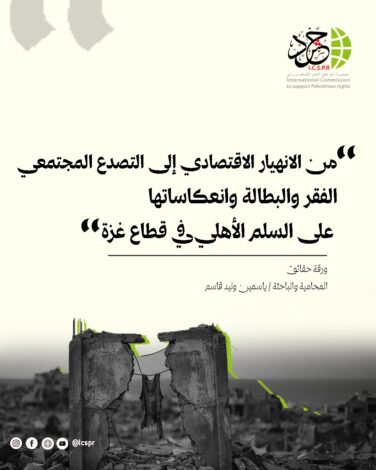
The International Commission to Support Palestinian Rights (ICSPR) has issued a fact sheet entitled “From Economic Collapse to Social Fragmentation: Poverty, Unemployment, and Their Implications for Civil Peace in the Gaza Strip,” prepared by lawyer and researcher Yasmin Walid Qassem. Drawing on figures and statistical data, the fact sheet documents the realities of poverty, unemployment, and the deterioration of livelihoods following three years of genocidal war. It also analyses their impact on social cohesion and civil peace.
ICSPR warns that mounting living pressures, coupled with the absence of effective oversight of goods and humanitarian assistance and the weakness of the security and judicial systems, increase the likelihood of disputes and violence within society. The Commission stresses that restoring civil peace is intrinsically linked to ending the genocidal war, holding those responsible for international crimes accountable, and creating the conditions necessary for reconstruction and enabling Palestinians to regain their livelihoods and dignity.
Figures Reveal the Depth of the Economic Collapse
The fact sheet presents indicators reflecting the scale of the deterioration in the Gaza Strip:
- Poverty has reached approximately 93%, while unemployment has exceeded 85% since the beginning of the year. More than 90% of the population is now without jobs or employment.
- More than 250,000 workers have lost their jobs and sources of income, while the number of unemployed people is estimated at approximately 400,000.
- Per capita GDP stood at USD 212 in 2025, equivalent to approximately USD 0.58 per day, representing just 17% of its 2022 level, according to the fact sheet.
- Gross Domestic Product (GDP) recorded an 84% decline in 2025 compared with 2023.
- Commodity prices increased by between 400% and 700% during the war compared with pre-2023 levels, while the purchasing power of money declined by approximately 66.7%.
- Approximately 80% of children in the Gaza Strip live in extreme poverty.
The fact sheet also indicates that approximately 97% of the population rely primarily on humanitarian assistance, charitable community kitchens, and food initiatives to obtain meals, while 1.6 million people face high levels of acute food insecurity.
From a Productive Economy to an Aid-Dependent Economy
The fact sheet explains that the Gaza Strip has shifted from an economy based on labour and production to one dependent on humanitarian assistance, amid the widespread destruction of productive sectors. Approximately 94% of the industrial sector has been destroyed, while around 96% of agricultural land, greenhouses, and groundwater wells have been damaged or destroyed. Economic activity in the construction sector has declined by 99%.
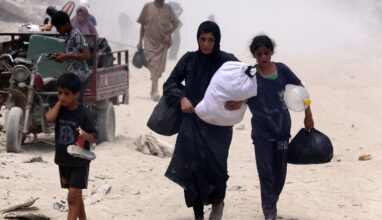
It further notes that most families have been displaced multiple times, approximately 94% of the population require shelter assistance, and 2.17 million people are concentrated in less than 30% of the Strip’s total area. Regarding the labour market, the fact sheet estimates that thousands of workers have lost their jobs across agriculture, industry, construction, tourism, technology, education, and other sectors, in addition to employees receiving only partial salaries or no salaries at all.
The Most Vulnerable Families Bear the Greatest Burden
The fact sheet highlights figures concerning the groups most severely affected by the crisis. These include 86,000 female-headed households, more than 64,000 widowed women, and 71,846 orphaned children. It also indicates that approximately 90% of persons with disabilities have no source of income or financial support, while more than 108,000 older persons lack sufficient income.
The fact sheet also addresses rising unemployment among young people, noting that more than 75% of those aged 15–29 have been excluded from education, training, and the labour market. It further highlights the growing phenomenon of children being forced to work long hours for meagre wages. Unemployment, it stresses, undermines economic independence, intensifies tensions within families and communities, and exposes young people to exploitation and recruitment by various actors.
How Does Deprivation Turn into Conflict?
The fact sheet explains that competition over food, water, medicine, fuel, shelter, and humanitarian assistance, alongside disputes over prices, debts, property, and monopolistic practices, places increasing pressure on social bonds, particularly in the context of weak law enforcement and the absence of effective oversight.
It points to the emergence of practices including the theft of humanitarian aid and commercial goods, begging, extortion, fraud, the exploitation of displaced people’s vulnerability, and even the use of weapons in disputes over humanitarian assistance, water, tents, and land.
The fact sheet also presents data on incidents associated with weapons and the breakdown of public order. According to the Supreme Commission for Tribal Affairs, tribal and community reconciliation committees addressed 11,987 cases and disputes between the beginning of 2026 and September 2026. ICSPR stresses that these efforts constitute a supportive community-based mechanism but cannot replace the formal justice system, nor can customary practices substitute for the rule of law.
Equitable Aid Distribution Is Essential to Building Trust
The fact sheet addresses the absence of a clear system for supervising humanitarian aid distribution and the lack of a unified, regularly updated database based on publicly announced criteria. This increases the risk of excluding the most vulnerable families and deepens perceptions of discrimination.
In this regard, it cites data from the United Nations Office for Project Services (UNOPS), indicating that approximately 88% of trucks collected between 19 May and 5 August 2025 did not reach their intended destinations, with the figure rising to approximately 94% in July 2025.
Regarding restrictions on supplies, the fact sheet states that goods available in local markets account for no more than 37% of basic needs, while the Israeli occupation’s compliance with the required number of trucks entering the Strip has not exceeded 34% since the ceasefire in October 2025, according to the figures cited in the document.
It also refers to payments estimated at more than USD 2.06 billion made under illegal coordination arrangements for the entry of commercial goods from the beginning of the war until 26 July 2026.
Psychological and Social Impacts
The fact sheet dedicates a section to the psychological and social consequences of poverty and deprivation, highlighting alarming indicators among children, young people, and women. These include sleep disorders and severe fear among children, increased levels of depression and anxiety among young people, and depression affecting approximately 75% of women.
It further reports that cases of gender-based violence have increased by more than 32% since the first quarter of 2026, while approximately 98.8% of women reported feeling unsafe inside displacement shelters.
ICSPR emphasises that protecting civil peace requires addressing economic, psychological, and social pressures simultaneously, rather than relying exclusively on a security-based approach.
National and International Calls to Restore Livelihoods
At the international level, ICSPR calls on mediators and guarantor parties to compel the Israeli occupation to end its genocidal war and fulfil its humanitarian obligations under the ceasefire agreement. It also calls for the regular and safe opening of border crossings and the entry of humanitarian assistance, fuel, and supplies required to repair infrastructure and facilitate reconstruction.
The Commission urges donor countries to finance safe temporary housing, debris removal, and the rehabilitation of water, sanitation, and electricity networks. It also calls on the International Criminal Court to continue its investigations and ensure accountability for those responsible, while stressing the importance of maintaining support for UNRWA and reactivating its role in the Gaza Strip.
At the national level, ICSPR calls for:
- A comprehensive national plan linking efforts to address poverty and unemployment with the provision of basic needs and the strengthening of social protection, while integrating civil peace and social cohesion indicators into response and recovery programmes.
- Temporary employment programmes for workers, young people, women, and families who have lost their breadwinners, through debris removal and the rehabilitation of public facilities, ensuring fair wages and vocational training.
- Emergency grants and accessible financing, or compensation schemes, for damaged small and medium-sized enterprises.
- Unified and publicly announced criteria for identifying humanitarian aid beneficiaries, alongside complaint mechanisms and community oversight, as well as measures to combat monopolistic practices and manipulation of prices and beneficiary lists.
- Integration of mental health and psychosocial support services into humanitarian assistance, social protection, and recovery programmes.
- A national initiative to mobilise Palestinian businesspeople and investors, both inside Palestine and abroad, to invest in productive sectors in the Gaza Strip.
ICSPR concludes by stressing that civil peace cannot be established amid the continuation of injustice, deprivation, exclusion, and the absence of justice. It underscores that justice, accountability, transparency, and good governance are fundamental pillars for consolidating civil peace.
The Commission further emphasises that reconstruction plans must be based on balanced and equitable foundations that take into account the needs of all geographical areas and social groups, reduce social disparities, and prevent the fragmentation of community bonds that the Israeli occupation seeks to undermine.