
ICSPR Publishes a Policy Paper on Rebuilding Security Services in the Gaza Strip During the Transitional Phase: Towards a Unified, Professional Palestinian Security System Governed by the Rule of Law and Accountability

Date: 16 November 2026
Press Release
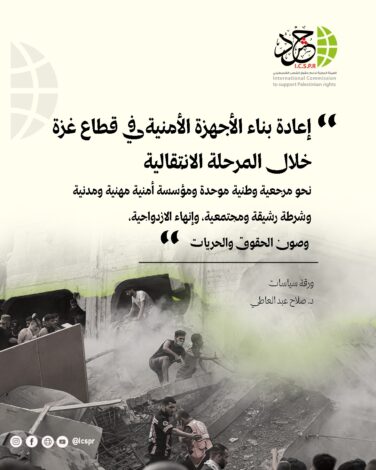
ICSPR Publishes a Policy Paper on Rebuilding Security Services in the Gaza Strip During the Transitional Phase: Towards a Unified, Professional Palestinian Security System Governed by the Rule of Law and Accountability, Protecting Citizens, Preserving Civil Peace, and Supporting Recovery and Reconstruction
Rebuilding security services in the Gaza Strip during the transitional phase represents a matter of profound national and institutional importance. It goes beyond merely resuming the operations of security agencies and facilities or redistributing ranks and positions. Rather, it requires redefining the relationship between authority and society and establishing a unified, professional, civilian Palestinian security system based on the rule of law, respect for human rights, oversight, and accountability. Such a system must be capable of protecting citizens and property, preserving civil peace, and providing the necessary environment for recovery, reconstruction, and the restoration of public life. In this context, the strategic position paper prepared by Dr. Salah Abd Alati presents a comprehensive national and institutional vision for rebuilding the security sector in Gaza. It proceeds from the understanding that security is not a privilege enjoyed by security agencies or a tool for controlling society, but rather a public function whose purpose is to protect people, their rights and freedoms, and to serve all citizens without discrimination.
The paper argues that the security crisis in the Gaza Strip is not solely the result of the war and its consequences. Rather, it is the outcome of long-standing accumulated factors, including the Israeli occupation, Palestinian division, institutional and jurisdictional duplication, multiple centres of power and weapons, declining public trust, and the disruption of parts of the justice system. These factors have been compounded by economic and social deterioration, widespread displacement, poverty, unemployment, and the loss of property. The war has further weakened law enforcement and justice institutions, deepened administrative and security vacuums, and created growing challenges involving looting, theft, assaults on property, extortion, and family and tribal disputes. Additional risks concern the protection of humanitarian aid, public facilities, hospitals, schools, shelters, and the safe return of residents and protection of their property.
The paper stresses that addressing these challenges cannot be achieved through partial security solutions or technical and administrative measures isolated from political, legal, and institutional reform. Nor can it be based on reproducing previous security structures, replacing one set of leaders with another, or carrying out superficial merger processes that preserve old centres of influence and loyalties. What is required is a comprehensive review of institutional functions, jurisdictions, leadership, human resources, legislation, and security policies, based on an independent national and professional assessment, reliable data, and actual needs. This would ensure the establishment of a new security institution capable of performing its duties efficiently, independently, and responsibly.
The paper places the establishment of a unified political and civilian authority at the forefront of the conditions necessary for successful reconstruction. Determining which body holds security decision-making authority, bears responsibility for setting policies and priorities, appointing leaders, approving budgets, and monitoring performance is the fundamental starting point for ending conflicting instructions and multiple centres of decision-making. It calls for adopting a national Palestinian civilian authority grounded in legal and political legitimacy, ensuring the unity of institutions in the Gaza Strip, the West Bank, and Jerusalem, and linking the process to the restoration of the Palestinian political and institutional system, without creating a separate administrative or security entity or entrenching a new institutional reality that deepens division.
Regarding the international and regional transitional arrangements related to the administration, security, and reconstruction of the Gaza Strip, particularly those connected to United Nations Security Council Resolution 2803 of 2025, the Board of Peace, the Palestinian National Committee for the Administration of Gaza, and the International Stabilization Force, the paper emphasizes the need to distinguish between internationally mandated transitional powers and Palestinian responsibilities for administering society and enforcing the law. It stresses that these arrangements must not evolve into permanent trusteeship, become an authority that overrides Palestinian will, or establish parallel security structures or detention and investigation facilities outside a clear legal framework.
The paper further emphasizes that, if empowered to carry out its responsibilities, the National Committee for the Administration of Gaza should operate as a transitional Palestinian framework for managing civil affairs and public services, in coordination with the government and relevant Palestinian institutions, and in accordance with a clear agreement defining the relationship between civil administration, police leadership, security agencies, and judicial authorities. The role of the Board of Peace should remain focused on coordination, support, resource mobilization, assistance with reconstruction, and capacity-building. Meanwhile, the mandate of the International Stabilization Force, its areas of operation, duration, rules governing the use of force, and coordination and accountability mechanisms must be clearly defined, alongside a specific timetable for transferring responsibilities to the competent Palestinian institutions.
The paper proposes the adoption of a transitional national security framework document as part of the national and political understandings. This document should clearly identify, in writing, the body responsible for political decision-making, the authority responsible for civil administration, the body entrusted with police leadership, the mandates of other security agencies, their relationship with the Public Prosecution and the judiciary, coordination mechanisms with international entities, rules governing information exchange, oversight of detention and the use of force, mechanisms for resolving disputes between institutions, and the timetable for transferring responsibilities. The paper also emphasizes that this document must include explicit safeguards preventing the establishment of parallel security or police agencies or the delegation of permanent domestic law-enforcement powers to non-Palestinian entities.
With regard to the required institutional structure, the paper calls for moving away from multiple agencies, authorities, and centres of power towards a unified Palestinian security system built around a professional, streamlined civilian police force. This force would be responsible for day-to-day domestic law enforcement, protecting citizens and property, and maintaining public order under a single command, a clear chain of authority, and well-defined responsibilities. The paper explains that unifying the security sector does not mean merging all institutions into a single agency. Rather, it means ending duplication and overlapping functions and powers, and defining the mandate of each institution in accordance with the law, thereby preventing other security agencies from becoming parallel police authorities or interfering in citizens’ political and civil lives.
The paper stresses the need to reorganize the National Security Forces, General Intelligence, and other security institutions through a comprehensive legal and institutional review that defines the nature of their duties, the limits of their powers, and the mechanisms for overseeing them, while preventing their use in arrests or investigations outside legal safeguards. It also emphasizes the independence of the Public Prosecution, the judiciary, correctional and rehabilitation institutions, Civil Defence, and health and social institutions in exercising their respective mandates, while developing coordination mechanisms with the police to ensure a clear separation between security, judicial, and civil functions.
The paper recommends adopting a new national security doctrine based on the principle that the function of security is to protect citizens, society, and the rule of law, rather than to protect those in power from society or one political faction from its rivals. This doctrine should be founded on political neutrality, respect for rights and freedoms, professional specialization, transparency and accountability, proportionality in the use of force, and the subordination of all security agencies to civilian and legal authority. It stresses that the governing principles of this phase must be that no security authority may operate without a clearly defined legal mandate, no power may be exercised without oversight and accountability, and no arrest, search, or investigation may take place outside established legal procedures and safeguards.
The paper places the rebuilding of the civilian police force at the heart of the reform process, considering it the primary day-to-day point of contact between public institutions and citizens. It calls for establishing a professional, streamlined, and effective force that responds to society’s needs and is founded on competence, integrity, and political neutrality, away from administrative bloat and unnecessary duplication of departments, ranks, and facilities. It proposes that the force include essential policing specializations, such as emergency response and rapid intervention, local and community policing, criminal investigation and forensic evidence, traffic policing, family and child protection, combating organized and cybercrime, protecting public facilities, and managing reports, communications, and records.
The paper also calls for adopting a clear organizational structure with a limited number of administrative levels, unifying operations and communications rooms, and distributing police stations and patrols according to population density and the actual needs of each area. It further recommends developing reporting and response systems, while emphasizing that the number of personnel, ranks, and police stations should not be determined before completing a comprehensive field-based, professional, and financial assessment. Police leaders must be selected according to publicly announced standards of competence, experience, and integrity. Terms of service in leadership positions should be defined, and appointments, promotions, and transfers should be based on merit, performance, and qualifications rather than political affiliation, personal relationships, or factional loyalties.
Regarding weapons and armed formations, the paper emphasizes that this issue must be addressed as a national, political, legal, and societal matter, rather than merely a security measure or a technical disarmament process. It calls for addressing the multiplicity of centres of power and weapons through a gradual national process that distinguishes between individuals, formations, and functions. This process should include registering weapons and ammunition, identifying the entities legally authorized to possess them, prohibiting the use of weapons in civil disputes, extortion, or the imposition of influence, establishing safe arrangements for the surrender or storage of illegal weapons within the framework of a national settlement, and providing reintegration and professional and social rehabilitation programmes for individuals who are not absorbed into official institutions.
The paper stresses the need to distinguish between armed formations affiliated with Palestinian factions and militias or armed groups linked to and collaborating with the Israeli occupation. While it proposes addressing the issue of Palestinian armed formations through a national, political, and legal settlement based on mutual guarantees, it affirms that protecting society and national sovereignty requires dismantling occupation-linked militias and ending their presence, preventing their continued activities or the provision of any political, security, or functional cover for them, and prohibiting the integration of their members and leaders into Palestinian security agencies or granting them any official status.
The paper also calls for investigating the crimes and assaults committed by these militias against citizens, property, and humanitarian aid, and holding those involved accountable in accordance with evidence and fair judicial procedures. It further calls for dismantling the financing, arming, communication, and support networks that enable these groups to continue operating, and establishing national, security, and judicial mechanisms to prevent their re-emergence or the infiltration of their members into official institutions, while protecting witnesses and victims and preserving civil peace. At the same time, it emphasizes that any comprehensive approach to the weapons issue must be linked to reciprocal commitments concerning the cessation of Israeli attacks, withdrawal, the opening of crossings, the prevention of displacement, and reconstruction. It must not become a unilateral obligation imposed on Palestinians while Israeli military control continues.
The paper gives particular attention to the situation of former and current security personnel, considering it one of the most sensitive aspects of reform and one of the fundamental conditions for its success. It explains that Palestinian division has created complex employment, administrative, financial, and pension-related circumstances in both the Gaza Strip and the West Bank. Addressing these circumstances must not be based on collective exclusion or automatic integration, but rather on a fair and comprehensive settlement that protects rights and takes into account the actual needs of the new institution. The paper proposes establishing an independent national committee to settle the status of all former and current security and police personnel, including active employees, retirees, those who have been absent from work or have stopped working, individuals with financial and pension entitlements, injured personnel, persons with disabilities, and the families of those who died in service.
The committee would conduct a comprehensive census and individual review of qualifications, experience, professional history, employment and financial status, professional records, conduct, and respect for human rights, in accordance with unified and publicly announced criteria, legal safeguards, and the right to lodge grievances and appeals. The paper proposes several pathways for settling personnel matters, including absorption into the police force or relevant agencies according to institutional needs and competence; transfer to civilian positions; professional retraining; voluntary or early retirement under fair legal and financial conditions; and settlement of outstanding dues, compensation, and pension entitlements. It also calls for prohibiting the collective or arbitrary suspension of salaries or entitlements and preventing the review process from being used to settle political scores or punish individuals on the basis of their affiliations or geographical backgrounds.
To strengthen the relationship between security institutions and society, the paper calls for launching a national community-policing programme based on prevention, partnership, and early response to risks. This would involve establishing community-policing units in neighbourhoods, refugee camps, and densely populated areas or areas with special needs, as well as forming local advisory councils comprising municipalities, women, young people, human rights and community organizations, trade unions, and professional sectors. The programme should also include developing safe and accessible mechanisms for submitting reports and complaints, launching programmes to prevent domestic and community violence, protecting children, women, older persons, and persons with disabilities, and developing early-warning mechanisms for disputes related to housing, property, aid, resources, and services.
The paper emphasizes the importance of strengthening partnerships between the police and psychosocial support, protection, and care institutions, and developing legal and community awareness programmes on rights, responsibilities, and dispute-resolution mechanisms. It also calls for establishing safeguards for community and tribal mediation to ensure that such processes do not override the law or undermine victims’ rights in serious crimes and grave violations. It stresses that community councils must remain advisory and supportive bodies and must not be granted police powers or authority to arrest, search, investigate, or use force.
The paper places the reactivation of the justice, oversight, and accountability system among the foremost requirements for building sustainable security. It emphasizes that no reform process can succeed while the judiciary remains weak, the Public Prosecution is disrupted, or detention facilities are not subject to oversight. Accordingly, it calls for restoring the operation of courts, the Public Prosecution, and correctional and rehabilitation institutions; protecting judicial records and files; developing criminal investigation, forensic evidence, and forensic medicine; and guaranteeing the right to defence, legal assistance, and judicial oversight of arrest and detention procedures.
It also stresses the absolute prohibition of torture, enforced disappearance, arbitrary detention, and degrading treatment. The paper calls for establishing an independent system for security complaints and accountability, separate from police leadership, tasked with receiving citizens’ complaints, investigating allegations of abuse, torture, and arbitrary detention, monitoring detention facilities, referring cases involving criminal conduct to the Public Prosecution, protecting complainants, witnesses, and whistleblowers, and publishing periodic reports on complaints and the measures taken. These mechanisms are intended to ensure that impunity is prevented and that security leadership itself remains subject to accountability.
In this context, the paper calls for launching a national transitional justice process to address the legacy of war, division, and violations. This process should be based on truth-seeking, documentation, accountability, reparations, institutional reform, guarantees of non-recurrence, and community reconciliation. It emphasizes that reconciliation must not be reduced to amnesty or political settlements that deprive victims of their rights in cases involving serious crimes. Nor should transitional justice be used as a tool for revenge or political exclusion. Instead, it should be grounded in independent documentation, the preservation of evidence, listening to victims, and guaranteeing their right to know the truth, obtain redress, and secure reform of institutions that enabled violations or concealed them.
The paper links the rebuilding of security agencies to civilian protection, recovery, and reconstruction, recognizing that security is a fundamental condition for restoring public life, resuming services, and protecting the most vulnerable groups. It calls for establishing clear priorities to protect displaced people, hospitals, schools, shelters, healthcare facilities, and municipal infrastructure; securing humanitarian aid and preventing its looting, monopolization, or the extortion of beneficiaries; protecting public and private property, documents, and records; ensuring the voluntary, safe, and dignified return of residents; and preventing the unlawful seizure of homes and land.
It also stresses the importance of coordination between the police, municipalities, Civil Defence, the health sector, social institutions, and humanitarian organizations in responding to emergencies, evacuation and rescue operations, dealing with explosive remnants of war and unexploded ordnance, protecting vital facilities, managing crowds, and securing roads and public infrastructure. It emphasizes that the technical handling of ammunition and remnants of war must remain the responsibility of specialized entities, while the police role should be limited to securing sites, organizing movement, and coordinating operations. The paper further affirms that security cannot be separated from addressing the social and economic causes that fuel crime and violence, strengthening social protection services, and enhancing the role of young people, women, and civil society in preserving civil peace.
The paper recommends launching a national programme for continuous training and professional development, covering law, human rights, safeguards governing arrest, searches and investigations, the use of force in accordance with the principles of necessity and proportionality, community policing, the protection of women and children, criminal investigation and forensic evidence, combating cybercrime and corruption, crisis and disaster management, professional ethics, and political neutrality. It also calls for developing specialized programmes to prepare middle and senior leadership in public administration, strategic planning, human resource and financial management, oversight, integrity, community engagement, and crisis management. Unified curricula and professional standards should be adopted to assess trainees, trainers, and training institutions.
On the financial and institutional front, the paper emphasizes that implementing reform requires a realistic and sustainable budget that goes beyond salaries and day-to-day operating costs. It must also cover the rehabilitation of facilities, equipment, communications, training, retirement, employment settlements, oversight, justice, and digital transformation. The paper calls for preparing a financial and actuarial study identifying the actual size of the security force, its needs, the costs of restructuring, rehabilitation, transfers, retirement, and compensation, as well as local and international funding sources and financial obligations over the medium and long term. It also recommends adopting a unified and transparent budget subject to financial oversight and independent auditing, publishing expenditure and performance data, and preventing conflicts of interest, monopolies, and unlawful commissions.
The paper emphasizes the importance of international and regional partnerships in training, equipment, rehabilitation, technical and financial support, and the transfer of expertise, provided that such partnerships respect international law, national ownership, and accountability. They must not interfere in appointments or professional decisions outside agreed legal frameworks, nor use funding and training to establish parallel agencies or impose a security doctrine that conflicts with Palestinian rights and national priorities. The paper also stresses that any partnership must include clear commitments to transferring responsibilities to Palestinian institutions and publishing general information on funding frameworks, expenditure, and results.
The paper proposes a phased implementation plan extending over twenty-four months, beginning with a foundational and emergency phase during the first three months. This phase aims to adopt the transitional national security framework, establish the independent national committee for restructuring and settling personnel matters, create the transitional national coordination room, approve a civil security emergency plan, begin institutional assessments and a personnel census, adopt a code of conduct and rules governing the use of force, arrest, detention, and searches, establish independent complaint and oversight mechanisms, and prepare an initial financial plan covering salaries, retirement, compensation, equipment, training, and operations.
The second phase, from the fourth to the sixth month, focuses on assessment, unification, and restructuring. It includes conducting a comprehensive survey of agencies, formations, functions, facilities, and resources; preparing a unified census of former and current personnel in the Gaza Strip and the West Bank; conducting individual reviews of employment and professional records; preparing a new organizational structure for the civilian police; reviewing the mandates of other security agencies; developing a unified system for human resources, discipline, promotion, and retirement; preparing a financial and actuarial study and a medium-term funding plan; and identifying the necessary legislative amendments.
The third phase, from the seventh to the twelfth month, moves towards institutional operations and professional and community development. It includes reopening police stations according to geographical distribution and actual needs; activating emergency response, rapid intervention, local policing, criminal investigation, forensic evidence, traffic, family and child protection, and cybercrime units; launching training and rehabilitation programmes; adopting a binding national code of conduct; activating the security complaints, oversight, and accountability commission; developing unified digital systems for reports, records, and human resources; launching community-policing programmes; and completing personnel settlements through individual, reasoned decisions that are subject to grievance and appeal procedures.
The fourth phase, from the thirteenth to the twenty-fourth month, aims to ensure institutional, professional, and financial sustainability; complete the transfer of responsibilities from transitional arrangements to Palestinian institutions; evaluate performance and results; develop oversight and auditing systems; complete professional development and specialization programmes; consolidate community partnerships; and publish periodic reports on progress, challenges, expenditure, and the corrective measures required.
The paper identifies twelve priority decisions to be taken during the first ninety days. These include adopting the transitional national security framework; establishing the independent national committee for restructuring and settling personnel matters; forming the transitional national coordination room; approving the civil security emergency plan; initiating institutional assessments and the personnel census; adopting a code of conduct and rules governing the use of force; establishing a central register of detainees and subjecting detention facilities to judicial and independent oversight; forming a security complaints, oversight, and accountability commission; preparing the initial organizational structure of a unified civilian police force; preparing a financial and actuarial plan; launching an initial community-policing plan; and adopting a timetable for transferring transitional responsibilities to the competent Palestinian institutions. The paper also calls for publicly announcing these decisions, their implementation deadlines, and the bodies responsible for them, and for issuing an initial report after ninety days explaining what has been achieved, what has been delayed, the reasons for any delays, and the measures required to complete implementation.
The paper stresses that the success of rebuilding the security sector in Gaza remains conditional on ending Palestinian division and restoring the unity of the Palestinian political and institutional system, ensuring that the Gaza Strip is not separated from the West Bank and Jerusalem, guaranteeing a unified Palestinian civilian authority, respecting political pluralism and the freedoms of expression, association, and peaceful assembly, and preventing security reform from being used to exclude any faction or political current or settle internal scores. It also emphasizes the need to link the rebuilding of security institutions to the restoration of democratic legitimacy and the reform of the institutions of the Palestine Liberation Organization and the Palestinian National Authority.
The paper concludes that rebuilding the security sector in the Gaza Strip is not a limited administrative or technical process, but rather an integrated national, institutional, political, and legal project. It requires Palestinian political will, a unified civilian authority, broad community participation, an independent judiciary, effective oversight, sustainable financial resources, and safeguards against reproducing division, imposing trusteeship, or using security as an instrument in political conflict. It further emphasizes that the success of reform should not be measured by the number of agencies that resume operations, the number of personnel absorbed, or the size of budgets and equipment. Rather, it should be measured by the new institution’s ability to protect citizens, respect their rights, enforce the law without discrimination, restore public trust, and end institutional duplication and competition over authority and weapons.
The paper affirms that the guiding principles for rebuilding the security sector must be: one Palestinian authority, one law, one unified civilian police force, clearly defined security mandates, an independent justice system, oversight and accountability, protected employment rights, community- and human-centred security, the dismantling of militias linked to the occupation, and Palestinian national unity.
The objective, therefore, is to move from the security of agencies to the security of citizens; from multiple authorities and loyalties to institutional and legal unity; from a logic of control to a logic of protection and service; and from managing division to restoring unity, legitimacy, and accountability. This is the foundation for a professional, civilian, and unified Palestinian security sector that serves as an instrument for protecting society, serving citizens, and safeguarding their dignity and rights, rather than a means of dominating them or restricting their freedoms.