
ICSPR: Rising Prices in Gaza Increase the “Cost of Survival” and Threaten the Right to Food Addressing the Crisis Requires Lifting Restrictions, Regulating Markets, and Protecting Purchasing Power

Date: 29 October 2026
Press Release
ICSPR: Rising Prices in Gaza Increase the “Cost of Survival” and Threaten the Right to Food—Addressing the Crisis Requires Lifting Restrictions, Regulating Markets, and Protecting Purchasing Power
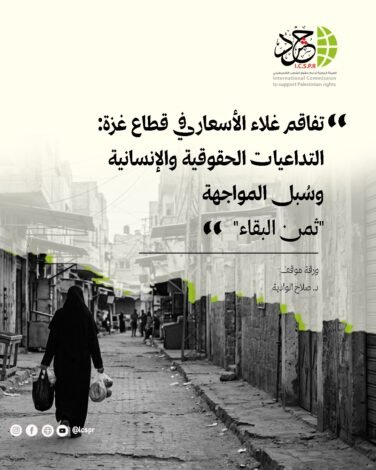
The International Commission to Support Palestinian Rights (ICSPR) has issued a position paper on escalating prices in the Gaza Strip, prepared by Dr. Salah Al-Wadiya. The paper examines the interconnected causes of the crisis and its human rights and humanitarian implications, and proposes measures to address it amid Israeli restrictions on the entry of goods, damage to productive facilities, disrupted supply chains, loss of income sources, and declining household purchasing power.
The Commission warns that the crisis is no longer limited to shortages of goods in markets. It now extends to the inability of large segments of the population to purchase essential supplies even when they are available for sale, threatening their rights to food, health, and an adequate standard of living, and compounding the burdens on families that have exhausted their savings and become dependent on assistance.
The Availability of Goods Does Not Mean People Can Afford Them
The paper explains that rising prices in Gaza result from the interaction of external and internal factors, including restrictions on crossings and trade, limited import channels, higher transport, storage, distribution, and fuel costs, as well as cash shortages, transaction fees, weak market oversight, and commercial practices that exploit limited supplies.
ICSPR stresses that addressing the crisis requires distinguishing between food availability and people’s ability to access it. The presence of goods on shop shelves does not guarantee food security if prices exceed families’ means, or if families must forgo medical treatment or other basic needs to secure food.
The paper emphasizes that the loss of employment and income, interrupted or irregular salaries, and repeated displacement make any increase in food, medicine, and energy prices more damaging to residents, particularly children, pregnant and breastfeeding women, older people, patients, and families that have lost their livelihoods.
Restrictions on Supplies Raise Costs and Increase Market Vulnerability
The paper examines the effects of Israeli restrictions on the quantity and types of goods entering Gaza and the regularity of their entry. It explains that supply disruptions and limited supply routes make markets more vulnerable to any closure, delay, or change in procedures governing the entry of goods.
It also notes that the destruction of commercial, agricultural, and productive facilities has weakened the local economy’s ability to compensate for import shortages and increased reliance on supplies that have become more complicated and costly to obtain.
The Commission stresses that assessing whether needs are being met should not be limited to the announced number of trucks permitted to enter. It must also consider what actually enters, the regularity of deliveries, the diversity of their contents, and their adequacy in meeting residents’ needs. It calls for a regular and sufficient flow of goods, fuel, and essential supplies alongside humanitarian assistance.
Cash Shortages Erode the Value of Funds Available to Families
The paper highlights the impact of cash shortages and the high fees associated with obtaining cash, citing information indicating that these fees range between 15% and 30% in some cases. This places additional burdens on residents and traders and reduces the effective value of the funds available to meet daily needs.
It explains that traders may pass part of the cost of obtaining cash on to consumers through higher prices, while consumers lose a portion of their money before spending it, creating accumulated burdens on both sides of the transaction.
The paper also addresses differences in the prices of some goods depending on the payment method—cash, payment applications, or bank transfers—and shortages of small denominations that may force some residents to purchase goods they do not need instead of receiving change. ICSPR calls for withdrawal, transfer, and payment costs to be treated as part of the cost-of-living crisis rather than as a separate financial issue.
Transparency and Accountability to Counter Exploitation and Monopolistic Practices
The paper raises questions about the concentration of some import and trade-coordination operations in the hands of a limited number of traders, the commissions and fees associated with bringing goods into Gaza, and their impact on the final cost borne by consumers.
It reviews field accounts concerning levies, fees, and commercial practices, calling for these accounts to be verified and subjected to oversight and accountability. It also calls for distinguishing between price increases linked to actual costs and those resulting from the exploitation of scarcity and weak competition.
ICSPR urges the authorities administering the Gaza Strip to strengthen market oversight, clearly disclose prices and costs, activate consumer complaint mechanisms, and investigate the withholding and stockpiling of goods for the purpose of raising prices and exploiting consumers. It stresses that these measures must respect legal safeguards and avoid actions that would further disrupt supplies.
An Integrated Response beyond Temporary Solutions
The Commission calls on the international community, the United Nations, and mediators to work to remove obstacles preventing essential supplies from reaching Gaza, ensure the regular entry of food, medicine, and fuel, and move beyond temporary relief interventions that do not address the causes of the crisis.
It also emphasizes the need to expand social protection programmes and support families that have lost their income, address cash shortages and payment costs, and support the restoration of local production. These measures would reduce reliance on imports and strengthen employment opportunities and the capacity to meet basic needs.
The paper stresses that tackling rising prices requires two parallel approaches: securing supplies and reducing obstacles to their delivery, while strengthening transparency, competition, oversight, and accountability within markets. Neglecting either approach, it warns, weakens consumer protection.
ICSPR concludes by affirming that protecting residents’ purchasing power is part of protecting their fundamental rights. Reducing the “cost of survival” in Gaza requires addressing restrictions on supplies, preventing exploitation of wartime conditions, restoring livelihoods, and ensuring that families have regular access to sufficient and safe food, medicine, and basic necessities at an affordable cost.