
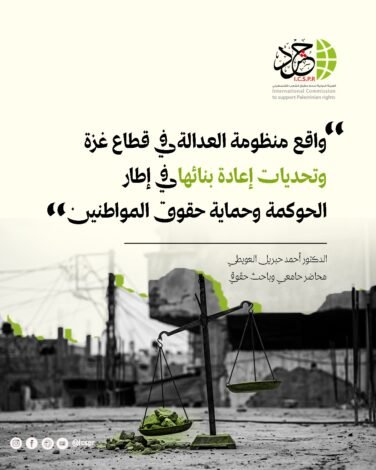
ICSPR: Collapse of Gaza’s Justice System Threatens Citizens’ Rights; No Stable Reconstruction Without an Independent Judiciary and Protection of Records and Property

Date: 19 October 2026
Press Release
ICSPR: Collapse of Gaza’s Justice System Threatens Citizens’ Rights; No Stable Reconstruction Without an Independent Judiciary and Protection of Records and Property
The International Commission to Support Palestinian Rights (ICSPR) has issued a paper titled “The Reality of the Justice System in the Gaza Strip and the Challenges of Rebuilding It within the Framework of Governance and the Protection of Citizens’ Rights.” The paper examines the destruction of courts, prosecution offices, the legal profession, and records; the consequences of disrupted judicial services for residents; and a phased pathway for rebuilding the system based on independence, integrity, and a unified legal framework.
The Commission stresses that the collapse of the justice system does not mean only the closure of courts. It deprives citizens of the primary means of protecting their rights to liberty, property, housing, and family, and of obtaining redress when those rights are violated. It emphasizes that restoring justice must be an integral part of the response and recovery effort, not a file postponed until after reconstruction.
The paper explains that the war on the Gaza Strip compounded pre-existing weaknesses, including political and legal division, overlapping legislative and judicial authorities, limited resources, case backlogs, and limited electronic archiving. It argues that rebuilding the system should not mean restoring the previous status quo without review, but addressing the vulnerabilities that weakened judicial independence, service quality, and public trust.
Widespread Damage to Justice Facilities and Rights Documentation
According to the assessment reviewed in the paper, approximately 90% of governance and rule-of-law facilities in the Gaza Strip were destroyed. Physical damage to these facilities was estimated at approximately $240.4 million, while the cost of rebuilding the justice, governance, and administration sector was estimated at approximately $526.7 million. The paper clarifies that these figures reflect damage across the broader sector and are not limited to court buildings.
The paper addresses the demolition of the main courthouse building in Gaza City, the shelling of the Bar Association headquarters and destruction of its official archive, and damage to other judicial, security, correctional, civil-records, and land-registry facilities.
ICSPR stresses that the destruction of documents is not merely an administrative loss. It threatens people’s ability to prove identity, lineage, marriage, death, inheritance, and property ownership, and complicates compensation claims, the restoration of rights, and return to homes and land.
The paper also notes that judges, lawyers, and justice-sector workers have been dispersed across displacement areas, with many working without offices, files, or adequate communication tools. This has disrupted personal-status cases, civil and criminal disputes, and decisions in cases involving detainees.
It further notes that the sources available when the paper was prepared did not include verified official figures on the total number of justice-sector workers killed or the precise volume of lost files and records, underscoring the need to complete assessment and documentation.
Women, Children, and Displaced People Most Affected by Disrupted Access to Justice
The paper explains that the disruption of courts directly affects cases involving alimony, custody, divorce, and inheritance, making it more difficult for women and families to claim their rights, particularly amid displacement, loss of documents and income, and limited legal assistance.
It also addresses the need for effective legal mechanisms to protect children who have lost their parents, regulate guardianship and custody, protect the assets of minors, and address files related to missing persons, proof of death, and families’ rights.
On housing and property, ICSPR warns that the destruction of homes, loss of documents, and restricted access to land increase the risks of disputes and property seizure, and threaten fair compensation and reconstruction.
The paper states that displaced people face additional barriers to filing and pursuing claims, including difficulty moving and communicating, loss of supporting documents, and lack of information and legal support. It stresses the need for accessible services that take into account the circumstances of women, children, and other people in vulnerable situations.
Mediation Cannot Replace Courts and Fair-Trial Guarantees
The paper notes that reliance on tribal reconciliation and informal mediation has expanded as judicial institutions have ceased functioning. While it acknowledges the role of these mechanisms in containing some disputes, it warns that they often lack fair-trial guarantees and enforcement powers, and may weaken the rights of women, children, and less influential parties.
ICSPR calls for regulating mediation within a clear legal framework that prevents its use as a substitute for courts in matters affecting fundamental rights and public order, and ensures that its outcomes are subject to judicial review and recognition in accordance with the law.
It also stresses the need for judicial and prosecutorial oversight of arrest and detention, expedited consideration of cases involving detainees and juveniles, and guarantees of the right to defence and a fair trial. The paper further addresses concerns about the detention of Gaza residents by Israel without trial, allegations of enforced disappearance and mistreatment, and calls for independent documentation and effective investigations.ppl-ai-file-upload.s3.amazonaws
Reconstruction Must Begin with a Unified Legal Framework and Judicial Independence
The Commission argues that the challenge extends beyond securing buildings and equipment. It requires agreement on a Palestinian legal and institutional framework that preserves the unity of the judiciary, prevents conflicting rulings, and clarifies the relationship of any transitional arrangements with the relevant national institutions.
The paper stresses that reconstruction should be Palestinian-led, with international support directed toward technical and financial assistance, without imposing models that disregard the Palestinian context or deepen division.
It calls for transparent criteria for appointing and promoting judges and prosecution officials, and for an objective review of exceptional appointments made during the division, based on competence, integrity, and defence guarantees, and free from political score-settling.
ICSPR affirms that judicial independence requires constitutional, financial, and administrative guarantees. Protection of personal liberty, property, and fair trial must be the benchmark for measuring the success of reform—not merely reopening courts.
Phased Pathway to Restore Services and Build Institutions
The paper proposes three interconnected phases for rebuilding the justice system. The first, an emergency stabilization phase lasting five months, focuses on restoring the minimum level of essential services, including documentation and proof of civil status, urgent consideration of cases involving detainees, juveniles, and families, and the possible use of temporary or mobile courts.
This phase also includes assessing damage, securing and safely digitizing surviving archives, establishing transitional rules for police and detention work that ensure judicial and prosecutorial oversight, and regulating reconciliation mechanisms in ways that protect rights.
The second phase, lasting from one to three years, aims at institutional recovery through rebuilding courts, prosecution offices, and correctional facilities; developing a national system for case management, information, and electronic archiving; and building the capacity of personnel.
Within this phase, the paper proposes a specialized mechanism to resolve property, housing, and compensation disputes. It would include judicial committees and flexible evidentiary rules that take account of lost documents, while preserving guarantees of fairness and the rights of all parties.
The third phase, from three to ten years, is dedicated to consolidating the system and unifying legislation, strengthening independent oversight of security and correctional institutions, and launching an integrated transitional-justice process that includes truth-seeking, redress, and guarantees of non-repetition.ppl-ai-file-upload.s3.amazonaws
Calls for Protection, Funding, and Accountability
ICSPR calls for a complete halt to hostilities, the entry of materials and equipment needed to rehabilitate courts, archives, and records, and the protection of justice-sector workers and safe access to their workplaces.
It also calls for urgent funding to repair and digitize civil-status and land records, provide free legal assistance to displaced people, and support fair mechanisms for resolving housing, property, and compensation disputes.
The Commission stresses the importance of involving women, displaced people, and the most affected groups in designing and implementing reconstruction programmes, publishing standards, budgets, and periodic reports, and providing clear complaint and accountability mechanisms.
It calls for independent and transparent investigations into attacks on justice-sector facilities and personnel, preservation of evidence, and its use in appropriate accountability processes. It stresses that truth-seeking and redress must not be postponed on the grounds of prioritizing reconstruction.
The paper proposes measuring progress through practical indicators, including the proportion of courts operating, average case-processing time, the proportion of detainees without a ruling, the proportion of judgments enforced, public satisfaction with justice services, the volume of digitized records, women’s representation in judicial positions, and the handling of complaints against enforcement bodies.
ICSPR concludes that courts and records are not secondary services, but fundamental safeguards for the return of displaced people, protection of property, restoration of trust, and civil peace. It stresses that rebuilding Gaza requires an independent and credible justice system that protects citizens from losing their rights, prevents impunity, and makes the rule of law the foundation of recovery and stability.