
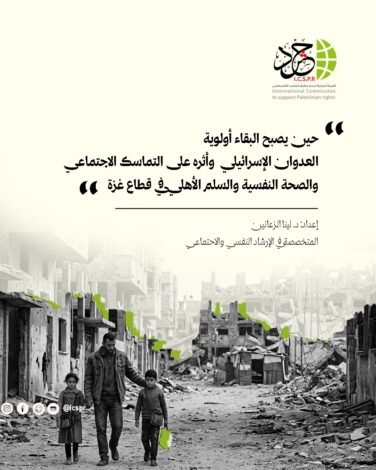
ICSPR Warns of “Solidarity Exhaustion” in Gaza Protecting Mental Health and Social Cohesion Is Essential for Survival and Recovery

Date: 18 October 2026
Press Release
ICSPR Warns of “Solidarity Exhaustion” in Gaza: Protecting Mental Health and Social Cohesion Is Essential for Survival and Recovery
The International Commission to Support Palestinian Rights (ICSPR) has issued a paper titled “When Survival Becomes a Priority: Israeli Aggression and Its Impact on Social Cohesion, Mental Health, and Civil Peace in the Gaza Strip.” The paper examines the overlapping effects of war, displacement, loss, and the collapse of services on families and community relationships. It warns of the depletion of residents’ capacity to provide care, cooperate, and support one another, despite continuing expressions of solidarity and local initiatives.
The Commission affirms that protecting mental health and social cohesion is not a peripheral service added to relief efforts, but an essential part of protecting people and their ability to survive and recover. It stresses that Palestinian society’s resilience does not mean it can bear the burdens of war alone, and that local solidarity must be a partner in the humanitarian response—not a substitute for services, institutions, and humanitarian obligations.
Solidarity Continues, but the Capacity to Give Is Being Depleted
The paper explains that society may appear cohesive from the outside while high levels of exhaustion accumulate within it. Families continue caring for their members and hosting displaced people, neighbours share food and water, and volunteers organise initiatives. Yet this sometimes comes at the expense of steadily diminishing psychological and material resources.
The paper introduces the concept of “solidarity exhaustion” to describe a situation in which the desire to help others persists while the material and psychological capacity to continue doing so declines. It warns against interpreting people’s reduced ability to give as a moral decline or a collapse of social values, when it may instead be a direct consequence of loss, poverty, and sustained pressure.
Through the paper, ICSPR distinguishes between solidarity as an immediate response to crisis and social cohesion as a broader capacity to maintain trust, belonging, and cooperation and manage disagreements without violence. It stresses that the continuation of grassroots initiatives, important as it is, does not remove the need for regular support to protect those running them from depletion.
When Life Is Reduced to Meeting Daily Needs
The paper examines how war reshapes the priorities of individuals and families, narrowing opportunities for work, learning, and planning for the future and replacing them with daily questions about water, food, medicine, shelter, safety, and the possibility of renewed displacement.
It explains that the constant search for these necessities consumes not only time and money, but also attention and psychological and emotional energy. This may limit individuals’ ability to tolerate disagreements, participate in public affairs, and maintain long-term relationships.
The paper also notes that a person may simultaneously need support and provide it: someone may be displaced while hosting others, affected by the crisis while caring for relatives, or exhausted while trying to comfort their children. The Commission considers that these overlapping roles create compounded burdens requiring a response that addresses caregivers’ needs, not only those of the people receiving care.
Displacement Dismantles Safety Nets and a Sense of Belonging
The paper affirms that displacement is not simply movement from one place to another. It is an uprooting from the environment that structures people’s lives, relationships, and everyday memories. Losing a home also means losing privacy, routines, neighbours, a nearby school, and the support networks that sustained families during difficult times.
According to the data reviewed in the paper, approximately 1.9 million of the Gaza Strip’s 2.1 million people were displaced in mid-2026. A report covering the first quarter of the same year indicated that approximately 800,000 children remained displaced, many living in overcrowded and unhealthy conditions lacking privacy.
ICSPR explains that repeated displacement makes rebuilding relationships more difficult, increases pressure on host communities, undermines children’s stability, and forces reliance on support networks that may themselves be depleted. It stresses that reducing displacement to a “shelter problem” obscures its deeper effects on belonging, trust, and social relationships.
The paper also examines the destruction of homes, schools, health facilities, and workplaces. It explains that their loss means more than the disappearance of their immediate services; it also means losing psychological and social functions, including safety, stability, social interaction, independence, and a sense of productive capacity.
Families and Caregivers Under Sustained Pressure
The paper notes that, as institutions and services cease functioning, families have become the primary safety net for children, patients, older people, and those who have lost their income—even when those families have themselves lost their homes or loved ones and are living in cramped conditions with limited resources.
It explains that, under these circumstances, families shift from being units of everyday living and care to units of crisis management, with responsibilities divided among finding water, food, medicine, and assistance and caring for children and injured people. It stresses that supporting one individual while leaving their family environment exhausted may have only a limited effect.
The paper pays particular attention to women and caregivers, who undertake a substantial amount of invisible daily work, from securing basic necessities to caring for patients, comforting children, and organising life in displacement settings.
ICSPR stresses that women must not be viewed solely as an affected group. They are also active contributors to community responses, initiatives, education, and care. Protecting them from exhaustion, it argues, means protecting a fundamental pillar of family and social life.
Protecting Children and Young People Is Part of Protecting Society’s Future
The paper explains that children experience war as a comprehensive disruption of their daily lives, depriving them of the places, relationships, and routines that provide a sense of safety. Its effects extend to learning, behaviour, relationships, and the ability to adapt.
It reviews data indicating that approximately nine out of ten children consulted during the first half of 2026 reported needing psychosocial support. The paper stresses that this finding should not be reduced to individual diagnoses, but understood as an indicator of the pressures affecting the environment in which children are supposed to grow.
The paper links the protection of children’s mental health to the presence of a family capable of providing care, a safe place, education and daily routines, food, water, health care, and spaces for play, expression, and interaction with peers.
Regarding young people, it notes that war disrupts education, employment, pathways to independence, family formation, and public participation. However, it stresses that young people are not merely recipients of assistance: they have contributed through volunteering, organising aid, supporting children, and exchanging information.
ICSPR calls for involving young people in designing programmes and community initiatives, non-formal education, dialogue, and mediation, thereby strengthening their role in solutions and preserving their capacity to participate and contribute.
Fair Aid Distribution Is a Condition for Trust and Civil Peace
The paper examines the relationship between resource scarcity and social tensions, stressing that the issue concerns not only the volume of aid, but also equitable access and clear distribution criteria.
It reviews monitoring findings from June 2026 indicating that cash assistance was the main source of income or support for 72% of beneficiary households covered by post-distribution monitoring. It clarifies that this percentage applies to the monitored sample and does not necessarily represent all households in the Gaza Strip.
The Commission argues that clear and fair distribution can strengthen trust, while uncertainty, perceived discrimination, and unequal access may turn assistance itself into a source of tension. It stresses that fairness in relief is not an administrative matter separate from civil peace, but one of its conditions.
The paper also notes that water scarcity and crowding at collection points consume families’ time and energy and may create additional pressures over responsibilities, priorities, and distribution. This highlights the need to link the restoration of services with reducing social burdens.
Conflict Prevention Begins with Addressing Its Causes
The paper warns that accumulated fear, loss, deprivation, and displacement, without sufficient opportunities for recovery, may weaken individuals’ capacity for dialogue and tolerance of differences. This can increase the likelihood that disagreements over water, money, housing, and care develop into wider disputes.
It stresses, however, that this outcome is not inevitable and that the Palestinian experience has demonstrated a strong capacity for solidarity, adaptation, and initiative. Regular essential services, fair assistance, psychosocial support, spaces for dialogue and mediation, and trusted local leadership can ease pressures and prevent them from escalating into conflict.
In light of the paper, ICSPR calls for an integrated response combining the provision of basic necessities and the restoration of services with support for families, host communities, volunteers, and caregivers, expanded access to mental health services and social support, stronger participation, and equitable resource distribution.
ICSPR concludes that protecting social cohesion does not begin after conflict occurs, but by preventing the conditions that make it more likely. Genuine recovery goes beyond rebuilding physical places to restoring trust, relationships, and the ability to live together. It stresses that a society continuing to show solidarity despite war needs support to preserve its capacity to carry on—not additional burdens placed upon it in the name of resilience.Hyn-ySbH-lbq-wlwy.pdf