
ICSPR: Three Years Since the Start of the Genocidal War in Gaza Losses Extend Beyond Casualties and Rubble to the Destruction of the Foundations of Life and Society’s Future

Date: 18 October 2026
Press Release
ICSPR: Three Years Since the Start of the Genocidal War in Gaza—Losses Extend Beyond Casualties and Rubble to the Destruction of the Foundations of Life and Society’s Future
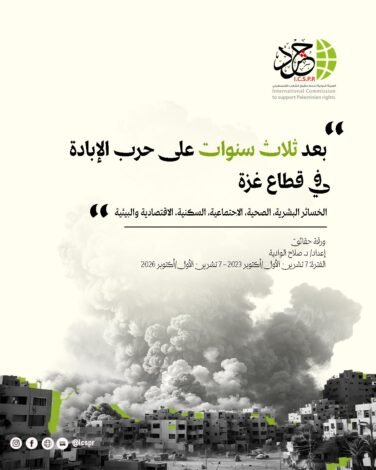
The International Commission to Support Palestinian Rights (ICSPR) has issued a fact sheet titled “Three Years Since the Start of the Genocidal War in the Gaza Strip: Human, Health, Social, Housing, Economic, and Environmental Losses.” Covering the period from 7 October 2023 to 7 October 2026, the paper examines the scale of accumulated losses and their consequences for residents’ lives, rights, and ability to recover.
The Commission affirms that the true cost of the war cannot be reduced to the numbers of people killed and injured or the value of destroyed buildings. It also encompasses the loss of families, livelihoods, education, health, and personal independence, the breakdown of social support networks, and the deterioration of the environment and essential services. It stresses that rebuilding Gaza requires an integrated response that restores people’s rights and security alongside the reconstruction of homes, institutions, and infrastructure.
Human Losses and Life-Changing Injuries
According to the data reviewed in the paper, the reported death toll reached 74,245, while 175,267 people had been reported injured as of 6 October 2026. The paper explains that these figures do not necessarily represent the final toll, as people remain beneath the rubble or in areas inaccessible to rescue teams, while searches, the recovery of bodies, and identification efforts continue.
It also reports 1,462 deaths and 5,151 injuries between the announcement of the ceasefire in October 2025 and 6 October 2026, reflecting continuing human losses and risks associated with intermittent bombardment, damaged buildings, and unexploded ordnance.
ICSPR notes that the consequences of injury do not end with initial treatment. More than 43,000 injured people sustained potentially life-changing injuries, according to the health estimates cited in the paper through spring 2026. These include serious injuries to limbs, the spinal cord, and the brain, as well as severe burns, while more than 50,000 people require long-term rehabilitation.
The paper reviews more than 5,000 amputation cases, with children estimated to account for approximately one-fifth of those affected, alongside a substantial gap between the need for prosthetic limbs and rehabilitation services and the capacity to provide them. The Commission stresses that protecting injured people and persons with disabilities requires ongoing treatment, assistive devices, accessible housing and facilities, psychosocial support, and opportunities for education and employment.
Childhood Amid Loss, Injury, and Interrupted Education
The paper identifies children as among the most severely affected groups, citing data indicating that at least 21,700 children had been killed and approximately 45,000 injured by 30 June 2026, including more than 11,000 with life-changing injuries. It explains that children’s suffering also encompasses the loss of parents, relatives, and friends, repeated displacement, malnutrition, interrupted education, and the loss of a sense of safety.
Regarding mental health, the paper reports that approximately nine out of ten children surveyed during 2026 expressed a need for psychosocial support. ICSPR stresses that this support must be integrated into education, health, and protection programmes rather than treated as a secondary intervention that can be postponed.
The paper explains that the destruction of education threatens long-term losses in skills, employment opportunities, and development. According to the July 2025 data it reviews, approximately 97% of schools had sustained some degree of damage, and 518 of 564 schools required complete rebuilding or major rehabilitation before they could function.
It also reports that 22 university campuses were completely destroyed and another 14 sustained varying degrees of damage out of 38 campuses assessed. The Commission affirms that restoring education requires rehabilitating institutions, addressing learning loss, and supporting students and teachers—not merely reopening buildings.
An Exhausted Health System and Growing Burdens on Families
In the health sector, the paper indicates that only 19 of 36 hospitals were partially functioning as of September 2026, with no hospital operating at full capacity and severe shortages of medicines, equipment, and fuel.
ICSPR warns of the consequences for cancer patients, kidney patients, people with chronic illnesses, pregnant women, and newborns, as well as injured people requiring specialised surgery and rehabilitation. It stresses that restoring health services requires securing operational supplies and continuity of treatment alongside the rehabilitation of facilities.
The paper examines changes in family structures, noting that approximately 86,290 households are now headed by women—nearly one in four households, compared with approximately one in nine before the war. It explains that this category includes not only widows, but also women whose husbands are missing, detained, severely injured, or whose fate is unknown.
The Commission argues that the loss of breadwinners and declining services have placed additional burdens on families, particularly women, amid poverty, displacement, a lack of privacy, and difficulties accessing care. It calls for emergency assistance to be linked with social protection, legal and psychological support, and economic empowerment.
Displacement, Housing Destruction, and Rubble-Related Risks
According to the assessments presented in the paper, approximately 1.9 million Palestinians experienced displacement within the Gaza Strip, many of them repeatedly, while more than 60% of residents lost their homes. The paper cites an estimate that more than 371,888 housing units were destroyed or damaged.
It also notes that an assessment of structures as of 16 June 2026 identified damage to approximately 201,290 structures, representing nearly 82% of the Gaza Strip’s structures, including 134,422 classified as destroyed. It clarifies that the figures for housing units and structures reflect different categories and assessments and should not be combined into a single total.
ICSPR affirms that the housing crisis extends beyond the loss of homes to overcrowding, loss of privacy, exposure to cold, heat, and rain, and difficulties accessing water, electricity, and sanitation. Returning to destroyed areas does not necessarily mean returning to a safe or habitable environment.
The paper reviews estimates of at least 61 million tonnes of rubble, with more recent estimates exceeding this amount when rubble and contaminated materials are included. It warns of the dangers posed by asbestos, hazardous materials, and unexploded ordnance to residents, returnees, rescue personnel, rubble-removal workers, and construction workers.
The Commission stresses that rubble removal must follow specialised procedures that safeguard residents and workers, enable the recovery of victims’ remains, and ensure the safe handling of hazardous materials and explosive remnants.
Water, Food, Agriculture, and the Economy
In the water sector, the paper reports that approximately 74% of Gaza’s population relies on drinking water delivered by trucks, according to the October 2026 data it reviews. It also indicates that all six wastewater treatment plants are out of service and approximately 70% of pumping stations are non-functional, increasing the risks of water contamination and disease.
The Commission affirms that restoring water and sanitation services requires repairing networks, operating facilities, and securing electricity, fuel, and spare parts, rather than merely maintaining emergency solutions without addressing the causes of service collapse.
Regarding food, the paper explains that improvements in supplies during some periods remained fragile. The problem concerns not only food availability, but also the destruction of the local capacity to produce it. It notes that, as of 24 June 2026, only approximately 3% of agricultural land remained both accessible and undamaged, while other accessible areas required rehabilitation.
The paper also addresses damage to fishing, coastal facilities, agricultural equipment, wells, and greenhouses, and the resulting loss of food and income sources for thousands of families. ICSPR considers support for agriculture and fishing and the restoration of local production essential to addressing prolonged dependence on aid.
On the economy, the paper reviews estimates indicating that unemployment reached approximately 78% during 2025, alongside the continuing disruption of major productive sectors and the destruction of facilities, equipment, inventories, and supply chains. It explains that an individual’s ability to work is insufficient when they lack a workplace, capital, electricity, raw materials, access to markets, and transport.
According to the damage and needs assessment cited in the paper, direct physical damage was estimated at approximately US$35.2 billion and economic and social losses at approximately US$22.7 billion, while recovery and reconstruction needs amounted to approximately US$71.4 billion over ten years, including US$26.3 billion during the first 18 months. The Commission stresses that these are distinct categories of estimates and that future needs cannot be reduced to the value of direct damage.
Recovery Requires Rebuilding Society, Not Buildings Alone
The paper concludes that the effects of the war accumulate across human, health, family, housing, education, economic, and development losses that are difficult to separate. It also addresses losses to culture, heritage, archives, and the memory of places, alongside the breakdown of neighbourhoods and networks of mutual support and care—damage that financial estimates cannot fully capture.
ICSPR affirms that the required response must combine civilian protection and guaranteed humanitarian access with restoring hospital operations, securing housing, removing rubble and explosive remnants, restoring education, water, and energy, and reviving agriculture, fishing, markets, and employment opportunities.
It also stresses the need to prioritise children, women, families that have lost their breadwinners, injured people, persons with disabilities, and older people, and to ensure their participation in identifying recovery needs so that reconstruction does not become disconnected from the rights of those affected.
ICSPR concludes that rebuilding Gaza is not merely an urban reconstruction project, but a process of restoring life, dignity, security, and the ability to learn, work, and produce. Any recovery plan remains incomplete unless it addresses individuals, families, and society alongside the rebuilding of institutions, services, and infrastructure.b-d-thlth-snwt-l-Hrb-lbd-fy-qT-Gz.pdf