

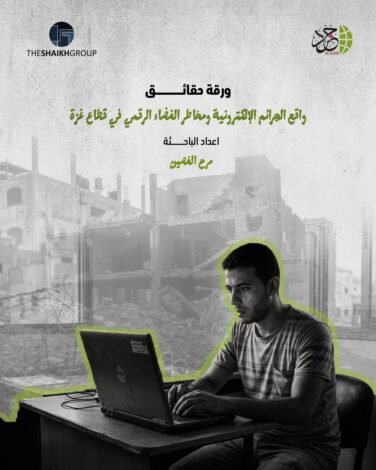
ICSPR Issues a Fact Sheet on Cybercrime and Digital-Space Risks in the Gaza Strip

Date: 8 September 2026
Press Release
ICSPR Issues a Fact Sheet on Cybercrime and Digital-Space Risks in the Gaza Strip
The International Commission to Support Palestinian Rights (ICSPR) has issued a fact sheet on cybercrime and digital-space risks in the Gaza Strip. The paper examines the escalating threats faced by individuals and institutions in the digital environment amid increasing reliance on the internet and social-media platforms for education, work, communication, and access to information and services, alongside the continuing war, declining traditional services, and weakened telecommunications and electricity infrastructure.
The paper explains that the digital sphere has become an essential part of Palestinians’ daily lives. Palestine’s population is estimated at approximately 5.5 million people, while internet usage ranges between 88% and 90% of the population, and smartphone penetration exceeds 82%. People aged between 18 and 35 account for approximately 80% to 85% of social-media users, with Facebook, WhatsApp, Instagram, and TikTok among the most widely used platforms.
The paper notes that the expansion of reliance on digital services and platforms has been accompanied by growing cybercrime risks, including account hacking and theft, online financial fraud, cyber extortion, phishing, digital identity theft, malicious software, cyberbullying and online defamation, as well as the spread of false news and misleading information.
The paper explains that account hacking includes taking over social-media or email accounts and stealing personal data. Cyber extortion involves threatening victims with the publication of private images or information in exchange for money or other gains. Online financial fraud includes impersonating institutions or individuals to obtain money or banking information through deceptive means.
It notes that phishing takes place through the circulation of fraudulent links, messages, and webpages intended to steal passwords and personal data. Digital identity theft involves creating fake accounts in the names of individuals or institutions for the purpose of deception, abuse, or fraud. The paper also warns of malicious software that may lead to the hacking or disabling of devices or the theft of their contents and data.
The paper explains that children, adolescents, young people, women, activists, online workers, and users of digital services are among the groups most exposed to these risks because of intensive use of digital tools and limited knowledge of protection methods. The exceptional humanitarian conditions in the Gaza Strip, electricity cuts, damage to communications networks, and increased dependence on digital platforms also make individuals more vulnerable to exploitation, fraud, and hacking.
The paper warns that the effects of cybercrime are not confined to material or technical losses. They extend to violations of privacy, data theft, defamation, extortion, and coercion, with serious psychological and social consequences. Such crimes may also result in the theft of bank accounts or electronic wallets and the spread of rumours and misleading information that affect public awareness and increase anxiety and instability.
The paper highlights the particular risks facing children and young people in the digital environment, including cyberbullying, exploitation, exposure to inappropriate content, and digital addiction, as well as the negative impact of these risks on their sense of safety and trust in using electronic services.
It identifies key challenges facing cybercrime prevention and the strengthening of digital security in the Gaza Strip, including weak cybersecurity awareness among a broad segment of users, particularly children and youth; limited technical capacity among individuals and institutions due to economic conditions and the siege; and reduced ability to use protection programmes and secure digital systems.
The paper further explains that the continuous evolution of cybercrime methods and the use of more complex technologies make such crimes difficult to detect or counter. It stresses the need to develop national legislation and policies related to data protection and cybercrime prevention in a manner that keeps pace with rapid technological developments.
The paper recommends strengthening community awareness programmes on digital security and safe internet use, with a focus on children, youth, and women, and integrating cybersecurity concepts and digital literacy into educational curricula and training programmes.
It also calls for developing national legislation and policies related to combating cybercrime and protecting privacy and personal data, while supporting the capacities of relevant bodies and enhancing their technical and technological capabilities to confront and investigate digital crimes.
The paper stresses the importance of encouraging the use of digital-protection measures, including strong and different passwords for accounts, two-factor authentication, regular updates of software and applications, and caution when dealing with suspicious links, untrusted messages, and applications from unknown sources.
It further recommends implementing regular awareness campaigns on the risks of online fraud and cyber extortion, prevention methods, and mechanisms for reporting digital crimes. It also calls for strengthening the role of families, schools, and civil-society organisations in protecting children from exploitation, cyberbullying, and inappropriate content in the digital environment.
ICSPR affirms that protecting individuals and institutions in the digital space has become an urgent community and human-rights priority. Strengthening safe digital literacy and developing protection tools, awareness, and institutional capacities are essential to reducing cybercrime and safeguarding the privacy, dignity, and personal security of users in the Gaza Strip.
ICSPR affirms that this paper is issued in partnership with The Shaikh Group (TSG) as part of efforts to raise awareness of cybercrime risks, strengthen digital security, and enable individuals and institutions to use the digital space safely and responsibly.
It should be noted that this fact sheet does not necessarily reflect the views of ICSPR or The Shaikh Group (TSG).
To read the full paper, click here.