
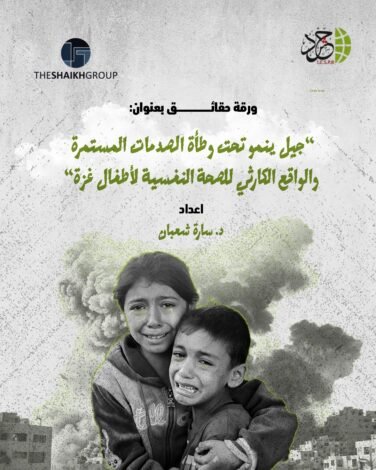
ICSPR Issues a Fact Sheet Titled “A Generation Growing Under the Weight of Continuous Trauma The Catastrophic Reality of Mental Health for Children in Gaza”

Date: 29 July 2026
Press Release
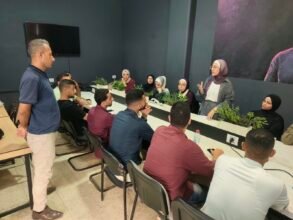
In partnership with The Shaikh Group (TSG) and as part of the Youth Civil Society Activists Diploma Program
ICSPR Issues a Fact Sheet Titled: “A Generation Growing Under the Weight of Continuous Trauma: The Catastrophic Reality of Mental Health for Children in Gaza”
The International Commission to Support Palestinian Rights (ICSPR), in partnership with The Shaikh Group (TSG) and as part of the Youth Civil Society Activists Diploma Program, has issued a fact sheet prepared by Dr. Sarah Shaaban titled: “A Generation Growing Under the Weight of Continuous Trauma: The Catastrophic Reality of Mental Health for Children in Gaza.” The paper highlights the profound and cumulative psychological consequences of the genocidal war, blockade, and repeated displacement on children in the Gaza Strip. It stresses that children’s experiences cannot be reduced to the conventional concept of post-traumatic stress disorder, but rather constitute continuous and cumulative trauma that accompanies them daily and threatens their psychological, social, and cognitive development in the long term.
The paper explains that the impact of war extends beyond visible physical destruction, leaving deep and invisible scars on the psychological well-being of the younger generation as a result of bombardment, the loss of loved ones, the destruction of homes, repeated displacement, and the absence of basic human security. Children in Gaza are living in a state of constant fear and alertness, which affects their ability to learn, interact socially, and develop properly.
According to the data reviewed in the paper, all children in the Gaza Strip require different forms of urgent psychosocial support as a result of their direct exposure to the horrors of war. Some 87% of children experience severe psychological distress and constant fear, while more than 80% suffer from depression and anxiety associated with loud sounds.
The paper states that more than one million children in the Gaza Strip are in urgent need of mental health and psychosocial support services. More than 92% show clear clinical symptoms of trauma, including persistent fear, acute anxiety, loss of appetite, sleep disturbances, nightmares, bedwetting, and dissociative reactions. Sleep disturbances and nightmares affect approximately 79% of children.
The paper notes that thousands of children have lost one or both parents or have become unaccompanied and separated from their families, depriving them of their primary and essential emotional safety network for coping with trauma. It stresses that family loss, together with displacement and the destruction of the educational and social environment, increases children’s vulnerability and undermines their ability to recover psychologically.
The paper reveals that around 85% of community mental health centres and clinics operated by the Ministry of Health and civil society institutions have been destroyed or closed, including the only psychiatric hospital in the Gaza Strip. It also refers to the killing, injury, and displacement of dozens of psychologists, social workers, and psychiatrists. Those who remain continue to work under extremely harsh conditions while suffering from secondary trauma and the displacement of their own families.
The paper explains that the collapse of mental health services coincides with the near-total depletion of essential psychiatric medicines, including sedatives, antidepressants, and antipsychotic medications. This has caused serious relapses among previously diagnosed patients and made medical intervention in acute cases extremely difficult.
The paper examines the physical, psychological, and behavioural manifestations of trauma among children, including insomnia, nightmares, night terrors, bedwetting, chronic headaches, and recurrent stomach pain. It also identifies emotional and behavioural disorders such as excessive attachment to parents, fear of loss, aggressive behaviour and unexplained anger, social withdrawal and silence, and exaggerated fear responses to sudden sounds.
The paper notes that continuous trauma affects children’s cognitive and educational abilities through impaired concentration, comprehension, and memory, as well as reduced interest in play and developmental activities. It warns that the ongoing neglect of mental health protection may lead to delayed or impaired cognitive development and increase the likelihood of chronic depression, anxiety disorders, isolation, and aggressive behaviour, in addition to psychosomatic disorders that may develop into chronic illnesses later in life.
At the social level, the paper explains that repeated forced displacement and family separation have caused the collapse of social support networks that form the essential foundation for children’s safety and sense of belonging. The destruction of schools or their conversion into shelters has deprived children of their natural environment for learning and social interaction, disrupted routines and stability, intensified frustration and community violence, and weakened prospects for healthy psychological and social development.
The paper affirms that the reality imposed on children in Gaza constitutes a grave violation of international humanitarian law and international human rights law, particularly the rights to life, comprehensive development, protection during armed conflict, and psychological and social rehabilitation under the Convention on the Rights of the Child. It further notes that the Fourth Geneva Convention affords children special protection and prohibits forced displacement, collective punishment, and unlawful attacks on civilians.
The paper calls for a comprehensive and sustained cessation of military operations as a fundamental prerequisite for beginning children’s psychological recovery. It also calls for establishing an emergency mental health and psychosocial support network through urgent international funding to rebuild support centres and train local personnel. In addition, it recommends support programmes for parents and caregivers to enable them to regain their role as a source of safety for children.
The paper further stresses the need to integrate mental health clinics and services into the educational process when it resumes, transform schools and shelters into child-friendly spaces, and adopt psychosocial support and art therapy programmes to help children express their experiences and address the effects of trauma. It also calls for supporting psychologists and social workers and providing them with self-care and professional support.
The paper recommends activating international legal accountability, pursuing those responsible for crimes against children, and exerting international pressure to compel the occupying power to respect the Convention on the Rights of the Child and the rules of international humanitarian law. It affirms that safeguarding the mental health of Gaza’s children is a global humanitarian, legal, and moral responsibility, and that investing in their psychological stability today is an investment in the survival, identity, and capacity for recovery of Palestinian society.
ICSPR affirms that this paper, issued in partnership with The Shaikh Group (TSG), forms part of efforts to expose the profound psychological dimensions of the genocidal war on children in the Gaza Strip and to advance an urgent and comprehensive international response that places the protection and rehabilitation of children’s mental health at the centre of humanitarian and human rights priorities.
It should be noted that this fact sheet does not necessarily reflect the views of ICSPR or The Shaikh Group (TSG).