
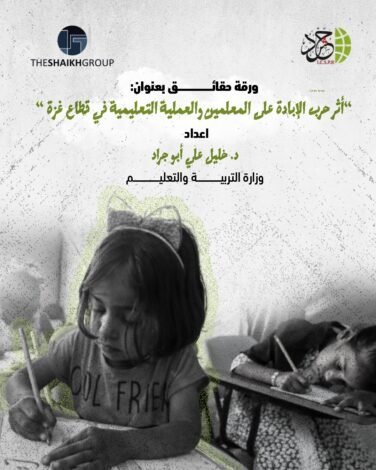
ICSPR Issues a Fact Sheet Titled: “The Impact of the Genocidal War on Teachers and the Educational Process in the Gaza Strip”

Date: 26 July 2026
Press Release
In partnership with The Shaikh Group (TSG) and as part of the Youth Civil Society Activists Diploma Program
ICSPR Issues a Fact Sheet Titled: “The Impact of the Genocidal War on Teachers and the Educational Process in the Gaza Strip”
The International Commission to Support Palestinian People’s Rights (ICSPR), in partnership with The Shaikh Group (TSG) and as part of the Youth Civil Society Activists Diploma Program, has issued a fact sheet prepared by Dr. Khalil Ali Abu Jarad of the Ministry of Education, titled: “The Impact of the Genocidal War on Teachers and the Educational Process in the Gaza Strip.” The paper highlights the catastrophic consequences of the ongoing genocidal war since October 2023 on the education sector, including the targeting of schools, universities, teachers, students, and educational infrastructure, which has resulted in the near-total collapse of the educational process in the Gaza Strip.
The paper explains that education is a fundamental pillar of community resilience and the preservation of Palestinian national identity. Its role goes beyond the transmission of knowledge to include providing psychosocial protection for children and young people and maintaining continuity of life during wars and crises. However, widespread attacks on educational institutions, alongside mass displacement and the conversion of hundreds of schools into shelters for displaced persons, have deprived hundreds of thousands of students of their basic right to education and created one of the gravest educational crises in contemporary Palestinian history.
According to the data reviewed in the paper, 18,863 students have been killed and 27,391 others injured. In addition, 792 teachers and administrative staff members have been killed and 3,251 injured. A total of 297 government schools and 100 schools operated by the United Nations Relief and Works Agency for Palestine Refugees in the Near East (UNRWA) have been damaged, while the proportion of damaged or destroyed schools has exceeded 97%.
The paper states that approximately 658,000 children have been affected by the disruption of education, while more than 785,000 students have been deprived of their right to education. It further documents the complete destruction of 63 university buildings and the use of hundreds of schools as shelters, which has reduced the availability of safe educational spaces and prevented the regular resumption of in-person education.
The paper addresses the severe humanitarian and professional conditions faced by teachers and educational personnel, including repeated forced displacement, the loss of homes and sources of income, and the killing of family members, in addition to the killing and injury of hundreds of education-sector workers. It stresses that these circumstances have directly affected their ability to sustain the educational process, despite their continued efforts to preserve a minimum level of education in an environment lacking safety and basic resources.
The paper explains that the extensive destruction of schools and universities has suspended in-person education for prolonged periods. Attempts to provide online and distance education have faced major obstacles, including repeated power and internet outages, limited technical capacity, and shortages of learning devices. These conditions have widened learning loss and reduced academic achievement among students at all educational levels.
Despite these circumstances, the paper notes limited initiatives aimed at maintaining the educational process through the establishment of temporary learning points and centres in camps, displacement sites, and tents, with the involvement of the Ministry of Education, civil society organisations, and international organisations. These initiatives sought to reduce learning loss and provide a minimum level of psychosocial and educational support for children, but remained limited due to continued attacks and shortages of resources and educational supplies.
The paper highlights the profound psychological, behavioural, and cognitive effects of the war on students and teachers, including heightened fear and anxiety, sleep disorders, psychological trauma, poor concentration, withdrawal, and aggressive behaviour among large numbers of children. The loss of safety and the continued exposure to bombardment, killing, and displacement have also weakened the ability to learn and comprehend, particularly among children who have lost family members or homes.
The paper notes that worsening economic and humanitarian conditions have contributed to increased school dropout rates and child labour, as some families have been forced to involve their children in different forms of work to secure the minimum requirements of daily life. It warns that the continuation of these conditions threatens to deprive an entire generation of Palestinian children and youth of opportunities for education, development, and social stability.
With regard to higher education, the paper documents the targeting of universities, colleges, laboratories, and research facilities, as well as the killing of academics, researchers, and university students. It stresses that the destruction of universities and the prolonged disruption of university education have weakened higher education institutions’ ability to fulfil their academic and research roles, threatening the future of thousands of students and the long-term state of scientific development in the Gaza Strip.
The paper concludes that the education sector in Gaza has been among the most targeted sectors during the genocidal war, whether through direct attacks on schools and universities or through the destruction of educational infrastructure and the conversion of schools into displacement shelters. It considers that this targeting extends beyond its academic consequences, constituting a long-term strategic threat to the educational and social environment and to the future of an entire generation of Palestinians.
The paper presents a set of urgent recommendations, most notably protecting educational institutions under the rules of international humanitarian law and preventing the targeting of schools and universities. It also calls for international pressure to end attacks on teachers, students, and the education sector in Gaza; support for emergency education and remedial learning programmes; expansion of temporary learning points and centres in displacement areas and shelters; and the provision of psychosocial support programmes for students and teachers affected by the war.
The paper further stresses the need to support the reconstruction and rehabilitation of schools, universities, and destroyed educational infrastructure, and to ensure the provision of educational materials and alternative learning tools for children in displacement areas, in order to protect their right to education and mitigate the continuing impact of the war on their future.
ICSPR affirms that this fact sheet, issued in partnership with The Shaikh Group (TSG), forms part of efforts to monitor and document violations of the right to education, expose the impact of the genocidal war on teachers, students, and educational institutions in the Gaza Strip, and advance urgent international action to protect education, rebuild the sector, and prevent the loss of the future of an entire generation of Palestinian children and youth.
It should be noted that this fact sheet does not necessarily reflect the views of ICSPR or The Shaikh Group (TSG).