
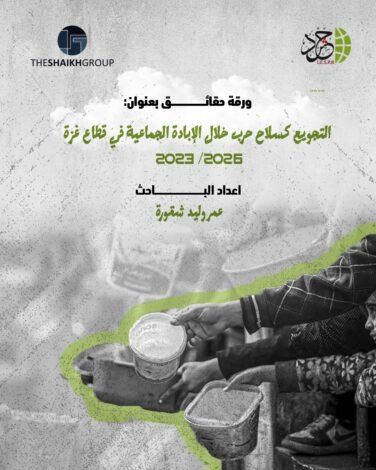
ICSPR Issues a Fact Sheet Titled: “Starvation as a Weapon of War During the Genocide in the Gaza Strip”

Date: 22 July 2026
Press Release
In partnership with The Shaikh Group (TSG) and as part of the Youth Civil Society Activists Diploma Program
ICSPR Issues a Fact Sheet Titled: “Starvation as a Weapon of War During the Genocide in the Gaza Strip”
The International Commission to Support Palestinian People’s Rights (ICSPR), in partnership with The Shaikh Group (TSG) and as part of the Youth Civil Society Activists Diploma Program, has issued a fact sheet prepared by researcher Omar Walid Shuqoura, titled: “Starvation as a Weapon of War During the Genocide in the Gaza Strip.” The fact sheet sheds light on the use of starvation as a systematic weapon of war against Palestinian civilians in the Gaza Strip between 2023 and 2025, presenting facts and figures drawn from UN and international reports and analysing these practices under international humanitarian law and international criminal law.
The paper explains that the occupying power has imposed a comprehensive siege on the Gaza Strip since 7 October 2023, including restrictions on the entry of food, water, medicine, fuel, and humanitarian assistance. This has led to the collapse of food security and the emergence of indicators of mass famine. It stresses that the siege was not merely a side effect of military operations, but rather a deliberate policy that targeted civilians and deprived them of the basic means of survival.
The fact sheet cites a public statement by Israeli Defence Minister Yoav Gallant on 9 October 2023, in which he announced a complete siege on the Gaza Strip, including the suspension of electricity, food, and fuel. It considers this statement evidence of prior intent to use starvation as an instrument of war against the civilian population.
According to the data reviewed in the paper, the threat of famine in the Gaza Strip reached catastrophic levels. Around 1.1 million Palestinians were threatened with catastrophic famine in March 2024, while reports issued in May 2025 confirmed that the entire population of the Gaza Strip was experiencing acute food insecurity and that approximately 500,000 people faced an immediate risk of famine. The paper further notes that, by December 2025, 77% of the population was experiencing acute food insecurity, with more than 100,000 people in the famine phase.
The paper highlights the devastating impact of hunger and malnutrition on children. It reports that 5,119 children were admitted for treatment of acute malnutrition in June 2025 alone, while 12,000 children were recorded as suffering from acute malnutrition in July of the same year. It also refers to a study published in The Lancet in October 2025, which confirmed that more than 54,600 children were affected by acute malnutrition.
The fact sheet documents the sharp increase in deaths linked to hunger and malnutrition, noting the deaths of 80 children from malnutrition within less than three months, and more than 430 deaths by September 2025, including 140 children. It also cites UNICEF estimates from October 2025, which placed the total number of hunger- and malnutrition-related deaths at more than 450, including 150 children.
With regard to food, water, and agricultural infrastructure, the paper states that 96% of agricultural land in the Gaza Strip had become either unsuitable for cultivation or inaccessible, alongside the near-total collapse of the local food system due to the destruction of bakeries, warehouses, and markets. It also documents the destruction of water desalination plants, municipal wells, and sewage networks, making access to safe drinking water extremely difficult and contributing to the spread of epidemics and disease.
The paper further explains that the targeting extended to the fishing sector, through preventing fishers from accessing the sea and destroying boats and harbours, thereby depriving the population of a key source of protein. It adds that the siege developed into a systematic system of administrative and military obstruction, including the classification of essential items as “dual-use” materials, such as water purification equipment and solar energy systems needed by hospitals, as well as repeated inspections and the rejection of aid trucks because of a single unauthorised item.
The paper highlights attacks on international and local humanitarian personnel, including the targeting of a World Central Kitchen aid convoy in Deir al-Balah on 1 April 2024, which killed seven humanitarian workers. It also documents attacks on civilians waiting for aid, including victims of the Al-Nabulsi Roundabout massacre, as well as killings and detention connected to attempts to bring humanitarian aid into the Gaza Strip.
The paper notes that, even after the entry of some aid trucks was permitted following prolonged and complete interruptions in food and medicine supplies, the occupying power continued to obstruct aid delivery and refused to secure or ensure its humane distribution. It also documents attacks on police officers and civilians who attempted to organise distribution operations and secure the arrival of humanitarian assistance, reflecting the systematic nature of the starvation policy.
Legally, the paper stresses that the starvation of civilians and the destruction of objects indispensable to their survival are prohibited under Article 54 of Additional Protocol I to the Geneva Conventions of 1977. It further notes that Article 8 of the Rome Statute of the International Criminal Court defines the intentional starvation of civilians and the obstruction of humanitarian relief as a war crime.
The paper addresses the provisional measures issued by the International Court of Justice in the case brought by South Africa against Israel in January and March 2024. These measures ordered the opening of crossings and the unimpeded entry of humanitarian aid to prevent genocide. The paper also refers to the request by the Prosecutor of the International Criminal Court for arrest warrants against Israeli leaders on allegations related to the use of starvation as a weapon of war.
The paper concludes with a set of urgent recommendations, most notably calling on the International Criminal Court to open a formal investigation into the use of starvation as a weapon of war in the Gaza Strip. It also calls on the International Court of Justice to monitor implementation of its provisional measures and ensure the unobstructed entry of aid, urges States Parties to the Geneva Conventions to meet their obligations to protect civilians, and stresses the need to strengthen legal and human rights documentation to ensure accountability for those responsible for these crimes.
ICSPR affirms that this fact sheet forms part of its efforts, in partnership with The Shaikh Group (TSG), to strengthen legal and human rights awareness of the policies of siege and starvation imposed on the Gaza Strip, expose their use as weapons of war against civilians, mobilise international pressure to end these violations, and hold those responsible accountable.
It should be noted that this fact sheet does not necessarily reflect the views of ICSPR or The Shaikh Group (TSG).