
ICSPR Publishes a Position Assessment Paper: The Ongoing Palestinian Nakba Is Evolving into a Comprehensive Colonial System Reshaping Geography and Regional Politics

Date: 15 May 2025
Press Release
ICSPR Publishes a Position Assessment Paper: The Ongoing Palestinian Nakba Is Evolving into a Comprehensive Colonial System Reshaping Geography and Regional Politics
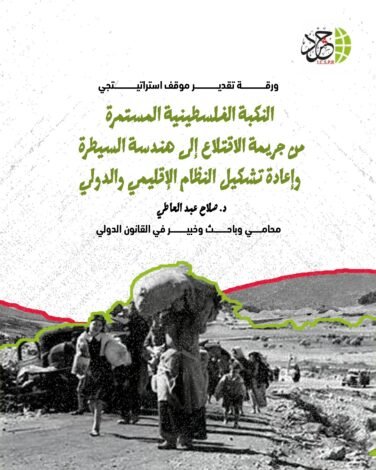
A recent strategic position assessment paper prepared by lawyer, researcher, and international law expert Salah Abdel Ati affirmed that the Palestinian Nakba is no longer merely a historical event dating back to 1948, but has become an ongoing settler-colonial system that reproduces itself through military, political, economic, and technological tools, with unequal international support.
The paper indicates that, after 78 years, the Nakba has come to represent an integrated structure for reshaping people, land, memory, and legitimacy in Palestine through uprooting, the reengineering of geography and demography, and the dismantling of Palestinian national identity.
Three Central Arenas of the Ongoing Nakba
The paper explains that the Nakba today is manifested in three main arenas:
- A genocidal war in the Gaza Strip
- Settlement expansion and creeping annexation in the West Bank and Jerusalem
- Targeting UNRWA and the Palestinian refugee camps as a political memory of the right of return
Gaza: The Peak of Genocide and the Reshaping of Existence
The paper affirms that the war on the Gaza Strip represents the “peak of the colonial system,” as it has turned into:
- Large-scale genocide
- Comprehensive destruction of infrastructure
- Organized starvation of the population
- Forced displacement of two million Palestinians
According to the estimates provided, the war has resulted in more than:
- 75,000 killed
- 175,000 injured
- 10,000 missing
- Near-total collapse of the health and service systems
The West Bank and Jerusalem: Creeping Annexation and the Dismantling of Geography
The paper monitors the escalation of Israeli policies in the West Bank and Jerusalem, including:
- Settlement expansion
- Land confiscation
- Home demolitions
- Judaization of Jerusalem
- Escalating settler violence and arrests
This is what the paper describes as a “gradual reengineering of Palestinian geographic reality.”
Palestinians Inside Israel: A Structural Apartheid System
The paper notes that Palestinians inside the 1948 territories face a systematic regime of discrimination that includes:
- Racist laws, most notably the “Nation-State Law”
- Land confiscation
- Political and institutional exclusion
- Discrimination in resources and services
UNRWA and the Camps: Targeting Memory and the Right of Return
The paper argues that targeting UNRWA and the Palestinian refugee camps aims to:
- Dismantle refugee status
- Erase the right of return
- Transform the Palestinian cause into a humanitarian issue stripped of its political dimension
- Remove the international witness to the Nakba of 1948
International Law: A Crisis of Enforcement, Not a Lack of Texts
The paper affirms that Israeli practices fall under:
- War crimes
- Crimes against humanity
- The crime of genocide
- Apartheid
- Forced displacement
- Illegal settlement activity
Despite the clarity of the legal references, including the Geneva Conventions, the Rome Statute, and Resolution 194, the core crisis lies in the obstruction of the implementation of international law by political will.
The War of Narrative: A Struggle Over Consciousness and Legitimacy
The paper indicates that the conflict is no longer only military, but has also become a battle over:
- The historical narrative
- The definition of victim and perpetrator
- Global consciousness
- International legitimacy
This comes amid a gradual decline in the Israeli narrative and the rise of the Palestinian narrative in academic, media, and legal circles globally.
Future Scenarios
The paper proposes three possible paths:
- Entrenchment of the Nakba: continuation of the war, settlement expansion, and the gradual liquidation of the Palestinian cause
- International shift: legal and political pressure leading to Israel’s isolation and a renewed political track
- Regional explosion: widening of the conflict regionally and the collapse of existing balances
Conclusion: A Test for the International System
The paper concludes that the Palestinian cause has entered a new stage of struggle in which it is no longer merely a conflict over land, but a struggle over:
- Existence
- Narrative
- International legitimacy
It affirmed that the future of the Palestinian cause will be decided at a critical intersection between the Palestinians’ ability to rebuild their national project and the international system’s ability to restore its legal and moral effectiveness, making Palestine a real test of the legitimacy of the international system itself and its ability to enforce justice rather than entrench power.