
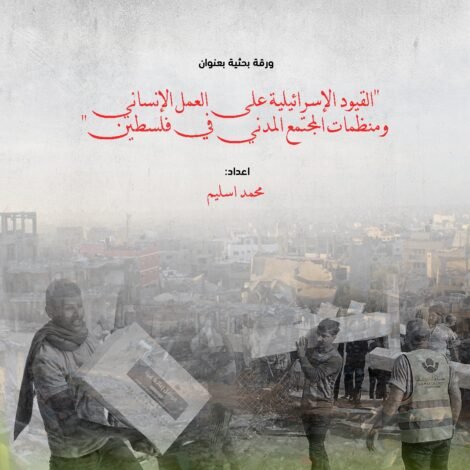
ICSPR: Israeli Restrictions on Humanitarian Work and Civil Society Organizations in Palestine Constitute Serious Violations of International Law and Entrench Policies of Repression and Starvation

Date: 19 January 2026
Press Release
ICSPR: Israeli Restrictions on Humanitarian Work and Civil Society Organizations in Palestine Constitute Serious Violations of International Law and Entrench Policies of Repression and Starvation
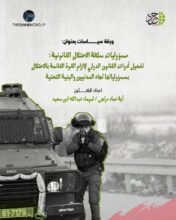
The International Commission to Support Palestinian People’s Rights (ICSPR) has issued an analytical research paper entitled “Israeli Restrictions on Humanitarian Work and Civil Society Organizations in Palestine,” prepared by researcher Mohammad Aslim. The paper exposes a comprehensive policy of legislative, administrative, and security restrictions imposed by the Israeli occupation authorities on international humanitarian action and Palestinian civil society organizations throughout 2025, aimed at subordinating humanitarian response to the interests of the occupation and neutralizing its impact.
The paper explains that these restrictions are not isolated regulatory measures, but rather a systematic policy adopted by Israel to restrict the entry of humanitarian aid, dry up international response mechanisms, and target humanitarian organizations—most notably the United Nations Relief and Works Agency for Palestine Refugees (UNRWA). This has significantly exacerbated the humanitarian catastrophe, particularly in the Gaza Strip, constituting a grave violation of the fundamental principles governing international humanitarian action.
The report notes that since March 2025, the occupation authorities have imposed a new registration regime for international non-governmental organizations, requiring them to submit sensitive information about their staff, local partners, funding sources, and operational activities. This represents a political and security tool to control humanitarian action and undermine its neutrality and independence, in clear violation of the principles of humanity, neutrality, impartiality, and independence.
The report further documents how Israel has obstructed the entry of humanitarian aid, rejecting hundreds of requests to allow food, medical supplies, and shelter materials under the pretext of “ineligibility.” This has resulted in the detention of millions of tons of relief supplies outside the Gaza Strip, as part of a systematic policy of starvation. Such practices constitute a blatant violation of Article (55) of the Fourth Geneva Convention and Article (8)(2)(b)(25) of the Rome Statute, which obligate an occupying power to ensure the provision of essential supplies to the civilian population and prohibit the use of starvation as a method of warfare.
The paper highlights that the occupation has directly targeted UNRWA by preventing the entry of approximately 6,000 aid trucks belonging to the agency since the ceasefire agreement entered into force, in addition to enacting and proposing legislative measures aimed at banning or restricting the agency’s operations in the occupied Palestinian territory. These actions seek to dismantle the international protection framework for Palestinian refugees and undermine UNRWA’s legal mandate.
ICSPR also emphasized that Israeli restrictions have not been limited to UNRWA, but have extended to major international humanitarian organizations, including Médecins Sans Frontières, Oxfam, CARE International, and the Norwegian Refugee Council. These organizations have faced arbitrary operational conditions, delays in permit issuance, and obstruction of advocacy and human rights activities, leading to a reduction in the scope of their interventions, the withdrawal of staff, and increased suffering among the most vulnerable groups—particularly children, women, the elderly, and persons with disabilities.
The paper further underscores that these restrictions have severely affected international humanitarian response plans. Only USD 1.6 billion has been funded out of the USD 4 billion required for the 2025 Humanitarian Response and Recovery Plan, amid unprecedented needs. Thousands of displaced persons continue to live in uninhabitable tents, while millions suffer from acute shortages of water, basic services, and livelihoods.
ICSPR affirmed in its report that these policies constitute serious violations of the Geneva Conventions and international human rights law, and in certain contexts may amount to war crimes, as they infringe upon the fundamental rights to survival and protection of the civilian population in Palestine.
The Commission called on the international community—including the UN Security Council, the Office of the High Commissioner for Human Rights, and international humanitarian organizations—to exert pressure on the occupation to lift restrictions on humanitarian work, ensure the unimpeded entry of aid and essential equipment, and protect the independence and neutrality of humanitarian organizations. ICSPR stressed that such action represents an urgent legal and moral obligation to save what remains of life in the occupied Palestinian territory.